

ST Engineering H2 profit increases 3.8%; to up dividend payout frequency to 4 times


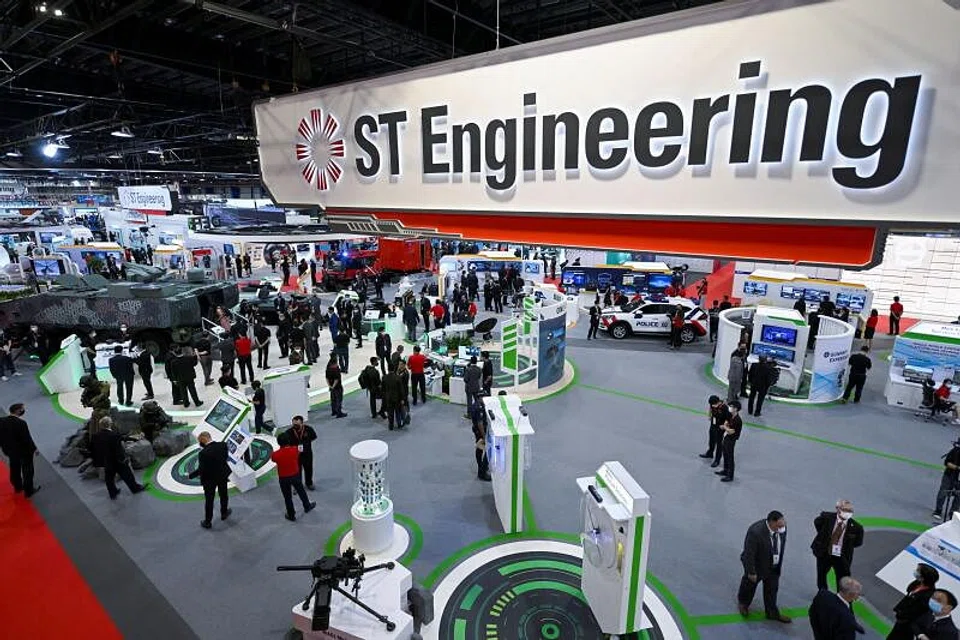
FOR the second half of the financial year ended Dec 31, 2021, Singapore Technologies Engineering (ST Engineering) S63 reported a net profit of S$274.4 million, inching up 3.8 per cent year on year from S$264.4 million.
In its financial results on Friday (Feb 25), the engineering heavyweight said that due to a "significant" reduction of non-taxable government support in H2 FY2021, its H2 net profit growth of 3.8 per cent was lower than its H2 pre-tax profit growth of 20.1 per cent on-year. The pre-tax profit rose to S$297.8 million from S$248 million.
Revenue for the second half of FY2021 was S$4 billion, a 12.7 per cent increase from S$3.6 billion a year ago, as all 3 business segments posted higher revenue year on year.
The best performer for the half-year was commercial aerospace, which had a revenue increase of 25 per cent to S$1.3 billion from S$1.1 billion, due to significant cost savings and partial business recovery that more than offset the reduction in government support of S$51 million.
Meanwhile, the revenue for the urban solutions and satellite communications segment grew 5 per cent to S$663 million from S$630 million in H2 FY2020, due to higher project deliveries but offset by global semiconductor chip shortages.
ST Engineering's revenue for the defence and public security segment went up by 8 per cent year on year to S$2.05 billion from S$1.89 billion, with contributions from all its sub-segments - digital systems and cyber, defence aerospace, land systems and marine.
The board has recommended a final dividend of S$0.10 per share, the same as the year-ago period, and payable on May 10 if approved by shareholders. Together with an interim dividend of S$0.05 per share, the full year's total dividend will be S$0.15 per share, also the same as FY2020.
The board has approved a dividend policy to declare dividends every quarter instead of twice a year to provide shareholders more frequent income streams, with FY2022 dividends planned to be S$0.04 per share each quarter, resulting in a total FY2022 dividend of S$0.16.
Vincent Chong, chief executive officer of ST Engineering, said at an earnings call on Friday: "Recognising the returning of value to shareholders is an important management objective, the group has been distributing profits to shareholders by paying dividends based on sustainable business results... Notwithstanding the new dividend policy, we continue to have the financial strength and flexibility to invest in growth initiatives aligned to our strategic goals to achieve our 2026 targets as communicated at our Investor Day in November 2021."
The engineering powerhouse has set a goal of generating more than S$11 billion in top line in 2026.
For the full-year FY2021, net profit increased 9.3 per cent year on year to S$570.5 million from S$521.8 million. This translated to an earnings per share increase for FY2021 to S$0.1830 from S$0.1674.
Revenue for the year also climbed 7.5 per cent to S$7.69 billion, from S$7.16 billion in FY2020.
ST Engineering's order book as at Dec 31, 2021 stood at S$19.3 billion. The group expects to deliver S$6.6 billion worth of orders in 2022.
In the fourth quarter alone, it clinched new orders of about S$3.2 billion: S$1 billion from commercial aerospace, S$400 million from urban solutions and satellite communications, and S$1.8 billion from defence and public security.
Chong confirmed that ST Engineering is hiring: "Yes, in certain growth areas to achieve our growth targets, we will be hiring... But then in other areas, we have to keep optimising our resources. So I don't think it's across the board."
He did not provide the number of new hires for businesses, including commercial aerospace and digital system and cyber, where recruitments will be made.
Jeffrey Lam, president of commercial aerospace, flagged the availability of labour as a key challenge after the departure of skilled talent from the aerospace industry, which has been hard hit by the pandemic.
"We are reviewing our compensation levels. And we're also therefore reviewing our contracts with customers because with labour wage inflation ultimately, these costs have to be covered. So our intention is that the industry will be able to achieve a certain stability, hopefully in the coming year. And therefore, our intention is to preserve our margins by ensuring that we continue to stay competitive with the market..." said Lam.
He has also observed a good recovery in the aerospace sector, although the demand for the passenger-to-freighter conversions is stronger and the maintenance, repair and overhaul (MRO) side has a "slow recovery".
Meanwhile, ST Engineering has an interest rate hedging policy that calls for half of its loans to be on fixed interest rates, but it has gone beyond this by having about two-thirds of borrowings on fixed interest rates.
In anticipation of interest rate hikes, it has employed a Treasury lock to manage interest-rate risk given its mega cash deal of US$2.68 billion to acquire US-based TransCore Partners and TLP Holdings to accelerate the growth of its smart city business.
A Treasury lock is a hedging tool that effectively locks in interest rates on federal government securities to cover future expenses that will be financed by borrowing.
Shares of ST Engineering were trading S$0.01 higher at S$3.79 at 3.52 pm on Friday.
READ MORE:
TRENDING NOW

Philippine power giant First Gen rebuffs foreign offers, plans up to US$2.6 billion in expansion

Cliff Tan has 7 million followers and a 4-month waitlist. Why won’t he expand his business?

Could stablecoins be the future of money?
From finance aspirant to Asean CEO: TUV SUD’s Jonas Strahberger on finding people who believe in you

