ST Engineering unveils AI deepfake detection platform
Company says its 5G all-in-one small cell outperformed Elon Musk’s Starlink service in a Malaysian plantation

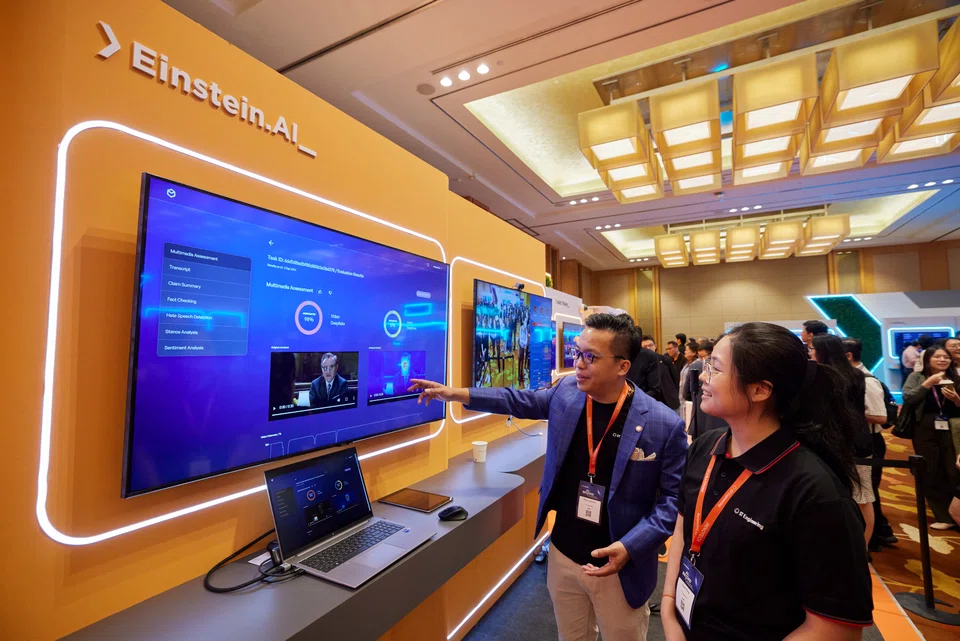
ST ENGINEERING on Tuesday (Sep 3) announced the release of software that can be used to detect audio, video, text and graphics that have been manipulated by artificial intelligence (AI).
The software will be sold as an AI-as-a-Service platform called Einstein.AI to customers who need “trusted and explainable verifications of media content”, said ST Engineering president of digital systems Low Jin Phang.
In his speech at the company’s InnoTech.AI 2024 event held at Marina Bay Sands Expo and Convention Centre, he said that the platform performs fact-checking of the content and flags inconsistencies and inaccuracies by cross-referencing the content with a range of trusted sources.
It also performs stance and sentiment analysis to identify signs of misinformation that can cause social unrest.
ST Engineering Deepbrain operations tech lead Kenneth Won said that the public sector has expressed interest in the solution.
For instance, the platform could be used by public health authorities to monitor online media to detect fake information. Governments could also use the platform to more quickly detect and combat misinformation during election seasons.
He added that the tool could also benefit companies that are going through more sensitive periods, such as the launch of an initial public offering.
Won said that instead of having a user scan every piece of media online, the platform can quickly give a good sense of what has been said in the information space.
While the platform can detect an AI deepfake, this is but one data point that is used to assess a piece of information.
“You cannot make a conclusion out of just one data point, so we start looking at other planes out in the information space, and we try to connect the dots,” Won said.
Aside from detecting deepfakes, Low also launched Merlin, the company’s virtual assistant which has been purpose-built for research and investigation work in the public and enterprise sectors.
He said that the assistant has been adopted as part of a proof of concept with an investigation agency in the public sector. During the project, the agency was able to halve the amount of time taken for an investigation.
ST Engineering Deepbrain senior principal engineer Tay Xian Jie said in that proof-of-concept case, the virtual assistant was customised to help investigators detect inconsistencies between the testimony of different suspects and witnesses.
He said that the company has also been able to customise the assistant for healthcare use, given that the assistant was previously used by the Singapore Civil Defence Force to reduce the cognitive load of responders taking emergency calls.
ST Engineering Deepbrain head and vice-president Tan Boon Leong said that the virtual assistant has been designed to be plugged into ST Engineering’s existing software used by its critical-information infrastructure clients. Clients will then be upsold to the solution.
Aside from its AI tools, Low also introduced the company’s Agil 5G all-in-one small cells, which combine both 5G and Wi-Fi 7 technology.
Low said that it has partnered with Sime Darby and Malaysia Communications to set up a mobile network at their palm plantation. The solution was able to provide strong coverage and sufficient bandwidth performance to remotely control ground vehicles and harvest palm seeds.
“This was a great success because it achieved what Starlink could not do when the plantation owner tested it,” he said, referring to SpaceX’s satellite broadband solution.
ST Engineering 5G products and C4I product line manager Lim Hua Chong said that unlike the solution deployed on Sime Darby’s plantations, the small cell will mainly be used indoors for smart factories and in healthcare settings.
The 5G network could be used in mission-critical devices, such as surgical equipment, which may have sensitive data and require a reliable connection. Other laptops and Internet of Things sensors may rely on Wi-Fi instead, Lim said.
He added that the company will work with partners in markets around the world to sell and maintain the equipment with telcos and with companies looking to deploy private 5G networks.