Stable teams could become greater differentiator in private markets
While some see high turnover producing a strong, positive impact on performance, others see it as a red flag in due diligence


RAPID growth in private markets could put pressure on a long-debated due diligence factor – team stability – and may even become a differentiating factor for general partners (GPs) or fund managers.
There is some evidence that turnover in a private equity fund manager’s team is associated with positive performance, but many investors told The Business Times that stability remains an important consideration.
“While I can’t comment on individual (situations), huge departures can be one of the big red flags in due diligence,” said Walter Zhang, director and head of private markets investor relations in Asia at Indosuez Wealth Management.
Team turnover has come under the spotlight after 22 members of Barings’ private finance team defected to newcomer Corinthia Global Management. The limited partners (LPs) who were invested in Barings’ funds are reportedly upset with both sides, and Barings is suing Corinthia.
LP due diligence on private market funds has always emphasised the team behind a GP because LPs typically commit towards a closed-ended fund or blind pool – there might be no assets in the fund yet, or very few.
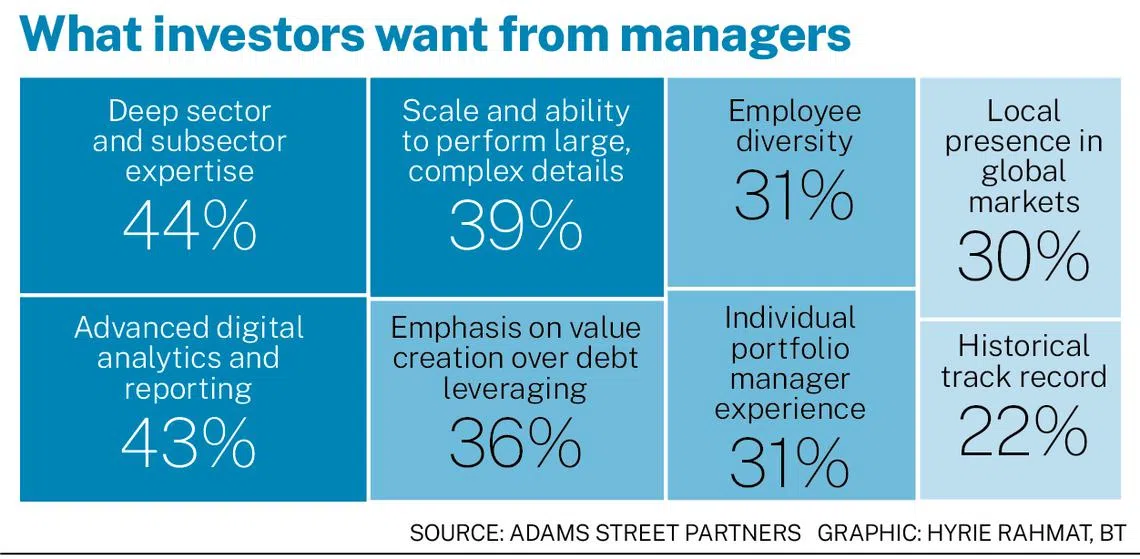
The only quantitative data available would be a GP’s past performance, but a survey by investment manager Adams Street Partners found this to be the least important factor.
Pierre-Alain Wavre, head of Pictet Wealth Management’s Pictet Investment Office – a dedicated investment office for very-large-wealth owners and families – said qualitative assessments tend to trump quantitative ones.
“The solidity of the firm, the investment process, how succession is done – all those things are important because… the results of funds seven or eight are not fully realised but you already commit to fund nine,” Wavre said.
“The team, the quality of the people, the ethics of those firms, their history (are all) important – as important as looking at return,” he said, adding that returns of past funds would often be unrealised.
GPs often look to launch their next fund before the previous fund has returned money to investors.
Indosuez’s Zhang said that past performance can be an indicator of the fund manager’s capability, but added: “A lot of the time, it’s about evaluation of their past yields (and) the stability of their teams.”
Factors that Indosuez will consider include a team’s expertise, its performance in focus sectors, how the GP conducts due diligence, and its approach to risk.
To assess the likelihood of continued team stability, Zhang said, Indosuez will seek alignments of interest. “How do you incentivise (team members), from the junior level to the operations team?”
Maintaining team stability may become more difficult as the private markets industry grows, though. The democratisation of private markets is attracting more managers, who seek to tap the wealth accumulated in family offices and with private banks.
Competition among GPs for new money is getting tougher partly because of the entry of newcomers, and partly because economic conditions are weakening rather than strengthening.
The biggest fundraising challenge for GPs has been competition with other funds, according to a survey of private equity firms conducted by intelligence provider Mergermarket on behalf of law firm Dechert.
Institutional investors, in particular, are dialling back on their ticket sizes, according to Dechert’s 2024 global private equity outlook.
Goldman Sachs Asset Management (GSAM) flagged in a report last year that fundraising headwinds were contributing to team instability.
“The need for GPs to dedicate more time and effort to raising new funds could potentially become a distraction for investment team members,” GSAM said.
“This not only introduces risk for strategy execution, but also could lead to morale and motivation issues for team members who may be asked to spend a disproportionate amount of time raising capital rather than deploying it.”
There is some long-established disagreement that team stability is positive for fund performance. One study by asset manager Capital Dynamics and the Coller Institute of Private Equity at London Business School found that turnover has a strong, positive impact on performance.
“Higher turnover of professionals with operational backgrounds led to a significant increase in performance – suggesting that frequently refreshing a team’s operational skill set is beneficial to performance,” the researchers said.
They concluded that a comprehensive team assessment should emphasise a team’s ability to adapt to different economic cycles and a changing market environment.
“Astute managers recognise the value of team evolution and that deep operational/industrial expertise is required to unlock value in a business and create subsequent value for investors.”
Andrew Tan, Asia-Pacific chief executive and head of Asia-Pacific private debt at Muzinich & Co, said that team composition is a major differentiating factor for the credit-focused investment firm.
“We have backgrounds spanning both private financing as well as distressed debt; so when it comes to… working out situations that have not gone according to plan, we have the toolkit (and) experience to do that,” he said.
Tan added, however, that what is most important is the retention of a strong core. “Even if the people at the periphery change, it won’t have an impact on (performance) too much.”