StarHub faces hurricane, not headwinds, says CEO

Even third-place operators 'are on Struggle Street, not Main Street' worldwide

Annabeth Leow
Annabeth Leow

Published Tue, Dec 11, 2018 · 09:50 PM

    Singapore

    BUSINESS deals are still on the horizon for StarHub, even as the telco steps up its cost-cutting and embarks on a digital transformation exercise.

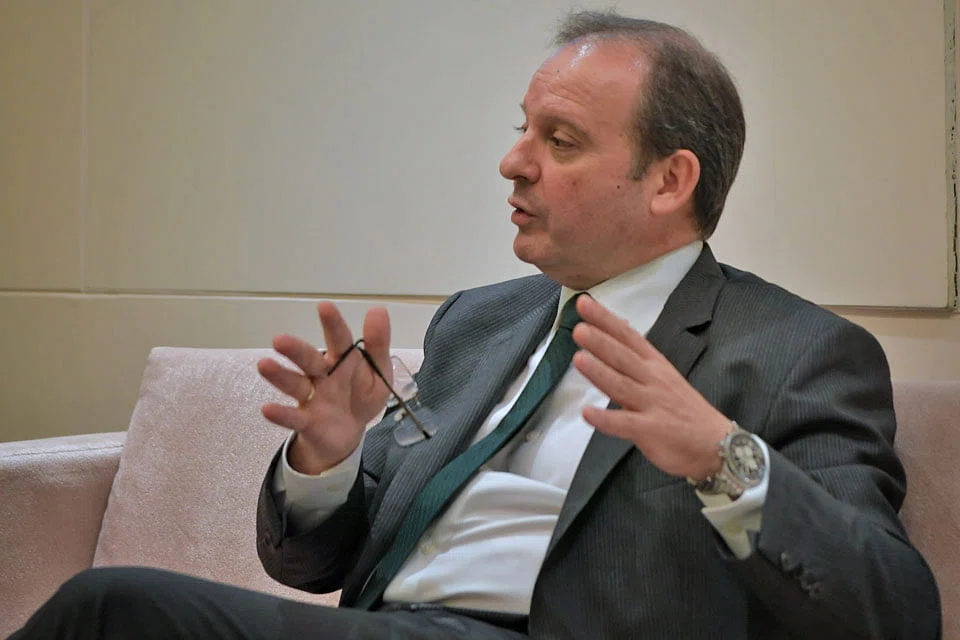
    That's according to new chief executive Peter Kaliaropoulos, who recently shared his vision for the company in a wide-ranging, hour-long interview with The Business Times.


    Amid the intense competition in Singapore's telco market, he reiterated that his strategy is to pare expenses and hold on to high-value subscribers in the crowded consumer segment, while advancing in StarHub's fledgling enterprise arm.

    The consumer business involves "defence and margin improvement and retention of high-value customers", he said, while acknowledging that growth is not expected there.

    But Mr Kaliaropoulos, who has wide global experience, poured cold water on the notion that going abroad would be a panacea.

    He said that StarHub does not want to take its eye off the local market "because we're about to go through a hurricane - I don't call it headwinds, the competitive intensity will increase so dramatically in the next couple of years".

    "You're not going to find us going to countries and digging up roads and putting fibre and putting base stations," he added, citing the high capital spending needed.

    "Most overseas markets are very well served with those infrastructure models. . . How do you leverage the infrastructure of various other geographies? Can you provide over-the-top type services?"

    Only such opportunities, he said, would lead him to do business abroad.

    Meanwhile, the telco veteran believes that mobile virtual network operators (MVNOs) will crash out of the market and industry consolidation is inevitable ("it's when and how").

    He's kept awake at night by the crowded landscape here, with a fourth network operator set to debut next year, and argued that even third-place operators "are on Struggle Street, not Main Street" worldwide.

    "We worry that there'll be structural changes because of the high penetration," he said. Official figures show that Singapore's mobile penetration rate is nearly 150 per cent, with WiFi penetration almost 200 per cent.

    "We're not afraid of competition; we're afraid, potentially, of the investment programme required," Mr Kaliaropoulos said. "What also keeps us awake is that we've got some big investment in front of us for 5G, for new technology, for new spectrum."

    He added that industry players actually need "to be sharing infrastructure, not building infrastructure".

    On the troubled pay-television front, where Mr Kaliaropoulos has been pushing to pay media companies based on the number of actual viewers, he held that the old rationale for subsidising pay-TV costs - to sell broadband lines - is long obsolete.

    "We're going to stay in the pay-TV business for a long time, but we're trying to improve the business model.

    "We never made a net positive bottom line from pay-TV... You cannot have a business unit where it's costing more than the revenues that you're getting back in net returns."

    The consumer-to-enterprise revenue ratio was 57:43 last year, but he believes "in the next couple of years you will see that tipping over" to 60 per cent enterprise and 40 per cent consumer.

    "We're beginning to focus more and more on the enterprise, both in the core business, for data networks, for connectivity; but also in the value-added businesses", he said, meaning data, cloud and security services.

    StarHub has made a splash in cyber security, including a pure-play joint venture with Temasek Holdings. And it is now bidding for "some very interesting and very innovative solutions" in the managed services sphere, such as facial recognition technology. Still, he stressed that any new ventures must be selectively picked: "We're looking for those verticals where we can make a difference in enterprise, instead of trying to be all things to every enterprise customer."

    StarHub's net debt stood at S$728.8 million as at Sept 30, up from S$632.3 million as at Dec 31, 2017. But he added that, if he spots Ebitda-accretive companies in adjacent markets, "you can borrow a bit more".

    "You're not going to get us spending S$500 million to S$1 billion to buy companies; but there are a lot of other companies in the S$50 million to S$150 million range"

    Mr Kaliaropoulos, a former StarHub executive who returned in July, unveiled an overhaul of the business months later, with a renewed focus on boosting customer service and digital processes. More than one-tenth of full-time staff were let go.

    Why did he feel that drastic transformation was needed? Citing as an example how "we're very embryonic in digital capability", he declared: "Unless we fix a number of things, we can't see the improvement and eventually will reflect that in terms of the share price, the dividends. Ultimately, that's how the market judges whether we've been successful when we talk about transformation programmes."

    Provisions for job cuts had already been made in previous quarters, during the tenure of predecessor Tan Tong Hai, who left in May.

    But Mr Kaliaropoulos said he drew up priorities to discuss with the board when he took over, "because even if the previous team had some initiatives, they need to be owned by the new team, by the new chief executive".

    "Hold me responsible for a lot of the new initiatives," he urged, adding: "Whatever Tong Hai did was great stuff, but the market keeps moving."

    *READ MORE: Boob tube's for rubes as pay-TV loses its lustre