

STI up 0.1% amid AI-stock rally, easing oil prices
Sats leads the gainers on Singapore’s blue-chip index

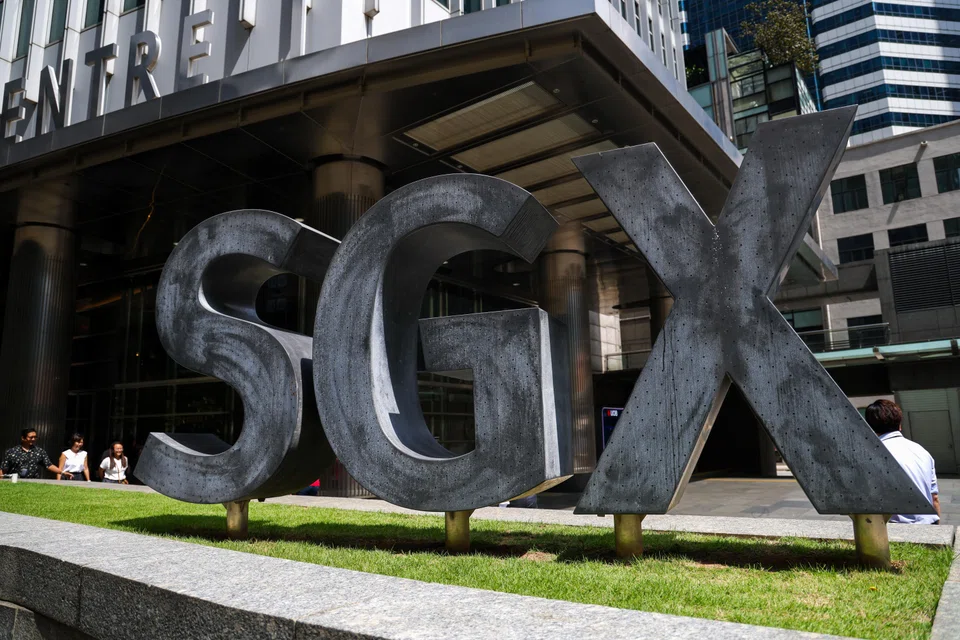
[SINGAPORE] Singapore stocks ended higher on Thursday (Jun 25).
The benchmark Straits Times Index (STI) gained 0.1 per cent or 2.97 points to finish at 5,218.96.
Sats led the gainers on Singapore’s blue-chip index, rising 2.5 per cent or S$0.11 to S$4.50.
The worst performer among STI constituents was Thai Beverage , which fell 2.3 per cent or S$0.01 to S$0.435.
The three local banks ended mixed on Thursday. UOB rose 0.03 per cent or S$0.01 to S$39.91, while DBS finished 0.2 per cent or S$0.15 lower at S$66.07, and OCBC closed 0.04 per cent or S$0.01 lower at S$24.94.
Within the iEdge Singapore Next 50 Index, PC Partner was the top gainer, rising 11.9 per cent or S$0.32 to finish at S$3.02, while Ultragreen.ai was the biggest loser, falling 3.8 per cent or S$0.05 to S$1.28.
Across the broader market, gainers trailed losers 259 to 294, after 1.2 billion securities worth S$1.8 billion changed hands.
Key regional indices ended varied. Hong Kong’s Hang Seng Index lost 1.4 per cent and the FTSE Bursa Malaysia KLCI declined 1.1 per cent, while Japan’s Nikkei 225 rose 4.6 per cent and South Korea’s Kospi was up 5.4 per cent.
The showing comes after a rally of artificial intelligence-related stocks, as optimistic forecasts from Micron and Qualcomm eased investor concerns over overheating valuations in the sector.

Oil prices have also declined to pre-war levels with the resumption of tanker traffic through the Strait of Hormuz.
“This has provided some relief from expectations of building inflationary pressures, with US Treasury yields lower across the curve by six to 11 basis points, and the 10-year US Treasury yields at 4.404 per cent,” noted OCBC research analysts.
Mike Gallagher, Continuum Economics’ director of macroeconomics and strategy, added that with the opening of the strait, the adverse economic effects and “second-round inflation effects” for most non-Middle Eastern countries will likely be small to modest.
“This makes it less likely that other central banks will follow the European Central Bank (ECB), South African Reserve Bank and Bank Indonesia in hiking to guard against second-round effects, and we see the ECB hike being reversed in 2027,” he said.
This article has been written with the assistance of AI and reviewed by a reporter
Decoding Asia newsletter: your guide to navigating Asia in a new global order. Sign up here to get Decoding Asia newsletter. Delivered to your inbox. Free.
Copyright SPH Media. All rights reserved.
TRENDING NOW

Philippine power giant First Gen rebuffs foreign offers, plans up to US$2.6 billion in expansion

Vietnam’s data-centre investment rush faces reality check on power and site constraints

Singapore should prepare for prolonged haze until November, says Grace Fu

Is stagflation returning? That mostly depends on the Iran war

