

STI blue chips expected to cut dividends as pandemic slashes profits
SPH among first to act to conserve cash; ComfortDelGro, SIA, Sats, Singtel likely to follow suit; Genting, SGX could be exceptions

Singapore
WITH some corporates slashing dividends or cancelling them in recent weeks, investors now worry that Straits Times Index (STI) components - many of them economy bellwethers and defensive dividend stocks - may follow suit amid the crushing impact from the novel coronavirus pandemic.
Among the first to release quarterly financial results for the current earnings season, SPH Reit cut its distribution per unit (DPU) to just 20 per cent of income available for distribution. The result was a 78.7 per cent decline in its DPU despite better performance for the quarter ended February.
Interim dividends at its sponsor Singapore Press Holdings (SPH), an STI constituent whose ad revenue has fallen among other revenue hits, also declined by 72.7 per cent. SPH publishes The Business Times.
Investors should expect dividend cuts from other companies. Sean Darby, Jefferies' global equity strategist, said the dividend coverage ratio is the first metric to get "binned" because companies need to meet their loan covenant targets. "I think companies will be under pressure to cut dividends and keep workers."
It will also take time for dividends to be restored. "Easy to cut, harder to resume is the mantra," Mr Darby added.
ComfortDelGro Corp is another prime candidate to apply the brakes on its dividend payout.
The land transport company has seen its businesses slow down as taxi and train riderships are affected by the government's movement restrictions to stem the coronavirus spread.
Citi analyst Patrick Yau wrote in a report that the current environment will significantly impinge on the ability of ComfortDelGro to maintain its dividend. He has cut his expectations for ComfortDelGro's dividend payout ratio to 50 per cent for the next three financial years, versus the average payout ratio over the last few years of 75 per cent. This would translate into a dividend yield of 3.8 per cent, he said.
He noted that ComfortDelGro's unprecedented offer of a full taxi rental waiver for a month during the circuit breaker would raise its total estimated coronavirus relief costs to S$99 million. Besides reduced taxi ridership, the company is also hit by a shrinking taxi fleet, lower train ridership on its Downtown line and unfavourable foreign currency translations for income repatriated from its UK and Australian operations.
The other transport plays, Singapore Airlines (SIA) and Sats, are also unlikely to be spared. IHS Markit told BT that it expects SIA to suspend its FY20 final dividend entirely, a revised view of its earlier, mid-March report which estimated a 45.5 per cent cut to its final dividend per share.
IHS Markit noted that the airline has cut 96 per cent of its capacity, with travel demand to recover only by the end of 2020. Naturally, earnings for FY20 are projected to slump and a loss to be registered in FY21. "Given the gloomy short-term market outlook and SIA's performance-linked dividend policy, we are expecting SIA to prudently manage its cash flows, thus suspending the dividend payout."
Further, it noted SIA's leveraged balance sheet and high capital expenditure (capex) would also diminish upside potential for future dividends.
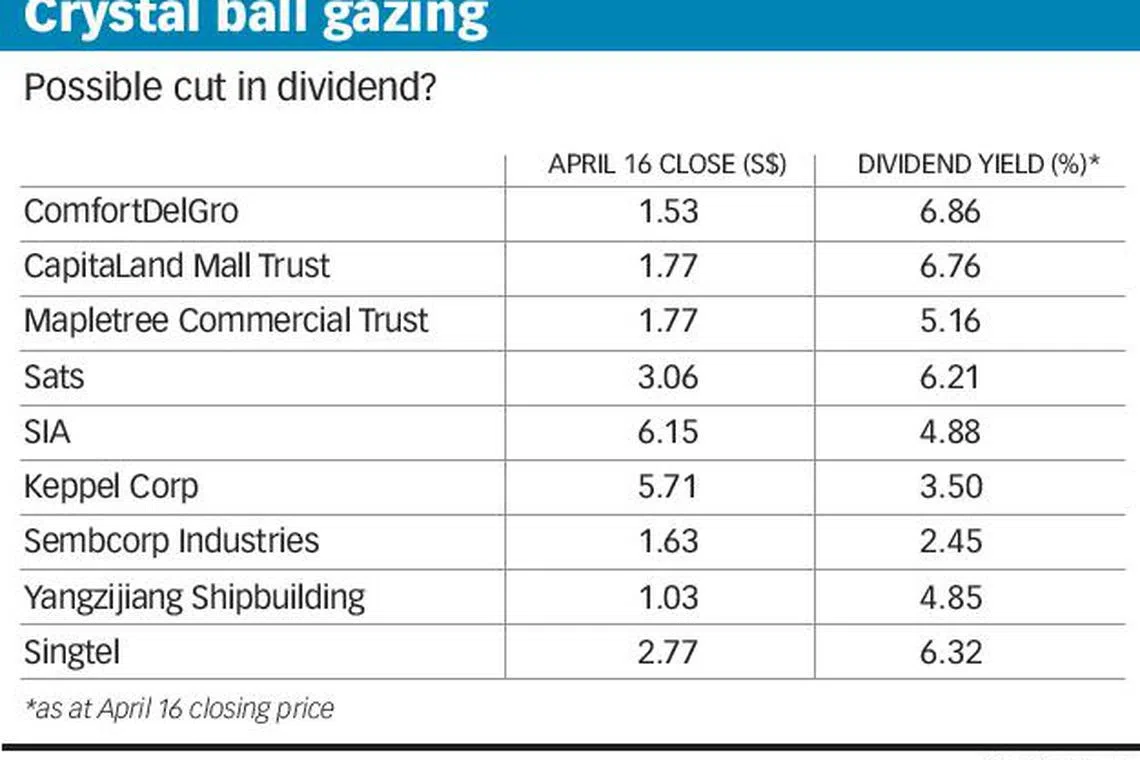
As for Sats, CIMB-CGS has cut its forecast dividend payout ratio for the ground handler and inflight caterer to 50 per cent for FY20 as it expects management to focus on cash preservation. The research house thinks Sats would return to profitability at the earliest in the fourth quarter of FY21 ending March, but still rack up losses for that fiscal year given the magnitude of the global lockdown. Although Sats would not face a cash crunch, it is no longer in a net cash position. A dividend cut therefore seems "inevitable", said CIMB-CGS.
Other dividend cut suspects include Sembcorp Industries (SCI), Keppel Corp, Yangzijiang Shipbuilding and Singtel, according to Janice Chua, DBS Bank's head of regional equity research. Although she thinks SCI will maintain its payout ratio at 20 to 25 per cent, there is downside risk to the current dividend per share projection given that SCI's energy segment is also affected by slower industrial activities in Singapore, India, and the UK.
In Keppel's case, she sees heightened risks of a dividend cut on the back of an earnings downgrade. "While overseas property completion seems to be on track, there will likely be delays in new residential property launches in Singapore as well as slower en-bloc sales and land sales at Tianjin Eco-city," Ms Chua said.
Her team is forecasting Yangzijiang's 2020 earnings to drop about 15 to 20 per cent. At the same time, the China-based shipbuilder is expected to lift its dividend payout ratio from 30 per cent to between 40 and 45 per cent, which would moderate its dividend per share decline from 4.5 Singapore cents to 4 Singapore cents.
She said the shipbuilder is supported by a strong balance sheet and cash flows. Further, its income stream is supported by its investment segment. This segment typically contributes 50 per cent of earnings, but is likely to contribute almost 75 per cent in 2020 due to lower shipbuilding profits. "Shipyard operations are nearly back to normal as of early April, though we could expect delays in conclusion of new orders and possibly rescheduling of deliveries due to Covid- 19," Ms Chua noted.
At Singtel, Ms Chua projects a reduction in dividend per share to between 14 and 15 Singapore cents in FY21F, from 17.5 Singapore cents annually for the three years to FY20 ended March. This is due to continued weakness in its core business in Australia and Singapore.
Citi analysts, however, see room for dividend upside as the telco is reportedly looking at selling its telecommunications towers in Australia worth more than A$2 billion (S$1.73 billion). The sale will free up cash for dividends or capex, the analysts said in a research report.
OCBC Investment Research has slashed its FY20 DPU forecasts by 27.7 per cent for CapitaLand Mall Trust (CMT), having taken into account CMT's rental concessions to its tenants. These include a pass-through of the government's property tax rebate, the release of security deposits and six-month rental deferments for 20 per cent of its tenants.
OCBC's model assumes all of the deferred rent is repaid in FY21, but that rental and occupancy rates are weaker. "As such, we slash our FY20F DPU forecast by 27.7 per cent but our FY21 forecast is only lowered by 2.1 per cent," the team wrote.
For Mapletree Commercial Trust (MCT), OCBC has pared its FY20F and FY21F DPU forecasts by 2.4 per cent and 10.1 per cent respectively, based on similar considerations.
A small number of companies are projected to pay a similar or higher amount in dividends, though.
Genting Singapore can still choose to maintain its DPS in 2020, given its net cash of S$3.95 billion, UOB Kay Hian analysts Vincent Khoo and Jack Goh wrote in a report. This is despite their cutting their forecasts for Genting's net profit by 43 per cent and 9 per cent respectively, for FY20 and FY21.
In fact, they think there is a possibility of the leisure heavyweight doling out a special dividend should it fail to win a Japan casino concession. The results should be known by the second half of this year.
Among other potential positives, RHB Research analyst Leng Seng Choon has forecast an FY20 DPS of 35 Singapore cents for Singapore Exchange (SGX), based on an 85 per cent payout ratio. This would be higher than the 30 Singapore cents paid in the last financial year, which translated into a payout ratio of 82 per cent. He noted: "SGX remains in a net cash position, with a monopoly over the trading of Singapore-listed equities."
READ MORE: Federal Reserve giving banks a break to keep markets calm
TRENDING NOW

Singapore identifies 7 firms responsible for haze fires, notices issued urging action: Grace Fu

Could stablecoins be the future of money?

Singapore should prepare for prolonged haze until November, says Grace Fu

High Court rules against Julius Baer’s Singapore trust arm in US$50 million family trust dispute

