

STI's decline continues on China, US rate concerns
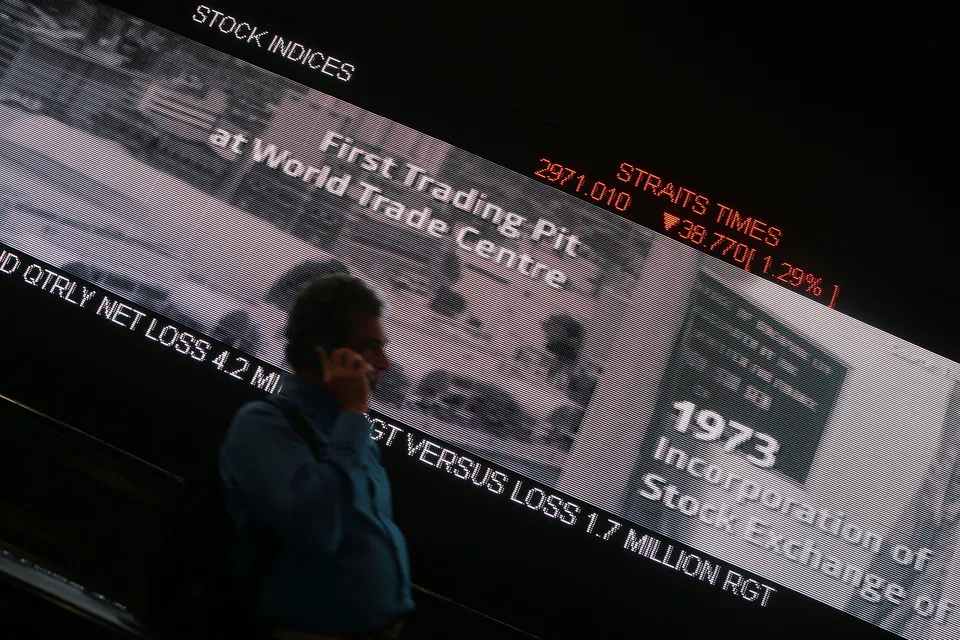
THERE were four trading days in this holiday-shortened week, three of which ended with the Straits Times Index in the red. The single rise was on Monday when the gain was a paltry two points, not enough to compensate for falls on the other days. On Friday, the STI dropped 13.1 points to 2,832.64, bringing its net loss for the week to 47 points or 1.6 per cent.
Daily turnover has picked up in recent sessions - on Friday, 1.4 billion units worth S$1.2 billion were done, above the uninspiring S$1 billion mark that has become the market's daily norm this year.
Friday's business was boosted by relatively heavy trading of blue chips - Singtel, which dropped S$0.06 to S$3.64 on volume of 45.3 million shares, and Neptune Orient Lines (NOL), which rose S$0.035 to S$1 with 24.3 million shares done.
NOL had been queried by the Singapore Exchange (SGX) on Tuesday because of unusual volume in its shares. After NOL replied that it did not know of reasons for the volume, SGX issued a "Trade with Caution" on NOL.
The week also saw three new stocks enter the STI - Yangzijiang, SATS and UOL, which replaced Olam International, Jardine Matheson and Jardine Strategic on grounds of liquidity.
By now, readers would be all too familiar with the reasons why the STI spent the week around a five-year low - a slowing China with its slowly imploding stock market that has prompted a withdrawal of capital out of emerging Asia, and US interest rate concerns.
Also becoming increasingly familiar to observers is that movements in the STI are dictated not just by rises and falls in China and Hong Kong, but equally by shifts in the Dow futures as traders anticipate how Wall Street might perform in the session ahead.
That China's economy is grinding lower - possibly to the point of a hard landing - was a point rammed home mid-week when a flash Purchasing Managers' Index fell to its lowest in six-and-a-half years.
Bank of America-Merrill Lynch, however, does not think China is headed for a hard landing. "Poor industrial activity data suggest sequential growth momentum could have weakened in August. But we do not think China is facing a big risk of a hard landing given robust consumption and a continued home sales recovery. We expect the government will take more easing measures in the near term to stabilise growth and financial markets," it said in its Sept 24 China Economic Watch.
US interest rate uncertainty erupted last week when the US Federal Reserve opted to keep its short-term rates unchanged because of overseas instability, which many took to refer to China's problems.
This made for a volatile week during which double-digit rises and falls in the index were common.
In its Friday Financial Markets Today report, research firm Ideaglobal noted that markets have a crisis of confidence from time to time, and the onset of autumn is very often the time.
"We...expect to see some new lows below the August lows in all the main equity markets before this is over," said Ideaglobal. "But unless we genuinely get evidence that the recoveries in the major economies have halted, we would see the current decline in equity markets as being close to its end."






