STI's high yield haven offers balm to painful bear grip
STI's dividend yield is highest among its Asian peers at 4.4 per cent as at end October
Singapore
INVESTING in the local stock market may not be a bad move for those looking at income though it may be difficult to convince weary equity warriors.
Year to date, the Straits Times Index, which stood at 3,117.61 on Nov 30, has fallen more than 8 per cent; regional peers like Hong Kong's Hang Seng Index is down some 11 per cent while the Philippines PSEi Index is a minus 14 per cent. Less bad are Kuala Lumpur's KLCI Index (-7 per cent), Bangkok's SET Index (-6 per cent) while Jakarta's JCI is minus 5 per cent.
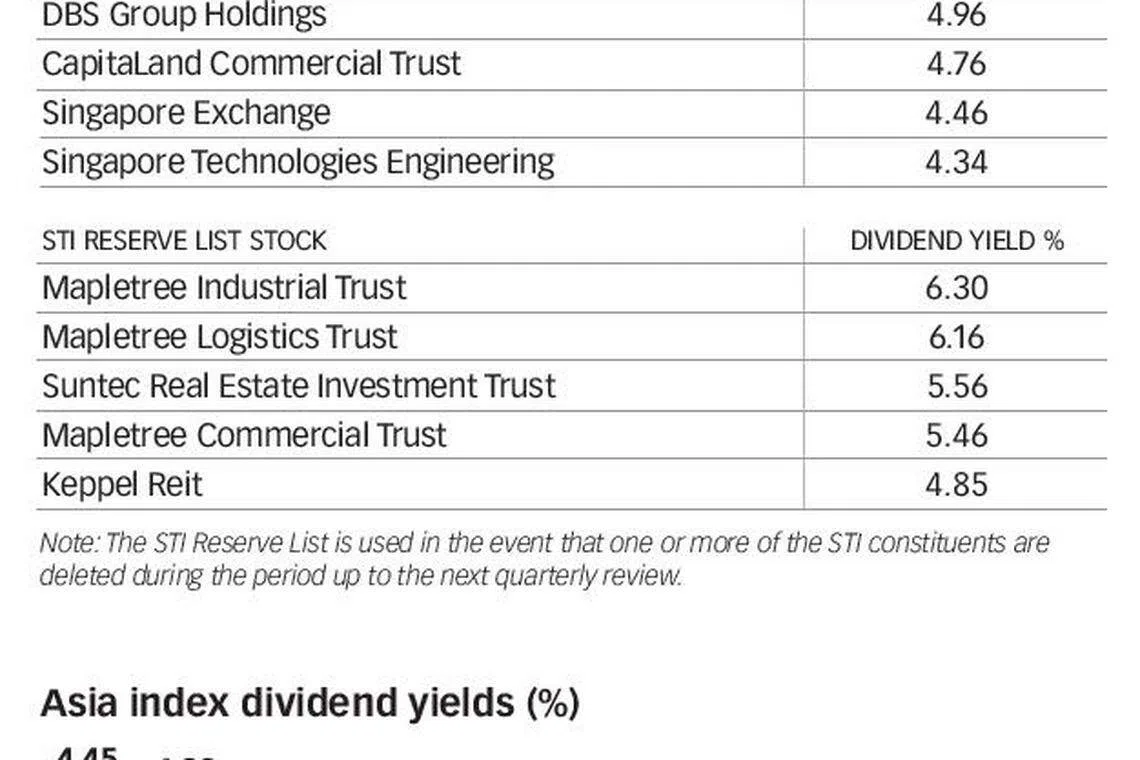
Going by dividend yield though, the STI is the highest among its Asian peers at 4.4 per cent, based on the FTSE Russell Country Indices as at end-October. Taiwan is next at 4.33 per cent, followed by Hong Kong's 3.3 per cent. Dividend yield for others in the region range from 1.6 per cent to 3.3 per cent.
Investing by looking at dividend yield is not a bad criteria though it may not be for the faint hearted in the current choppy market.
But the high yield can patch the losses somewhat and the STI can be regarded as a dividend haven, said one equity strategist.
"Singapore has been touted as a dividend haven as it currently pays one of the highest dividends among Asian countries," said Joanne Goh DBS group research, regional equity strategist. This is one of the reasons why DBS is overweight on Singapore, she said.
"In this period of high volatility where we do not rule out the possibility of investors losing money in the share market, stocks which pay high dividends could offset some of the capital loss," added Ms Goh. "Dividend-paying stocks are also believed to have more resilient earnings with steady business, good capital management policies and embrace shareholder value creation.
"Similarly, their share prices should also be less volatile with good price support from longer-term investors."
To Inclusif Value Fund portfolio manager Teh Hooi Ling, dividend yield is a proxy for value, just like price earnings ratio, price-to-book ratio, et cetera.
"In the short term, valuation can be an imprecise tool to determine market entry, cheap can get cheaper, and expensive can get more expensive," said Ms Teh.
But if an investor can take a longer term view, such as up to five years, then valuation - which has been described as the gravitational force of the financial markets - is a good indication for future expected returns, said Ms Teh.
Looking at data going back 30 years, Ms Teh found that since 1988, whenever the STI dividend yield is higher than 3.5 per cent (using the Thomson Reuters Datastream numbers), the STI total returns averaged a sizable 35 per cent 12 months later.
The STI dividend yield was at its highest, at 5.5 per cent, at end Feb 2009 when fear of the Global Financial Crisis was at its highest, she said. "The STI total return a year later was 79 per cent," said Ms Teh.
"In the long-term, dividend yield has been the principal contributor to investor returns, more profoundly in Asia," said Suresh Tantia, Credit Suisse investment strategist - Asia Pacific chief investment office.
"Therefore, dividend yield is one of the key parameter in valuing equity markets and we believe high dividend yield reflects the attractive valuation of Asian equities.
"In the case of Singapore, dividend yield of 4.4 per cent is the most attractive proposition to buy Singapore stocks."
This becomes much more striking in the context that economic growth remains healthy, though moderating, and currency is very resilient, he added.
"In addition, the spread between STI dividend yield and Singapore 10-year bond yield is at 2-year high, making equities more attractive for income-oriented investor," he said.
In terms of prices, the Singapore market has been the worst performing Asean market, excluding the Philippines, in 2018. Still, the earnings growth story remains healthy, with 7.5 per cent earnings per share growth expected in 2019, according to Credit Suisse's Mr Tantia.
"Singapore's equity market is dominated by banks and is thus likely to benefit from rising interest rates," said Mr Tantia. "The property market is already stabilising in the wake of the imposition of cooling measures so the need for further tightening on that front is decreasing.
"Therefore, given the healthy earnings picture, attractive valuation and high dividend yield, we expect STI to rebound to 3,450 over the next 12 months."
When considering individual stocks, DBS' Ms Goh said she looks for those which can pay sustainable dividends, even through trough cycles and bad times.
"We also look for stocks which can grow their dividends, such as having a fixed payout ratio policy and thus dividends will grow with their earnings," she said.
Investors will also have to evaluate the businesses and see if they can generate positive free cash flows. Generally, asset-light companies and defensive businesses such as telcos and utilities should be able to generate healthy cash flows, she said.
"Companies which are state-owned or have substantial shareholders such as insurance companies tend to pay high dividends," she said. "We like real estate investment trusts (Reits) with strong sponsors such as Mapletree, CapitaLand, Frasers and Ascendas."
She added that Reits in the retail and industrial sectors should continue to see good rental revision rates and room to grow for their distribution per unit. Her picks also include UOB and selected companies such as Venture and ST Engineering, Netlink Trust and ComfortDelgro with high dividend yields, said Ms Goh.