

Stocks finish mixed in quiet trading
Uncertainty over Greek referendum and volatility in China stocks cited for the listlessness
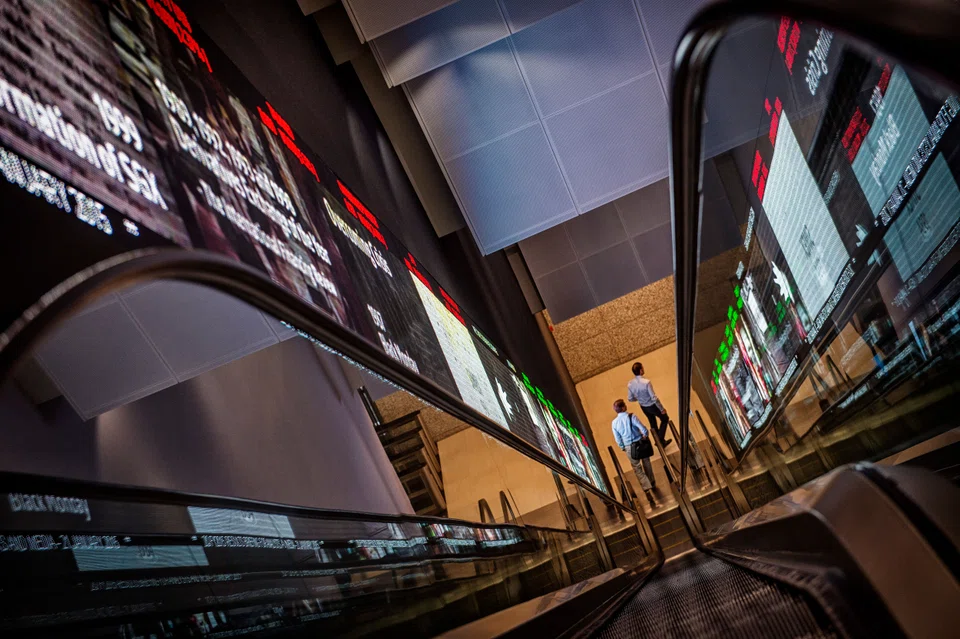
A NEW day, another nondescript session. The Straits Times Index on Thursday displayed all the verve of a patient on life support, finishing a coma-inducing session a nett 3.3 points weaker at 3,327.84.
Turnover amounted to a weak 907 million units worth S$912.4 million and excluding warrants, the advance-decline score of 208-221 which left about 400 stocks either not traded or unchanged suggested that many investors and traders spent their time indulging in other more exciting pursuits, among them watching grass grow.
For want of better reasons most brokers pointed to Greece and China as the main reasons for the weak state of trading, though many privately admitted that trading has been dead for many months now.
Still, with China's stock market gyrating as much as 10 per cent per day and with Greece still tottering on the brink of financial ruin, it stands to reason that sentiment here must have been affected.
The day's top story revolved around the Singapore Exchange (SGX), whose shares on Wednesday jumped almost 6 per cent, thus drawing a query from the Monetary Authority of Singapore (MAS). The exchange on Wednesday had replied that it did not know of reasons for the rise, and this led to the MAS issuing a "Trade with Caution" on SGX's shares on Thursday. The stock ended S$0.10 down at S$8.08 on volume of 1.9 million.
In the offshore and marine sector, shares of Ezion Holdings slipped S$0.005 to S$1.025 on volume of 9.3 million. RHB said it took Ezion on a non-deal roadshow (NDR) last week to Kuala Lumpur.
"Investor interest was high, with many marvelling at the depressed valuations of Singapore's oil and gas firms. Key concerns on charter contract terms and rate fears were well addressed, in our view," said RHB, which maintained its "buy" and S$2.10 target price for Ezion.
On the situation in China where brokers' margin calls have led to heightened volatility in recent days, Bank of America-Merrill Lynch (BoA-ML) said in a June 30 report that based on its analysis, the Shanghai Composite could fall to 2,500 or 36 per cent from present levels before largescale margin calls will kick in.
"However, this doesn't mean that margin calls are not a serious risk now. In our view, the selling pressure so far has mainly come from stock-related borrowings via various unofficial channels where the leverage is much higher," said BoA-ML.
"We don't think the deleveraging process in the stock market has run its course and the market may stay volatile in the coming weeks." The Shanghai Index on Thursday lost 3.5 per cent.
On Greece, DBS Group Research said the muted reaction to Greece failing to repay the International Monetary Fund on June 30 reassured markets that contagion risks were not as high as they were in 2010-12.
"The private sector and foreign banks are significantly less exposed to Greek debt today. Portugal, Ireland and Spain have already exited their bailout programmes with the troika (of the European Union, the European Central Bank and the International Monetary Fund).
DBS also noted that the Greek referendum scheduled on July 5 has become a "binary event" and market has come to view a 'Yes' vote as a 'No' against Greece exiting the eurozone.
"As far as the Greek government is concerned, it has shaped the referendum as a 'No' against austerity demanded by creditors. Many wonder if Greek voters actually know what the 'Yes' and 'No' boxes mean in the ballot paper," said DBS.
For full listings of SGX prices, go to http://btd.sg/BTmkts
TRENDING NOW

South-east Asia has lost Nvidia’s best salesman

Demand, tech capabilities position Apac and AI as Skyscanner’s next growth frontiers: CEO Bryan Batista

Peter Kwee’s Ridley Park bungalow on the market with S$100 million asking price

Beyond the greenback, Vietnam’s big borrowers turn to Asian-currency bonds

