

Straits Trading Company strives to unlock value, boost returns
Executive chairman Chew Gek Khim believes the company is fairly well-cushioned amid geopolitical tensions and threat of a global recession
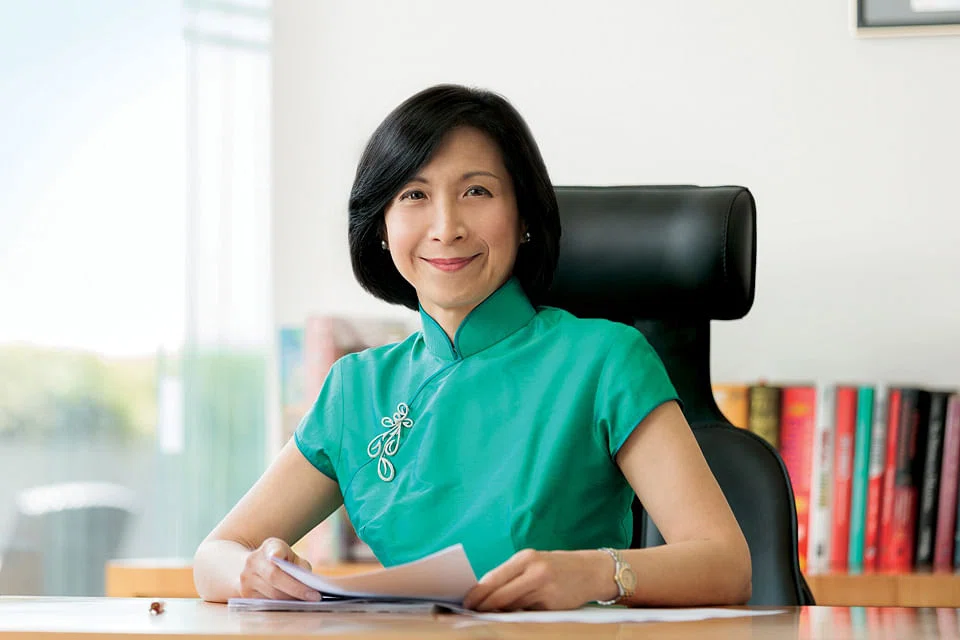
RADIATING pragmatism from every pore, Chew Gek Khim is down to earth, thanks in part to her late maternal grandfather, pioneer banker and philanthropist Tan Chin Tuan.
"I was brought up to be a very practical person," the petite executive chairman of The Straits Trading Company Ltd - one of Singapore's oldest firms established in the 1880s - said with a laugh.
In the late 1980s, after three years with law firm Drew & Napier, the National University of Singapore law graduate joined family investment vehicle Tecity Group, founded by her grandfather. From him, Ms Chew gleaned many valuable life lessons.
Dr Tan served as chairman of Straits Trading since 1965 for more than two decades, and OCBC Bank from 1966 to 1983. He was known as a shrewd businessman - some also say brilliant, tough and obstinate - with both feet firmly planted on the ground.
"I remember we went shopping one day, and ended up in a jewellery store, where I was eyeing some diamonds," Ms Chew recalled.
"He was very clever - he told me, "Khim, diamonds don't pay dividends". With that comment, he didn't have to buy me the diamonds, and second, it forced me to think: What's my objective? Is it for personal pleasure? There's a big difference between an item for show and one that generates a return."
Another principle is to forgive yourself for making mistakes. "It's okay to make mistakes, just as long as they don't kill you," she pointed out. "At the same time, he was extremely particular about reputation and integrity."
But whatever it is, life is a marathon, not a sprint. "Worry about the long term, not the short run," she added.
Ms Chew's skills in building up the family's corporate legacy - in which Straits Trading continues to play a key role - were established during those early years. "I had no real business background, and it was my grandfather who taught me the ropes," she said.
"He had a style of mentoring that was common to his generation - they don't really teach you, but you learn by watching."
Watch and learn
In the beginning, Ms Chew peppered him with questions. "We were taught in school to ask questions if we didn't understand, so I kept asking him why this, why that. After a while, he told me off - 'Stop asking. Watch and figure out why it's done that way'."
Over time, Ms Chew was able to hone her instincts and judgement. "By observing, you come to your own assessment and conclusions," she said.
"Like everything in life, business is very nuanced - what's right in one situation may not be right in another. By watching not just your mentor, but also others around you, you learn what they did right, and what they did wrong. That's a useful skill."
Another influential figure was Ms Chew's then-mentor in Drew & Napier, Lucien Wong, the current attorney-general of Singapore.
"He was very conscientious about work, and very demanding of himself and his staff, making every effort to improve himself constantly," she recalled.
Many of these values rubbed off on Ms Chew. That sharp acumen was never more obvious than in 2008, when she led a high-profile corporate tussle for control of Straits Trading at her grandfather's behest - pitting Tecity against the founding Lee family of OCBC Bank - and won.
Dr Tan, who passed away in 2005 at the age of 98, very much wanted to own his life's work - companies he was instrumental in building up during his time at OCBC Bank. The opportunity arose when the bank, which acquired Straits Trading in the 1950s, was required by the Monetary Authority of Singapore in 2006 to divest its non-banking assets.
"I tried to buy Robinsons but failed, I tried to buy Raffles Hotel and failed as well. Straits Trading was the only one I got," Ms Chew recalled, referring to other companies within the bank's stable.
Ms Chew was appointed non-executive and non-independent chairman of Straits Trading in 2008, and a year later, became its executive chairman, a post she has held for the last decade.
Her entry marks a watershed in the group's history - its transformation from a traditional, colonial-era tin smelter into a savvy financial and property investment company with robust cash flows.
Sustainable returns
Straits Trading's history can be traced back to the late 19th century, when Scottish businessman James Sword and German entrepreneur Herman Muhlinghaus set up a partnership to do tin smelting. The firm was incorporated in Singapore in November 1887 with a capital of 150,000 Straits dollars, and eventually grew into one of the world's largest tin smelters.
By the late 20th century, Straits Trading began diversifying into hotel and property management, as well as financial assets, while its unit, Malaysia Smelting Corporation, took over its mining and smelting operations.
Today, Tecity holds 70.1 per cent of the investment holding company, which has stakes in the real estate, hospitality and resources sectors across the Asia-Pacific.
Straits Trading owns 89.5 per cent of property investment vehicle Straits Real Estate (SRE), 21 per cent of global integrated real estate assets fund manager ARA Asset Management Ltd - including a 9.9 per cent deemed interest in SGX-listed Suntec Reit - as well as a 30 per cent stake in hospitality assets owner and operator Far East Hospitality Holdings. It also holds 54.8 per cent of Malaysia Smelting Corp, the world's third largest tin smelter that is dual listed on Bursa Malaysia and SGX.
"Back in 2008, we started off with what was already on the balance sheet - leveraging off existing real estate assets so that we could generate higher returns more quickly for shareholders," Ms Chew recalled.
"And that strategy has not changed over the decades - we've always targeted stable, sustainable and cash-generating investments so as to grow the portfolio, and to grow it consistently and rapidly."
Straits Trading has a current market capitalisation of about S$860 million. In FY2018, the 132-year-old company grew its net profit attributable to shareholders by 54.5 per cent to a five-year high of S$71.7 million, driven mostly by its real estate operations.
Savvy capital recycling
Growth opportunities in the region range from the need for custom-built industrial warehouses to demand for Tokyo apartments from rural-to-urban migrants. "In acquiring assets, we look for those with unrealised latent value. We also have a growing track record of successful value enhancement initiatives," she added.
Looking ahead, Straits Real Estate will continue to boost its existing footprint in Japan, Australia and South Korea, while exploring opportunities in other countries. Over the longer term, it aims to be a global real estate investor with investments in multiple markets and across asset classes.
"Wealth remains a key growth factor for Straits Real Estate and ARA, both in and outside Asia, as many investors aim to capitalise on rising asset prices. As for Far East Hospitality, it's all about increasing travel demand, while for Malaysia Smelting Corp, the use of tin in a widening array of applications will be the main driver," she pointed out.
Meanwhile, the relocation of Malaysia Smelting Corp's operations from Butterworth, Penang, to its new smelter in Pulau Indah, Port Klang, will also unlock a significant redevelopment potential for the site, given its size - about 16.2 ha - and prime location, she added. The freehold parcel is a stone's throw away from Penang Sentral, the newly launched key transportation hub for the state of Penang, which raises its appeal to a wide range of investors and developers.
In the year-to-date, Straits Trading shares have generated a total return of 6.2 per cent, outperforming total returns of 3.5 per cent and 5.1 per cent for the benchmark Straits Times Index and broader FTSE ST All-Share Index, respectively. The stock, however, is trading at approximately 40 per cent discount to its net asset value of S$3.62 per share as at March 31, 2019.
As with any business, challenges always exist, but Ms Chew is unfazed by potential stumbling blocks, which include geopolitical tensions and the threat of a global recession.
"Sure, these will have an impact on asset prices, but from a big-picture and longer-term perspective, they're not crippling issues. Being in real estate, mining and hotels, we believe we are fairly well-cushioned versus say, an electronics manufacturer," she noted, pointing to continuing US-Sino trade tensions, which are remapping supply chains across the industry landscape.
Sturdy safety net
Another defining characteristic that bodes well for Straits Trading is its active board of directors, which Ms Chew admitted is relatively "unusual" in Singapore's corporate scene.
"The board is very involved in all decisions, including capital allocation - it's not a rubber-stamp board. The members are independent-minded people with very different professional backgrounds, all looking at how they can contribute to the business," she said.
"Needless to say, we have very interesting debates at our board meetings," she added, half tongue-in-cheek. "It's healthy - the aim is to try to minimise big mistakes, and to arrive at the most robust decision possible."
This provides a safety net in the event that an oversized ego or excessively stubborn streak creates a blinkered perspective during the decision-making process.
"My weakness is that I can be very stubborn, and that needs to be managed as well," Ms Chew remarked with disarming frankness.
"But I would like to think that you need a degree of stubbornness to get anywhere in this world, and anyone who wants to achieve something has to be stubborn. But there are times when you are just hitting your head against a wall, and the challenge in life is to know when - in that situation - to call it a day."






