

Strong global chip demand boosts Excelpoint
Electronics component distributor is investing in AI, IoT space to drive future growth and move up value chain.
Singapore
IN SPITE of the uncertainties brought on by Covid-19, electronics component distributor Excelpoint Technology has posted a strong rebound from earlier trade war woes.
Its net profit for FY20 was US$10.3 million - more than six times the US$1.6 million achieved in FY19. This comes as demand for semiconductors surged on the back of accelerated technology adoption, resulting in a global chip shortage.
But its chairman and group chief executive Albert Phuay told The Business Times that the mainboard-listed company, which has weathered various crises over the past three decades, is not depending on the rising tide to lift its fortunes. Instead, it is focusing on new opportunities brought about by the pandemic and moving up the value chain.
Mr Phuay has set an ambitious goal of hitting US$2 billion in revenue in the next two to three years - almost twice Excelpoint's full-year revenue of US$1.1 billion for FY2020.
Change in lifestyles
Excelpoint is a business-to-business platform for the sale of electronic components such as chips. The company adds value by creating technology solutions for mobile phones, computers and various types of industrial equipment.
With more people working and studying from home in the past year, Mr Phuay said demand has been "huge".
"These changes will likely persist even after the pandemic ends," he noted.
Demand also came from customers in cloud applications, communications, data centres, and medical equipment. With Covid-19, the business went one step further by expanding into tracing devices and temperature sensors - a growth area that powered its profit surge last year, said Mr Phuay.
The biggest demand came from its manufacturing partners in China, with about 55 per cent of revenue coming from the market as it bounced back quickly from Covid-19.
Nurturing startups
Even as the company focused on new areas of growth, one key focus for Excelpoint over the past few years was on how to move up the value chain to strengthen its value proposition.
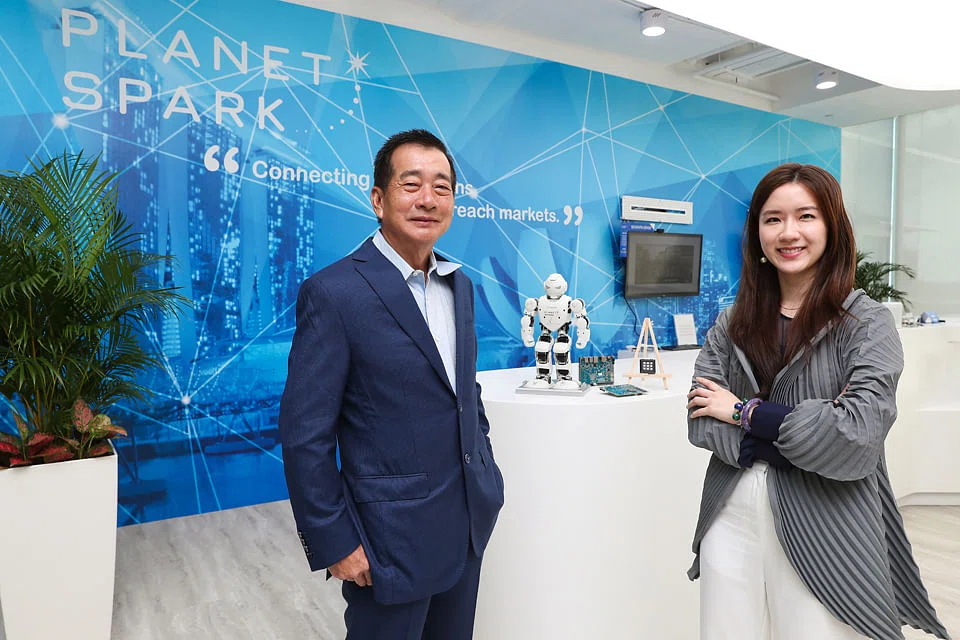
This led to the birth of its investment and entrepreneurial arm known as PlanetSpark, which recently launched an innovation centre to nurture Singapore-grown hardware tech startups in the artificial intelligence (AI) and Internet of Things (IoT) sectors.
Mr Phuay said: "This is a dream of Excelpoint for many years."
The innovation centre is a collaboration with Enterprise Singapore under which both sides invest an initial S$5 million to accelerate the growth of more than 30 startups in the next three years.
PlanetSpark's managing director is Phuay Li Ying, Mr Phuay's daughter. She is also deputy director of corporate development at Excelpoint.
The innovation centre seeks to drive Excelpoint's next phase of growth by investing in areas complementary to its core business and strengths, she said.
As the business views AI and IoT as having "huge market potential", the team decided to make this emerging segment its new strategic focus, she added.
PlanetSpark was first set up as an entity to look at investments in startups to complement Excelpoint's technologies and research and development (R&D). But she realised early on that what these startups need is not simply funding, but market access.
"It's not about the money - money is quite accessible to startups in a country like Singapore," she said. "They need guidance and connections."
This is where Excelpoint, having been in the business of electronics distribution for more than 30 years, can come in.
PlanetSpark's role is that of an accelerator with the aim of helping its startups commercialise their innovations. This comes as startups face many hurdles on their path to commercialisation as the AIoT (where AI meets IoT) hardware segment is competitive, fast-paced and requires a long gestation period, said Ms Phuay.
PlanetSpark will be able to connect these startups to engineering capabilities, industry resources and market intelligence to help them deliver a proof-of-concept within six months, instead of the usual two to three years.
Not only will the startups get a leg up, the business will also benefit by moving up the value chain as the solutions to be developed will then be offered to Excelpoint's channels and customers. This sharpens its technical capabilities and provides more value-add for customers, positioning the business to capture opportunities in the AIoT space.
The centre has five startups in its inaugural batch: spacetech startup NuSpace; thermal sensing solutions firm Nexwah Technology; facial recognition startup Seventh Sense; Excelpoint-invested CLOPTech, which is developing wireless connectivity solutions; and Meridian Innovation, a developer of thermal imaging solutions.
These startups pay S$20,000 to participate in the six-month programme, with subsidies from Enterprise Singapore.
"We are looking at this from a commercial standpoint, so we are hoping that this is not just a money burn," she said. "We hope that through what we do, we will churn out new businesses for the startups, and in turn Excelpoint will also benefit."
She said that most of PlanetSpark's investment goes into the building of engineering capabilities, which is paramount. She expects to break even after the second year.
AI, IoT to drive growth
Looking ahead, Mr Phuay said that they hope for Covid-19 to come to an end and for borders to be reopened. This is despite the pandemic giving the company's performance a lift in 2020.
"To do business, face-to-face (interaction) is very important," he said. "With new opportunities from the changing lifestyles of consumers, I remain positive and confident in the electronics industry."
Ms Phuay said the company foresees upbeat future demand in AI, high performance computing, electric vehicles and 5G wireless networks, as well as industrial applications arising from them. These segments will the main drivers of growth, she noted.
The group will also continue to focus on investments in its technical capabilities to keep its edge.
"We need to make sure Excelpoint is always a driver of technologies, not a follower," said Mr Phuay.
TRENDING NOW

Singapore identifies 7 firms responsible for haze fires, notices issued urging action: Grace Fu

Philippine power giant First Gen rebuffs foreign offers, plans up to US$2.6 billion in expansion

DBS remains analysts’ pick ahead of Q3 earnings after Singapore banks’ share slump

Indonesia imposes US$116 million in fines over manipulation of Sinar Mas, Prajogo-linked stocks

