Strong wealth segment likely to boost Q3 earnings at Singapore banks: analysts
They expect local lenders to continue posting stable results amid lower net interest margins

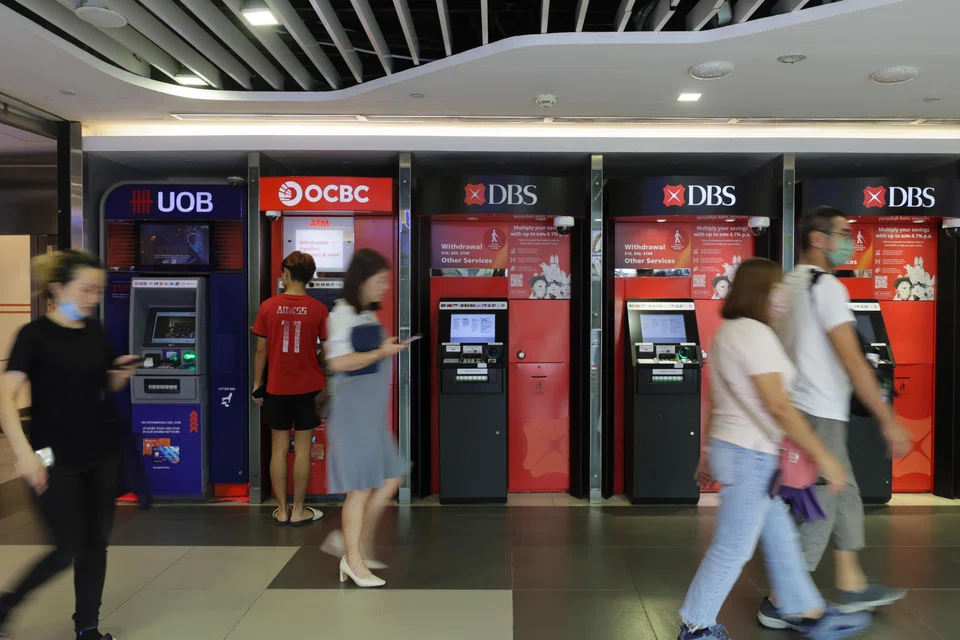
STRONG wealth management fees are likely to have continued boosting earnings at the three local banks during the third quarter of this year, according to analysts awaiting the results of DBS, OCBC and UOB.
A slower-than-expected contraction in net interest margins (NIMs) should also continue to support earnings, despite interest rate cuts, they said.
The local banking trio will report their results for Q3 in November – DBS on Nov 7, followed by OCBC and UOB on Nov 8.
Analysts expect the banks will continue to post stable results as strong wealth management fees will likely offset the impact of lower NIMs across the three banks.
Non-interest income – particularly from wealth management – likely rose amid a conducive market environment and declines in fixed deposit yields, said Thilan Wickramasinghe, head of research at Maybank Investment Banking Group.
China’s latest financial stimulus – announced on Oct 12 – should also drive revenue growth momentum, Wickramasinghe added.
Past Chinese stimuli in 2009 and 2015 had boosted loan momentum in the North Asian operations of the Singapore banks, and benefited their overall loans and profit, he noted.
Furthermore, the banks’ strategy of parking liquidity in low yields will likely slow the pace of NIM decline, as these yields have been locked in, Wickramasinghe added.
Still, NIMs may still take time to stabilise as funding costs from higher-priced fixed deposits roll off, said Andrea Choong and Lim Siew Khee, analysts at CGS International.
They may also be soft in Q3, as asset yields drift lower amid lower benchmark rates, the analysts noted.
In September, the US Federal Reserve started its rate-cutting cycle, resulting in the Singapore Overnight Rate Average (Sora) and other benchmark lending rates seeing a slight rollover in Q3.
Nevertheless, IG market strategist Yeap Jun Rong expects the pace of moderation will remain gradual, which suggests any tapering in the banks’ NIM may remain measured.
“The peak in NIMs has already been priced to a large extent, and recent calls for more patience in Fed’s easing process are likely to offer some resilience to NIM’s tapering,” he explained.
Jayden Vantarakis, head of Asean and Singapore research at Macquarie Capital, added that it is too early to see the impact of US Federal Reserve rate cuts in Q3.
What to watch for
The CGS analysts expect investors will be focusing on banks’ interest rate outlooks for next year, wealth management growth prospects, credit cost writeback timelines, and capital and dividend strategies.
Choong and Lim said that UOB could outperform its peers if its NIMs hold steady, given that funding costs were optimised earlier in the year; it should also see broad-based loan growth.
For OCBC, the CGS analysts said that NIMs will likely stabilise, since the bank has deliberately deployed its funds into lower-yielding high-quality assets in the second quarter.
There are also pockets of opportunity for loan growth, even though it could be largely flat in Q3, they added.
Meanwhile, Vantarakis expects DBS may raise dividends to signal its confidence in its capital position.
He also noted that this will be the first quarter for which CEO-designate Tan Su Shan is involved.
Overall, Wickramasinghe expects the sector is well-placed to benefit from a confluence of positive themes – which includes China growth, rising regional credit demand, the Johor Bahru-Singapore Special Economic Zone and higher wealth management fees.
He upgraded the sector outlook to positive and raised his call on UOB and OCBC to “buy”, while maintaining his “buy” call on DBS.
Vantarakis also said valuations of the three banks look fair, with attractive yields compared to their developed market peers.
Strong US bank earnings – which are normally a good indicator of the direction of trading income for the Singapore banks – indicate a strong base for the quarter, he noted.
Additionally, the kick-in of Basel IV from Q3 should also reflect the higher quality capital position of the Singapore banks relative to higher-yield European and US banks, he added.
But Citi analyst Tan Yong Hong kept his “sell” call on the three banks – despite the likely strength of the Q3 results, the risk-reward profile remains skewed to the downside with valuations at multi-year highs.
At the close on Wednesday (Oct 30), shares of DBS were down 1.6 per cent at S$38.66, OCBC fell 1.6 per cent to S$15.19, while UOB lost 1.8 per cent to S$32.16.