Surge in privatisations as share prices remain undervalued
Deal value this year jumps 70% from 2019 as founders, controlling shareholders, managements tie up with PE funds to rescue companies from undervaluation
PERSISTENT undervaluation and the stock market's failure to recover to pre-Covid levels have led this year's privatisations to surpass last year's in deal value by 70 per cent.
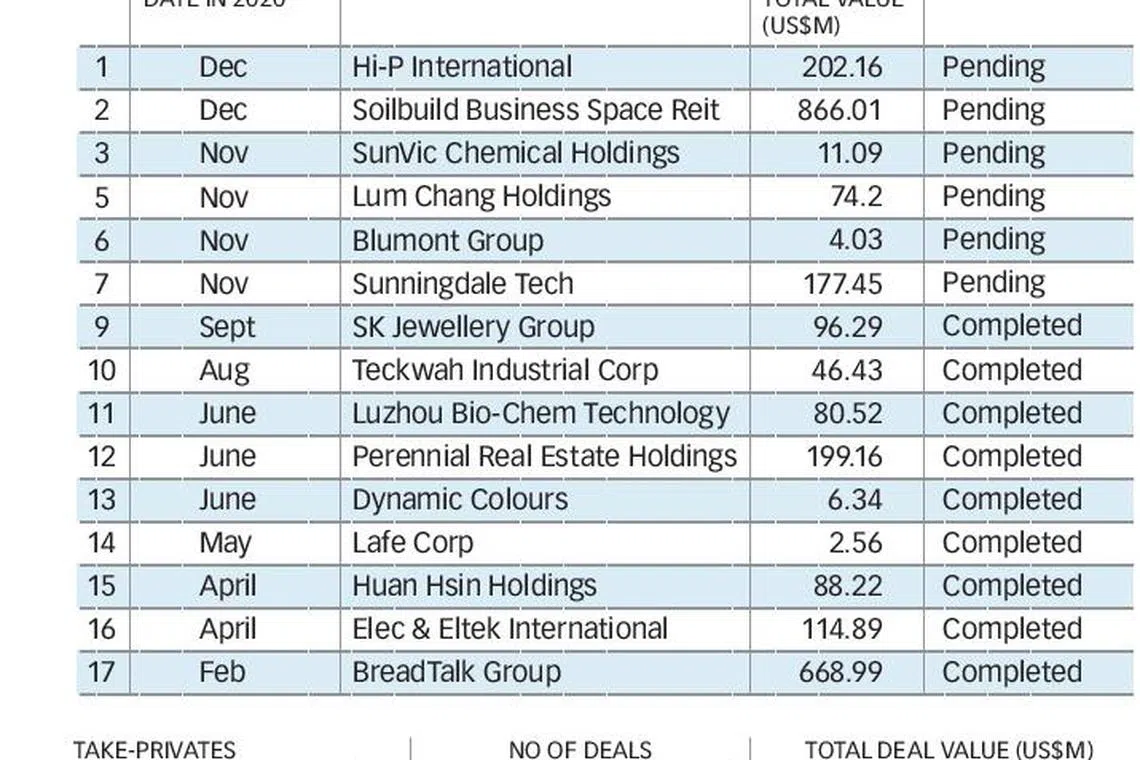
Friday's announcement of Hi-P International CEO's offer for the contract manufacturer brings the tally for take-private deals this year to 17, with a combined deal value of about US$5.8 billion, according to Bloomberg data.
This is fewer than the 19 privatisation deals in the whole of 2019, but the deals last year only added up to US$3.4 billion, partly due to a number of very small deals which were less than S$10 million each.
Wayne Lee, CEO of issue manager and accredited Catalist sponsor W Capital Markets, said he is not surprised by the data, given how the Singapore equity market is one of the worst performing markets in Asia as a result of Covid-19.
As at Dec 18, the Straits Times Index is down 11.6 per cent year-to-date, versus a 6 per cent drop for the Hang Seng Index, 4 per cent incline in the KLCI, 13.1 per cent increase for the Nikkei 225, and 26.1 per cent surge in the Kospi.
"Founders, controlling shareholders and key management of some Singapore-listed companies who have seen their share price decline significantly below their fair equity valuations, and who are confident of their mid-to-long term business growth prospects, may partner with strategically value-adding private equity funds and take the opportunity to delist their companies," Mr Lee said.
He added that because the need to preserve cash halted many companies' inorganic growth strategies, delisting naturally became the key M&A theme for the year.
Privatisations are expected to spill over into 2021, as long as significant valuation gaps remain between the fair value of listed companies and their trading prices.
This could be due to illiquidity or lack of interest from the investment community, he said.
Privatisation deals in Singapore this year include a number of prominent homegrown companies such as BreadTalk Group, Perennial Real Estate Holdings, SK Jewellery and Soilbuild Business Space Reit. They also include a couple of companies such as Lafe Corp and Huan Hsin whose controlling shareholders were forced to make an exit offer because they had repeatedly failed to meet listing requirements for profitability and market value to exit the watch-list.
The delisting trend is by no means unique to Singapore. Around the region, Hong Kong recently reported a three-year peak in privatisation transactions after recording 54 deals worth US$22.5 billion up until mid-December, which is 160 per cent higher than a year ago.
The Star also reported that Malaysia's stock market has seen at least 10 privatisation offers this year.
On the bright side, Mr Lee expects initial public offerings (IPOs) to return in late 2021, into 2022. His firm is currently working on four IPO deals, which can take about 10 months to come to market.
He also believes that with vaccinations made available from early next year onwards, corporate earnings will improve significantly from their 2020 trough, resulting in an overall recovery in the stock market.
READ MORE: Hi-P's CEO makes voluntary unconditional offer at S$2 per share with view to delist firm