

Baidu’s swift US$11 billion sell-off shows struggle to meet AI hype
The stock has also suffered on account of a wave of new listings by pure-play AI firms
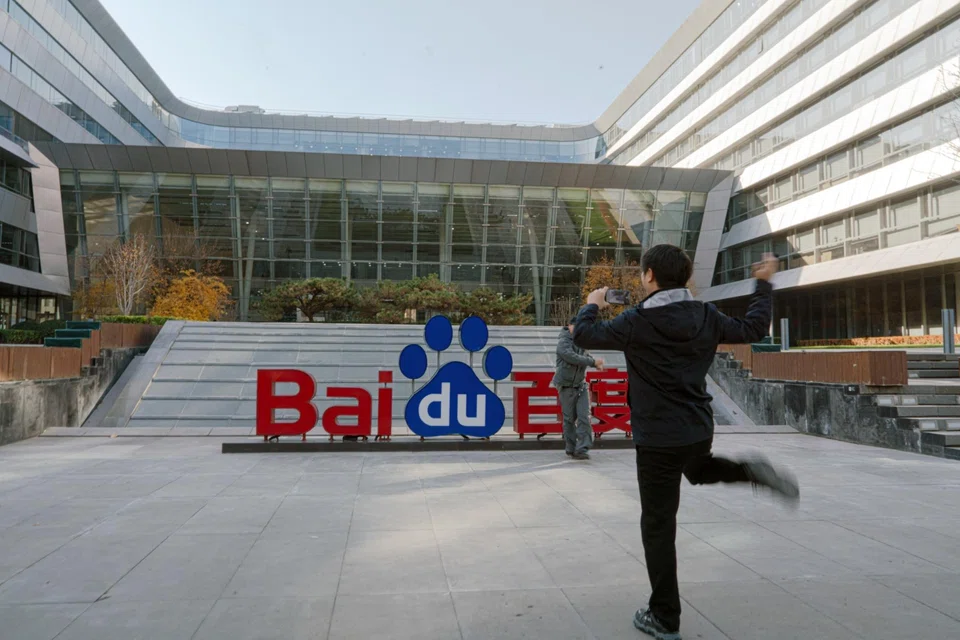
[HONG KONG] A 20 per cent slide in Baidu’s shares over the past month serves as a crucial reminder for companies in China’s rapidly intensifying artificial intelligence (AI) race: investors are demanding tangible results.
The search engine specialist kicks off December-quarter earnings for China’s Big Tech on Thursday (Feb 26), amid growing concern that its AI investments are not translating into a meaningful growth driver quickly enough. Despite strength in the cloud business, analysts predict both revenue and profit to fall year on year, hurt by continued weakness in the core advertising business that’s closely tied to the broader economy.
With markets fixated on AI, positive management commentary or evidence that capital spending is bearing fruit will be crucial to help stem an equity rout that’s eroded US$11 billion in market value since a three-year high on Jan 23.
“In the crowded field of Chinese AI players, Baidu is viewed more as an optionality or valuation-driven sum-of-the-parts story rather than a clearly defined long-term winner,” said Gary Tan, portfolio manager at Allspring Global Investments. “Baidu must demonstrate it is leveraging its AI capabilities to build a true full stack AI platform rather than acting as a jack of all trades.”
Baidu was among the first Chinese companies to embrace AI and roll out a ChatGPT-like service, but it has lost leadership in the field to larger rivals as well as newcomers such as DeepSeek. The Beijing-based firm’s flagship mobile application has also seen popularity wane, with young users flocking to social apps from rivals ByteDance and Xiaohongshu for search queries.
The stock has also suffered on account of a wave of new listings by pure-play AI firms such as chip designers and large language model developers. The outsized gains in shares of companies such as MiniMax Group and Knowledge Atlas Technology, better known as Zhipu, are luring investors away from diversified Internet conglomerates such as Baidu, Alibaba Group Holding and Tencent Holdings.
The Hang Seng Tech Index, which counts Alibaba, Tencent and Baidu among heavyweights, is down 9 per cent over the past month. Shares of Alibaba and Tencent down about 12 per cent each. Baidu’s stock has fared much worse, losing nearly 20 per cent over the period.
The downtrend has continued even after the company earlier this month announced plans to issue its first dividend and a three-year stock buyback programme of as much as US$5 billion in a bid to reward investors.
Some market watchers have expressed optimism ahead of the results.

“Baidu is moving into a phase where the contours of its AI-led transition are becoming more visible, in our view, with early signs that user adoption for AI functions, AI product integration into existing mobile Internet services and operational efficiency are beginning to improve,” JPMorgan Chase analysts led by Alex Yao wrote in a note last month.
Baidu’s 12-month forward consensus earnings estimate has also risen over 6 per cent since reaching a more than three-year low late last month.
Even so, the options market is signalling investor caution. Demand for downside protection has increased, with the cost of insuring against a 10 per cent drop in Baidu’s US-traded stock climbing to its highest level since April relative to upside bets earlier this week, according to one-month implied volatility data compiled by Bloomberg.
Options traders are pricing in a 5.7 per cent swing in either direction for its American Depositary Receipts after the results. That’s more than the average 4.6 per cent fluctuation seen following the last eight quarterly reports.
“Baidu needs to convince investors of greater adoption of its Ernie-based agents, particularly on the enterprise side,” given that agentic AI systems, which require less human supervision, are becoming “a larger and larger disruption risk”, said Felix Wang, tech sector head at Hedgeye Risk Management. BLOOMBERG
Decoding Asia newsletter: your guide to navigating Asia in a new global order. Sign up here to get Decoding Asia newsletter. Delivered to your inbox. Free.
Share with us your feedback on BT's products and services






