Circular AI boom goes global as Asia windfall funds hyperscalers
For much of North Asia, surging chip exports have overwhelmed the drag from higher energy prices stemming from the Iran war
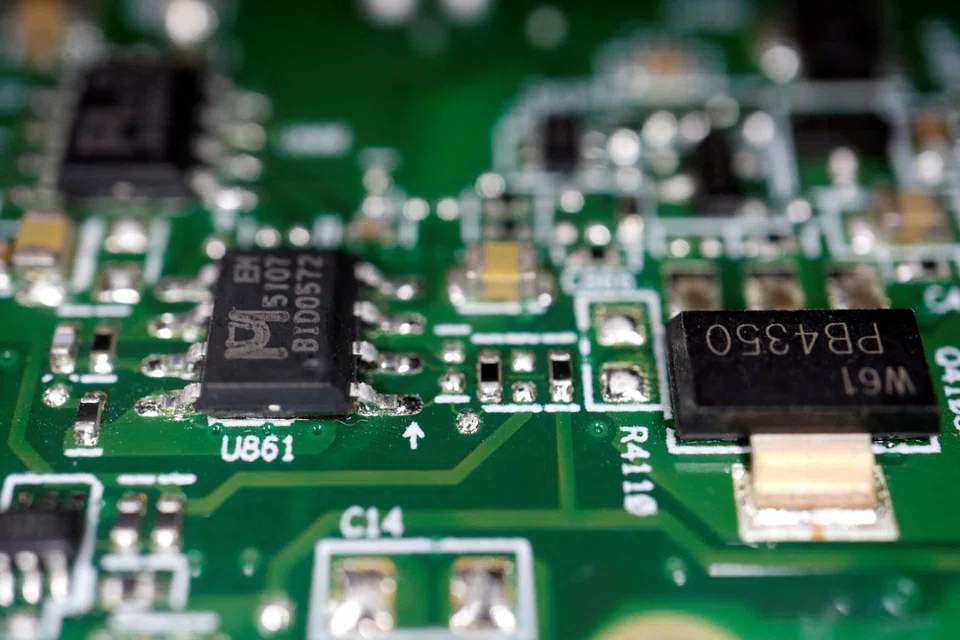
[HONG KONG] The windfall earned by Asian chip makers is coursing through the world economy, mirroring on a global scale the circular flow of money within the artificial intelligence ecosystem.
The AI boom is generating unprecedented amounts of cash for the likes of South Korea and Taiwan, which in turn is creating a narrower version of the Asian savings glut that kept US borrowing costs low through the late 1990s and early 2000s.
That’s according to a new note from Oxford Economics examining how technology-producing economies are converting export earnings into external surpluses faster than domestic investment can absorb them.
Some of that capital is finding its way back into US dollar assets, head of Asia economics Louise Loo wrote in the note. Such investments indirectly support the financial conditions that help fund capital spending by big tech companies known as hyperscalers, a group that includes Alphabet, Meta Platforms, Microsoft and Amazon.com.
“This framework of Asian savings recycled into US assets echoes Bernanke’s savings-glut framework two decades ago,” Loo wrote in the note, referencing a theory popularised by former US Federal Reserve chair Ben Bernanke. But “today’s AI-linked version of Asian surplus recycling is narrower and more concentrated”.
For much of North Asia, surging chip exports have overwhelmed the drag from higher energy prices stemming from the Iran war. That’s fuelling the fastest economic growth in decades in Taiwan and boosting Japan’s and South Korea’s tech-heavy economies, too.
It’s also creating a windfall for companies, including Taiwan Semiconductor Manufacturing Company, the main chipmaker to Nvidia and Apple, and Samsung Electronics, which saw a 48-times jump in profits for its semiconductor arm in the first quarter.
At the macro level, the boom is generating massive imbalances.
Data on Wednesday showed Taiwan’s current account surplus jumped 111 per cent from a year earlier to US$62.5 billion in the first quarter. And there’s no sign of chip demand slowing just yet, with export figures on Thursday from South Korea for the first 20 days of May jumping nearly 53 per cent from a year earlier when adjusted for working day differences.

The excess earnings amassed by Asia’s biggest economies now far exceed the surpluses accumulated by Gulf Arab economies, which were once a pillar of a petrodollar system that relies on pricing crude exports in the US currency. “De-dollarisation is more likely to be determined by how North-east Asia deals with its surpluses than by reduced petrodollar recycling in the Middle East,” Gavekal Research said.
But the concentration of surplus formation in a handful of upstream Asian tech economies and final demand among US hyperscalers also creates potential vulnerabilities.
“This financial recycling loop is powerful but could be exposed to a turn in the US-led AI cycle, FX pressures, and growing domestic institutional balance sheet risks,” Loo warned.
The biggest US tech firms now plan to spend as much as US$725 billion this year on capital expenditures, primarily on AI data centre equipment.
And Asia is critical to those investment plans. The US gets more than 55 per cent of imported advanced-technology products from Asia, reflecting production niches that are difficult for other regions to replicate, Loo notes.
Taiwan, South Korea and Japan are benefiting at the high end thanks to years of accumulated expertise and spending on research and development. Meantime, India, Vietnam, Malaysia and other parts of South-east Asia are taking advantage as companies adopt a China-plus-one strategy to diversify their supply.
While the investment boom may fuel upside gains for Asia’s exports and growth, the transmission to the broader economies will be constrained by factors including reliance on imported equipment, foreign ownership and the capital intensity and geographic concentration of production, Oxford Economics said.
Loo estimates that every additional US$100 of US AI-linked hardware imports could raise gross domestic product across the main Asian suppliers by US$35. The main beneficiaries are Taiwan, China, South Korea, and Vietnam, Loo said.
In a note last week, Goldman Sachs economists led by Andrew Tilton argued the tech-export surge is creating what it called the “AI-driven super surplus” in current accounts above 10 per cent of gross domestic product in Korea in 2026 and over 20 per cent of GDP in Taiwan.
So far, South Korea’s surplus has been recycled mainly into overseas equities and Taiwan’s into FX deposits, according to the Goldman analysts, but appreciation pressure may be building.
Oxford’s Loo draws a similar conclusion.
“Policy intervention and portfolio outflows can manage the consequent currency appreciation pressure for a time, but as external claims rise relative to GDP, the tension between external fundamentals and prevailing exchange-rate settings will become harder for policymakers to ignore,” Loo wrote. BLOOMBERG
Decoding Asia newsletter: your guide to navigating Asia in a new global order. Sign up here to get Decoding Asia newsletter. Delivered to your inbox. Free.
Share with us your feedback on BT's products and services