



A guide to the Nvidia chips at the centre of US-China AI rivalry
The H200 is considerably more powerful than the H20
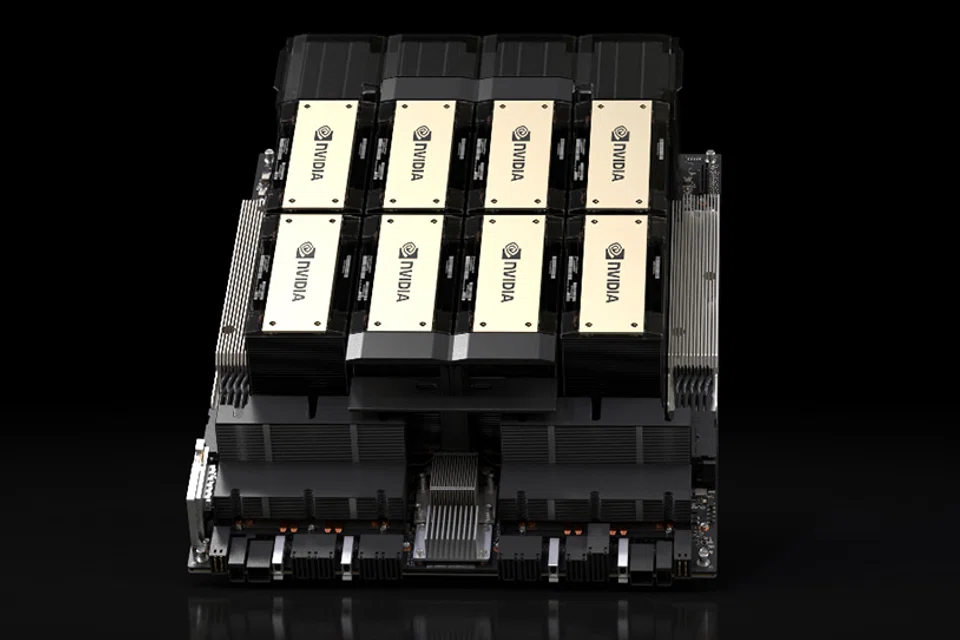
[SAN FRANCISCO] As China races to catch up with the US in artificial intelligence (AI) technology, the state of relations between the countries can be gauged by looking at which of the chips made by Silicon Valley’s Nvidia can be shipped to Chinese customers.
Generally regarded as the global leader in AI hardware, the company was given permission by US President Donald Trump on Dec 8 to sell its H200 chip to “approved customers” in China, lifting what had been a total ban on their export there.
The H200 is considerably more powerful than the H20, which Nvidia specifically designed for export to China. But Nvidia’s cutting-edge B200 is still off the table for the country.
Here’s a short guide to the Nvidia chips that have been in the news:
The H200
The H200 is the ultimate version of Nvidia’s Hopper generation, named after the late pioneering computer scientist Grace Hopper, a rear admiral in the US Navy. The series, which was first unveiled in 2022, became the backbone of the explosion in the deployment of AI computers.
It’s a so-called accelerator, a chip that turns massive amounts of data into AI software and then runs that code, providing increasingly humanlike responses to complex questions and tasks.
The H200 went into mass deployment in 2024 and is still on sale, despite being superseded by a newer design. Much of the work done in massive new data centres all over the world is done on H200-based hardware.
The H20
The H20 is a derivative of the Hopper design that Nvidia created in response to limitations imposed by US authorities on the capabilities of chips that could be sold to Chinese customers.
In both Trump administrations and during the presidency of Joe Biden in between, the US government has used technical specification limits to try to ensure China could not build AI infrastructure that rivals that in the West.


The H20 had crucial handicaps, such as reductions in memory and in the speed at which it accessed information stored in memory chips.
Nevertheless, after an initial period, the US barred it from export to China. When that was later reversed, Beijing told Chinese companies to avoid it and concentrate their purchases on locally designed alternatives.
As a result of the tussling, Nvidia said it had no orders for the massive Chinese data centre market, which company co-founder Jensen Huang estimated in August represented a US$50 billion opportunity in 2025.
The B200
The B200 is Nvidia’s current flagship chip. It’s part of a generation named after the late mathematician David Harold Blackwell. The Blackwell design was announced in March 2024, and the B200 went on sale in late 2024.
This November, Nvidia said that runaway demand for the chips helped it generate US$51.2 billion of data centre revenue in its most recent quarter. That was a gain of 66 per cent from the same period a year earlier and gave the unit sales that are larger than the companywide annual totals of its nearest rivals, Intel and Advanced Micro Devices.
Trump earlier said that he’d consider allowing the shipment of a scaled-back version of the B200 to China. But in granting permission for exports of the H200, he said that the Blackwell chips are not “part of this deal”. BLOOMBERG
Decoding Asia newsletter: your guide to navigating Asia in a new global order. Sign up here to get Decoding Asia newsletter. Delivered to your inbox. Free.
Share with us your feedback on BT's products and services
TRENDING NOW

Grab CEO’s wife Chloe Tong on life with Anthony Tan and finding her purpose
Stocks to watch: DBS, DFI Retail, Frasers Property, Clint, ESR-Reit, Centurion, Coliwoo
DFI Retail to bag US$340 million, Starbucks business in Asia in deal with Maxim’s Caterers
Green fuels, autonomous ships: How Singapore is future-proofing its shipping industry

