

HPE projects sales that top estimates on AI hardware demand
The company expects the memory chip shortage to continue well into next year
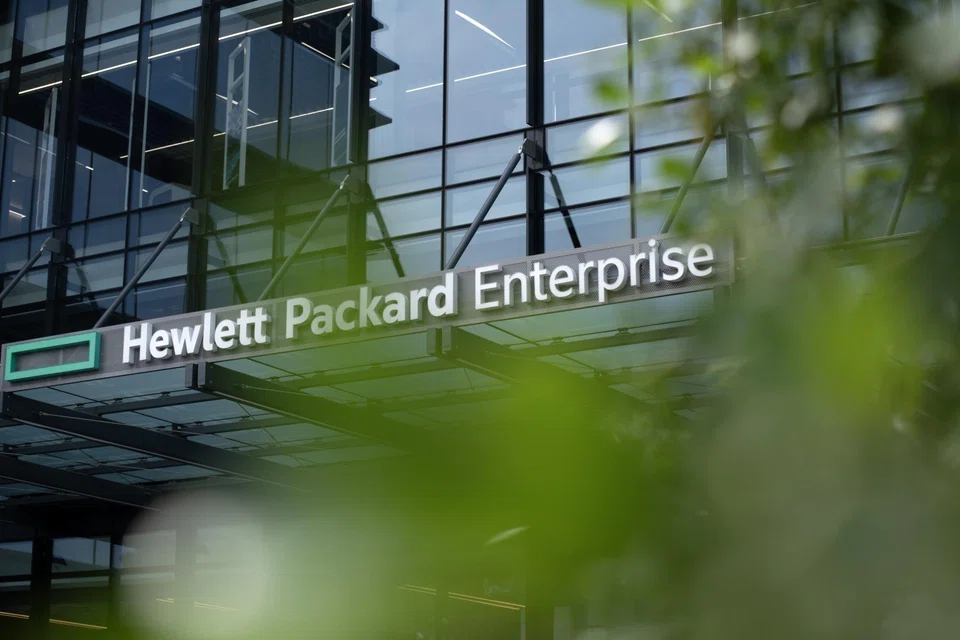
[SEATTLE] Hewlett Packard Enterprise (HPE) gave an outlook for revenue in the current quarter that exceeded analysts’ estimates, a sign the company is benefiting from solid demand for hardware that helps customers run artificial intelligence (AI) workloads.
Sales will be US$9.6 billion to US$10 billion in the period ending in April, the company said on Monday (Mar 9), compared with the US$9.57 billion average estimate of analysts polled by Bloomberg. Profit, excluding some items, will be 51 US cents to 55 US cents a share, HPE said, in line with the average estimate of 53 US cents.
The company reiterated its revenue growth outlook for the full year, while raising its annual earnings forecast to US$2.30 to US$2.50 a share. Analysts, on average, anticipated US$2.35.
HPE is seeing strong demand for its networking products, driven by a boom in AI tasks that need faster ways to route data. The Texas-based company purchased Juniper Networks for about US$13 billion last year and sees networking as a major part of its future expansion.
In the most recent quarter, HPE widened margins by raising prices and opting to forgo supplying some customers as the industry deals with severe price increases and shortages of memory chips.
“We executed with very, very, strong discipline in a very dynamic environment driven by the supply chain shortages and inflationary cost,” chief executive officer Antonio Neri said.
In the fiscal first quarter, sales rose 18 per cent to US$9.3 billion, while profit, excluding items, was 65 US cents a share. Analysts had expected sales of US$9.37 billion and profit of 58 US cents.
Cloud and AI revenue, which includes servers and storage, declined 2.7 per cent to US$6.3 billion, although margins in the unit widened. The company has an AI server backlog of US$5 billion, Neri said.
The shares were little changed in extended trading after closing at US$21.81 in New York. The stock has fallen 9.2 per cent so far this year.


HPE expects the memory chip shortage to continue well into next year. The company is raising prices, in some cases even between when it quotes prices and when it ships products. HPE is also forgoing supplying some equipment to mobile service providers to focus on higher-profit clients such as enterprise customers and sovereign deals.
“We are not done raising prices,” Neri said. Still, HPE is not really losing any market share, he added.
“There are markets and segments and products that you may gain share, and other ones maybe you are losing share, depending on what the opportunity is,” he said. “But on average, we are all in the same boat.”
The company is also vying for more contracts with countries building their own AI clouds, but those deals take longer to sign and get US export control approval, so that revenue is likely to show up in the latter half of the year, Neri said. BLOOMBERG
Decoding Asia newsletter: your guide to navigating Asia in a new global order. Sign up here to get Decoding Asia newsletter. Delivered to your inbox. Free.
Share with us your feedback on BT's products and services
TRENDING NOW

Grab CEO’s wife Chloe Tong on life with Anthony Tan and finding her purpose

US trade chief to consider trade deal tariff caps in excess capacity probe
Bee Cheng Hiang customers’ e-mail addresses exposed in Singapore’s first case of AI-related data breach

DFI Retail to take over Starbucks business in Asia from Maxim’s Caterers

