

Nvidia scores lobbying win as Congress rejects chip export bill
Lawmakers are working on another bill, the Safe Act, which would codify existing limits on AI chip sales to China
[WASHINGTON] Nvidia is on the verge of securing a massive lobbying win after US lawmakers kept a measure out of must-pass defence legislation that would have limited the company’s ability to sell their advanced artificial intelligence (AI) chips to China and other adversary nations.
The so-called Gain AI Act would require chipmakers, including Nvidia and Advanced Micro Devices, to give American customers first dibs on their powerful AI chips before selling in China and other arms-embargoed countries.
Lawmakers sought to advance the proposal as part of the annual defence policy bill, which is set to be released on Friday (Dec 5). A source familiar with the defence bill said that it is not in the bill, though the situation could still change unexpectedly.
The decision caps a fierce lobbying fight that pitted China hawks and AI safety advocates against Nvidia and other industry players, which have sought to expand their market access to Beijing. Nvidia argued the legislation would restrict global competition for advanced chips, insisting it was not necessary because the company would not deprive American customers seeking to buy high-powered chips.
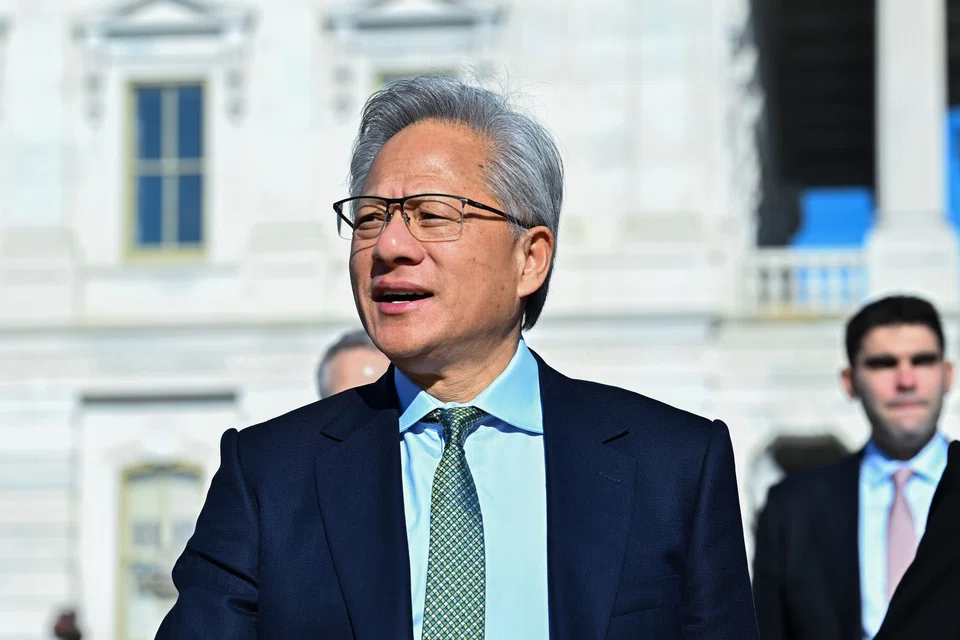
The high-stakes battle culminated in Nvidia CEO Jensen Huang coming to Washington on Wednesday to meet with US President Donald Trump and key lawmakers. Huang told reporters outside of Speaker Mike Johnson’s office that he was in town to “answer questions about AI”.
Later, Huang called lawmakers’ decision to not include Gain AI in the defence bill “wise” and compared it to another policy Nvidia has fought against.
“The Gain AI Act is even more detrimental to the United States than the AI diffusion act,” Huang said.
The matter has taken on increased urgency as the White House weighs whether to export the H200, an Nvidia AI chip better than any of China’s indigenous products that is currently subject to licensing requirements.
Trump previously suggested he was open to shipments of a downgraded version of Nvidia’s Blackwell, though key Cabinet members have made clear they are opposed to such exports.
SEE ALSO



White House AI czar David Sacks has continually floated selling more American chips to China to boost US technological leadership globally. The White House sided with Nvidia and lobbied against the provision, Bloomberg News previously reported.
Yet advocates of the legislation have expressed fears about the Trump administration’s approach and sought to limit exports on advanced AI chips to China, raising national security concerns should Beijing use American AI products to strengthen their economy and military.
Despite their failed attempt, China hawks on Capitol Hill are poised to continue their push for stricter restrictions on cutting-edge AI technology, signalling ongoing challenges for the industry. Lawmakers are working on another bill, the Secure and Feasible Exports, or Safe, Act, which would codify existing limits on AI chip sales to China.
The failure to include the Gain AI Act in the defence bill marked a loss for some American hyperscalers and Nvidia’s largest customers, such as Microsoft and Amazon, which supported the legislation. The policy would preserve their access to hardware over Chinese rivals. BLOOMBERG
Decoding Asia newsletter: your guide to navigating Asia in a new global order. Sign up here to get Decoding Asia newsletter. Delivered to your inbox. Free.
Share with us your feedback on BT's products and services
TRENDING NOW

ComfortDelGro appoints two new independent directors

Once staunchly pro-China, Malaysian Chinese businesses are now distancing themselves from Beijing

NoonTalk needs continued financial support from CEO Dasmond Koh, auditors warn

DP Architects sets the benchmark for sustainability disclosure and design

