NEWS ANALYSIS

Singtel must show results from NCS, Optus divisions to help fuel share price uptrend

Analysts are also looking for potential expansion from big ticket deals, such as the data centre agreements announced earlier this year

Yong Jun Yuan
Published Tue, Oct 8, 2024 · 05:00 AM
    • Analysts also note that Singtel's share price could have risen on better earnings visibility and greater institutional interest.
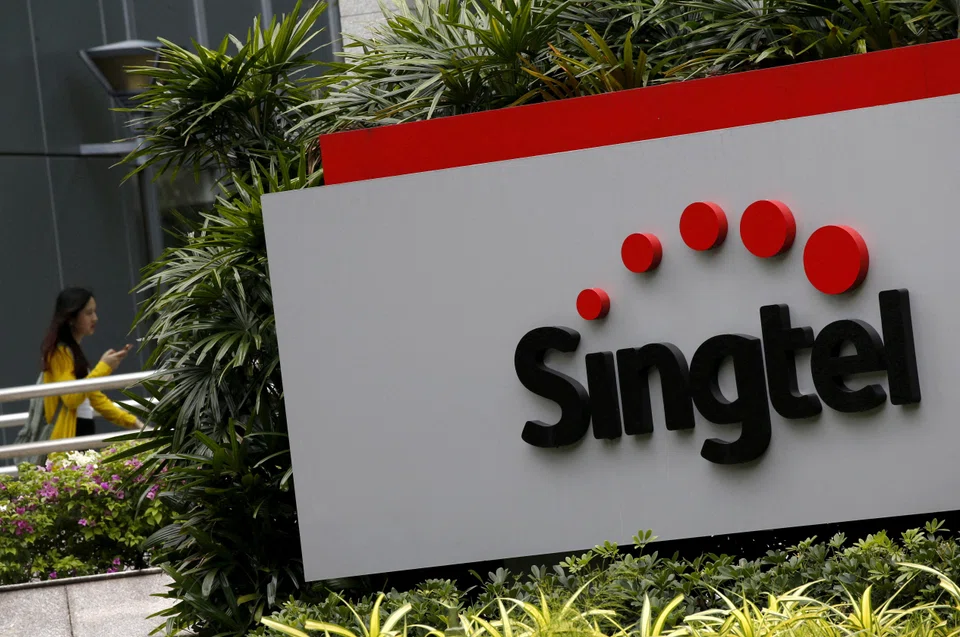
    • Analysts also note that Singtel's share price could have risen on better earnings visibility and greater institutional interest. PHOTO: REUTERS

    TELCO giant Singtel’s share price has risen significantly in recent weeks as investors have gained a better understanding of how the company will execute its dividend plans.

    Year-to-date as at Sep 30, the company’s share price has risen 31.2 per cent. In just over a month after the company’s investor day on Aug 29, its share price has risen by 7.3 per cent.

    Even so, analysts expect that the company will need to show further consistency in the performance of its Australian subsidiary, Optus, as well as its technology services arm, NCS.


    Maybank analyst Hussaini Saifee noted that Optus reduced its employee headcount in the second half of FY24 and has begun to raise rates in the first quarter of FY25. He will be looking out for whether the improved performance from the subsidiary can be sustained in the upcoming first-half earnings of FY25.

    “Optus’ management was a fair bit cautious at (Singtel’s) investor day in terms of guiding for growth,” he said, adding that the macroeconomic environment in Australia has also weakened.

    At Singtel’s investor day event, Optus’ management highlighted challenges as Australians suffer from high inflation, which has dented business confidence and consumer confidence.

    Already, Optus’ mobile revenue rose 4.7 per cent year-on-year in the first quarter of FY25 on higher postpaid plan prices and a higher prepaid customer base.

    However, overall operating revenue declined 3.2 per cent over the same period due to lower information and communication technology and project-based satellite revenues.

    Meanwhile, DBS analyst Sachin Mittal noted that the company’s stock has typically shown a high correlation to its core operating earnings before interest and tax (Ebit) from its operations in Singapore and Australia.

    Aside from Singtel’s Australian operations, he will be looking out for the performance of NCS, as well as that of the company’s Digital InfraCo business as key growth drivers.

    “You can keep doing the cost cutting in the traditional (telecom) side of the business, but there is a limit to this,” he said.

    He added that the company appears to have understood these businesses and invested for growth. For instance, it made acquisitions in Australia to boost NCS’ capabilities and drew in funds from private equity firm KKR to invest in its data centre business.

    “These were not easy decisions in the past; but I think those decisions, in hindsight, definitely have proven right,” he said.

    The company’s data centre business, Nxera, should also draw a significant premium as it targets high-end data centre workloads, Mittal said. He estimates that such “AI-ready” data centres, which are more power-dense and require advanced cooling technologies, could draw in between 50 and 100 per cent in rental premiums.

    Similarly, Maybank’s Saifee in a Sep 24 report raised Singtel’s target price to S$3.70, after imputing an enterprise value of S$8.7 billion for its data centre business, as well as higher Bharti valuation to reflect the recent increase in Bharti’s share price.

    In the first quarter of FY25, NCS operating revenue rose 3.8 per cent year-on-year while earnings before interest, tax, depreciation and amortisation (Ebitda) and Ebit grew 12.6 per cent and 27.6 per cent respectively.

    The company attributed this to continued cost optimisation efforts, as well as strong bookings of S$788 million at the start of the financial year.

    Meanwhile, Digital InfraCo revenue climbed 5.8 per cent year-on-year on higher customer reservation fees, increased utility passthrough and price uplifts. Still, its Ebitda and Ebit fell 13 per cent and 32.2 per cent respectively as its data centre business, Nxera, and enterprise platform Paragon remain in their expansionary phase.

    Dividend visibility

    Analysts also noted that the company’s share price could have risen on better earnings visibility and greater institutional interest.

    Singapore Exchange market strategist Geoff Howie observed that the company has booked S$114 million, S$103 million and S$642 million of net institutional inflow in Q1, Q2 and Q3 this year, respectively.

    This compares to S$322 million of net institutional outflows last year.

    “From here, analysts are looking for potential growth that emanates from big ticket deals, such as the data centre deals announced this year with Telekom Malaysia and STT GDC,” Howie said.

    He added that analysts are also looking for further progress in material asset monetisation and savings, such as the announcement in Q3 2024 by Singtel’s associate Intouch about a merger with Gulf Energy.

    In a report on Sep 5, RHB analysts said that the telco provided some idea of where it would continue to generate returns on its investor day.

    “While there were no specifics, we think a further sell-down in Airtel is likely following the more than S$3 billion successfully raised in recent years, coupled with partial divestments of NetLink Trust and NCS,” they said, adding that these moves would comfortably pay for the value realisation dividend to shareholders.

    As part of its earnings briefing in May this year, Singtel announced a value realisation dividend ranging between S$0.03 and S$0.06 per share annually that will be funded by excess capital from past and future asset recycling efforts, after investing in growth.

    For FY24, the value realisation dividend stood at S$0.038 per share.

    Maybank’s Saifee noted that the company’s management has been “very vocal” in terms of monetisation, which could have given investors confidence in its dividend plans, even if it did come with a lag.

    While the company’s fundamentals are important to watch, he said that external factors – such as interest rates – will also affect Singtel’s share price.

    “If the interest rates start coming down, then the yield spread widens – which also is a positive factor from Singtel’s point of view,” he said.