StarHub faces pressure from consumer segments, could benefit from consolidation: analysts
Company now appears to be more open to inorganic opportunities for growth, says UOBKH

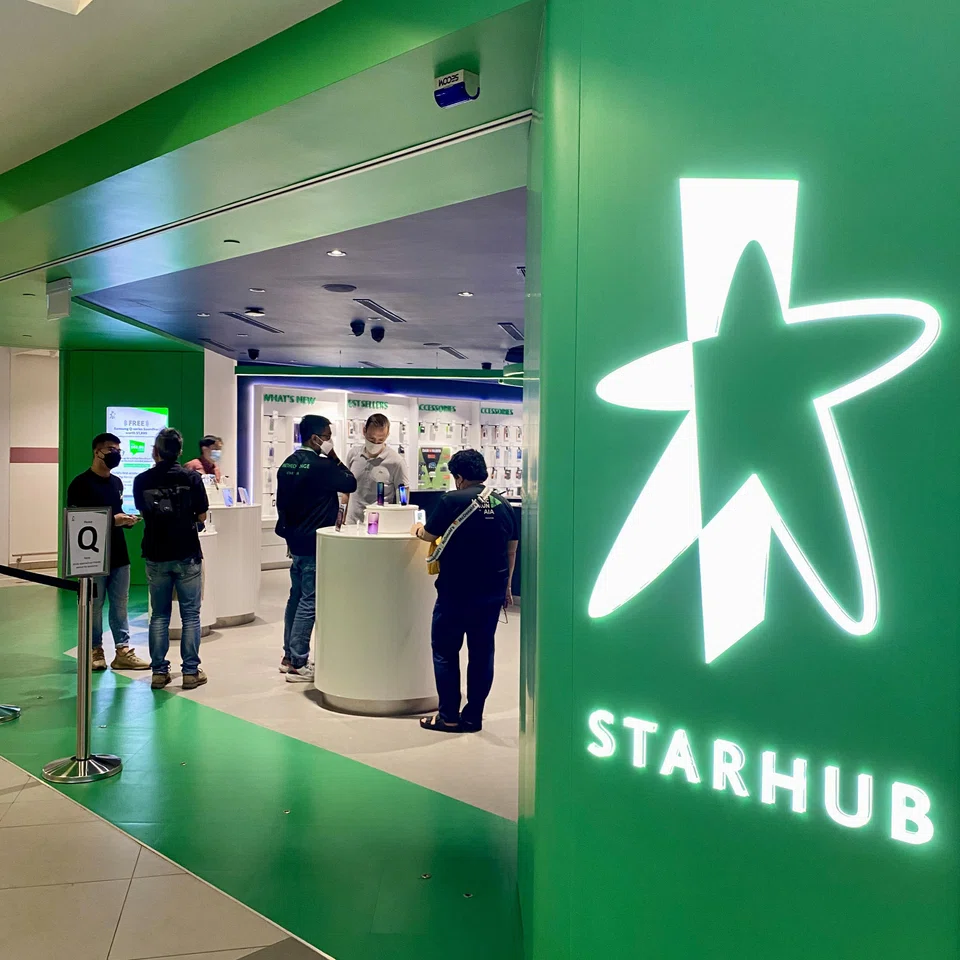
STARHUB posted a decent first-quarter net profit increase, but analysts have flagged that the company’s consumer business continues to face intense pressure, especially in the area of data roaming.
The telco’s net profit grew 8.1 per cent to S$40.1 million for the quarter ended Mar 31, 2024, while revenue dipped 0.1 per cent to S$545.4 million.
UOB Kay Hian (UOBKH) analyst Llelleythan Tan noted that revenue from the company’s consumer segments – comprising mobile, broadband and entertainment – declined across the board.
He said that pressure looms from companies such as Simba, which have offered very competitive broadband plans. While StarHub currently offers its 1 Gigabit per second (Gbps) plan for S$38.24 per month, new entrant Simba offers its 2.5Gbps plan for S$21.80 per month.
Tan said that StarHub could be showing “signs of cracks” as data roaming is unable to offset any further declines in its consumer segments. He added that he would keep an eye on the upcoming quarters to monitor if some of the declines were due to seasonality.
Similarly, Phillip Securities research head Paul Chew noted that the company did not see a further uplift in roaming revenues despite inbound and outbound travel remaining strong.
StarHub posted a quarter-on-quarter increase in prepaid subscribers due to inbound tourism and acquisition activities, but postpaid average revenue per user fell on quarter due partly to lower roaming figures.
In a report published on May 16, Chew said that the company’s Dare+ programme will become a necessity as it moves away from simply charging for commoditised network access.
“If you think about it, after 20 years, the rough business model of telcos hasn’t really changed – they sell network access with maybe a phone subsidy. If this continues, the whole sector will just get very meagre earnings,” he said.
StarHub launched Dare+ in November 2021 to harness 5G Internet of Things products and solutions as well as cloud connectivity to deliver sustainable revenue growth and reduce operating expenditure.
Since then, the company has offered more value-added services to consumers. These include the bundling of video streaming services such as Disney+ and Netflix, as well as game streaming in partnership with Nvidia GeForce Now.
Chew noted that some of the customers for game streaming have even originated from outside Singapore.
However, Maybank analyst Hussaini Saifee said that elevated competition limits up-selling and cross-selling potential as the local market already has four mobile network operators and is highly saturated.
Instead, he said investors are hopeful that the company can pursue market consolidation. “Singapore is the only Asian market which has yet to see consolidation,” he added.
In a report released on May 14, DBS analysts noted that in the scenario of a merger between StarHub and Keppel-owned competitor M1, there could be room for StarHub’s earnings to grow by 16 to 37 per cent while Keppel’s market capitalisation could rise by 4 to 6 per cent.
“Singtel, with similar revenue share, commands about 37 per cent earnings before interest, taxes, depreciation and amortisation margins in Singapore, suggesting big room for the merged entity’s margins to improve from about 20 per cent,” the analysts said. “Admittedly, Singtel commands higher-end consumer and enterprise customers, but it also reflects sub-optimal scale of StarHub’s and M1’s business,” they added.
UOBKH’s Tan noted that StarHub used to deny market speculation of consolidation in the past. However, he said, the company appeared to be more open in recent quarters to inorganic opportunities for growth.
He said that it would make sense for the company to consolidate with M1 as both companies are likely to be able to realise operating synergies.
StarHub and M1 are no strangers to working together. In 2020, the companies entered into a joint venture to bid for 5G operating licences. StarHub said in a statement at the time that “this strategic cooperation will allow both companies to optimise infrastructure and spectrum costs”.
Furthermore, Tan added that StarHub’s higher share price makes it more viable to use a mix of equity and cash to complete such an acquisition.
Year-to-date, StarHub shares have risen 13.5 per cent to S$1.26 as at May 24.
Phillip Securities’ Chew agreed that the industry could be due for consolidation. However, he expects that StarHub could lose subscribers in the short term if it does consolidate.
“(Competitors) will do some tactical marketing moves to try and catch some (market) share because once they consolidate, maybe that opportunity will be gone,” he said.
In the meantime, he believes that investors may have overreacted to recent consolidation rumours, adding that the company has only guided for just single-digit growth in revenue.
“We think that it could be pricing in a bit too much in the very near term because you are not sure of the timing of (the consolidation),” he said.
Enterprise remains strong
Meanwhile, the company has continued to post strong results on the enterprise front.
Enterprise revenue rose 10.4 per cent on the back of a 37.1 per cent increase in cybersecurity services revenue. In particular, Ensign InfoSecurity’s revenue grew 54.2 per cent.
The strong performance of Ensign has fuelled market speculation that StarHub could spin off its cybersecurity business as it achieved operating profit breakeven last year.
In a recent report, DBS analyst Sachin Mittal said the cybersecurity business could fetch S$0.23 to S$0.35 per share in a public listing as he expects Ensign’s enterprise value to come in at between S$730 million and S$1.1 billion. StarHub has a 55.73 per cent stake in the company, which was launched as a joint venture with Temasek in 2018.
However, analysts expect StarHub to hold off on monetising its stake in the business for now as it is still trying to capture operating leverage.
UOBKH’s Tan said that without strong profitability yet, it could be difficult for StarHub to find a buyer for the company, especially with the current high interest rate environment.
Phillip Securities’ Chew said that the company is still trying to push its enterprise services with a triple play of cloud, connectivity and cybersecurity services. He also believes that it is unlikely for the company to sell Ensign while it is still seeing sharp growth.
Still, he added that StarHub could consider selling a small stake in the company to crystallise a bit of value as it could be a “hidden gem”.
“Most analysts have not captured the full valuation of cybersecurity so it’s kind of lumped unfairly together with telco valuations,” Chew said.