

Charting big tech’s US$70 billion spending spree in South-east Asia
A WHIRLWIND tour of Malaysia, Singapore, and Vietnam all in less than a week.
Sounds like the tour schedule of BTS or another K-pop supergroup? Well, this was the trip taken by Nvidia co-founder and CEO Jensen Huang in South-east Asia late last year to discuss investment deals for the chipmaker in the region.
Huang looks every bit the rockstar in his trademark leather jacket, even autographing bras along the way. While his peers such as Apple CEO Tim Cook and Microsoft CEO Satya Nadella may have less star power, they have also visited the region in the past 18 months and committed huge amounts of investment.
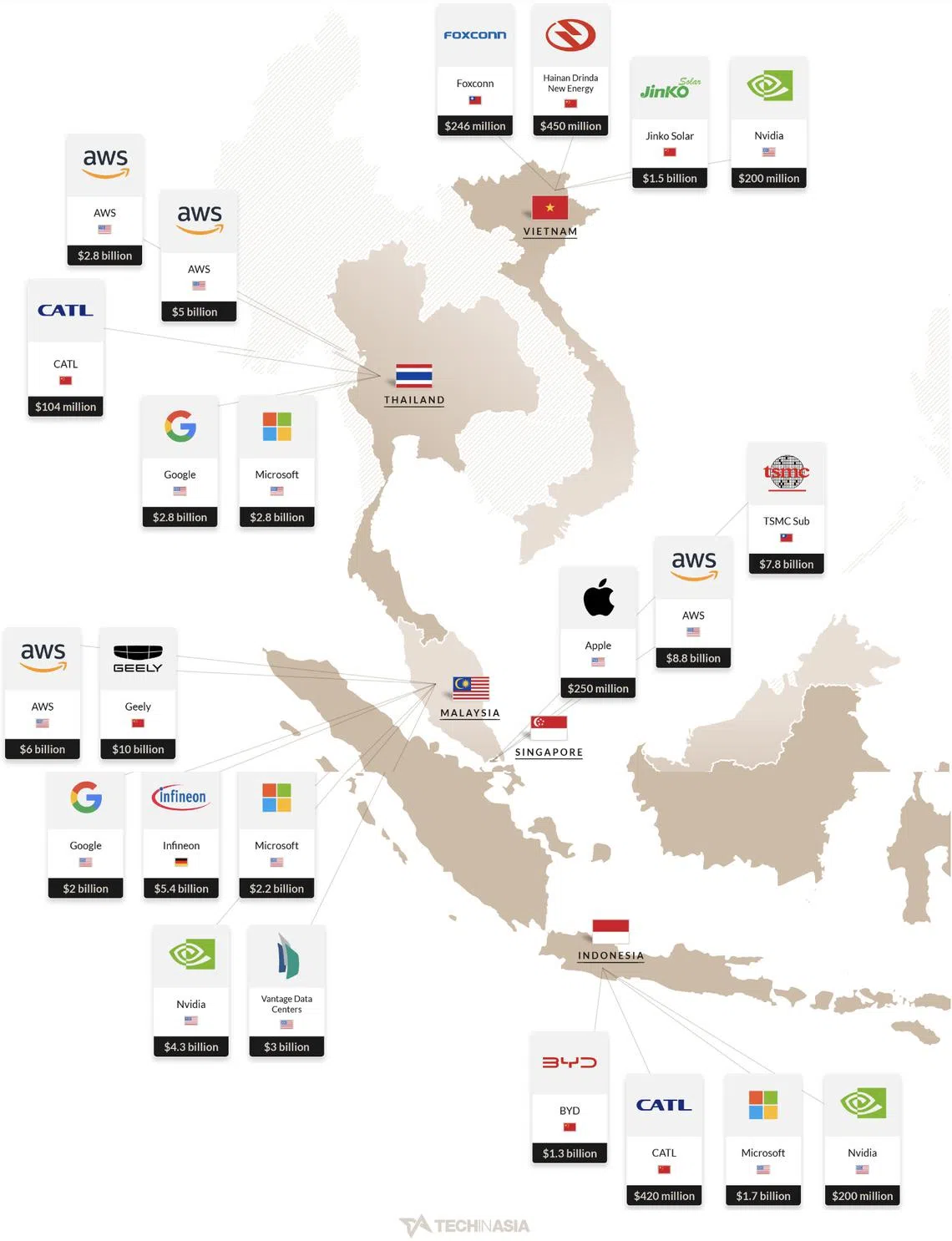
From artificial intelligence (AI) chip factories to data centres and electric vehicle (EV) plants, some of the world’s biggest tech firms have agreed to a flurry of investments in South-east Asia in the last year and a half. The region’s tech talent, abundant natural resources for industries such as EVs, and growing consumer markets all appear to have played a role in drawing this attention.
While a non-exhaustive list, a Tech in Asia analysis of various media reports reveals that since the start of 2023, global tech majors have committed to investing US$69.3 billion in Malaysia, Singapore, Indonesia, Thailand, and Vietnam.
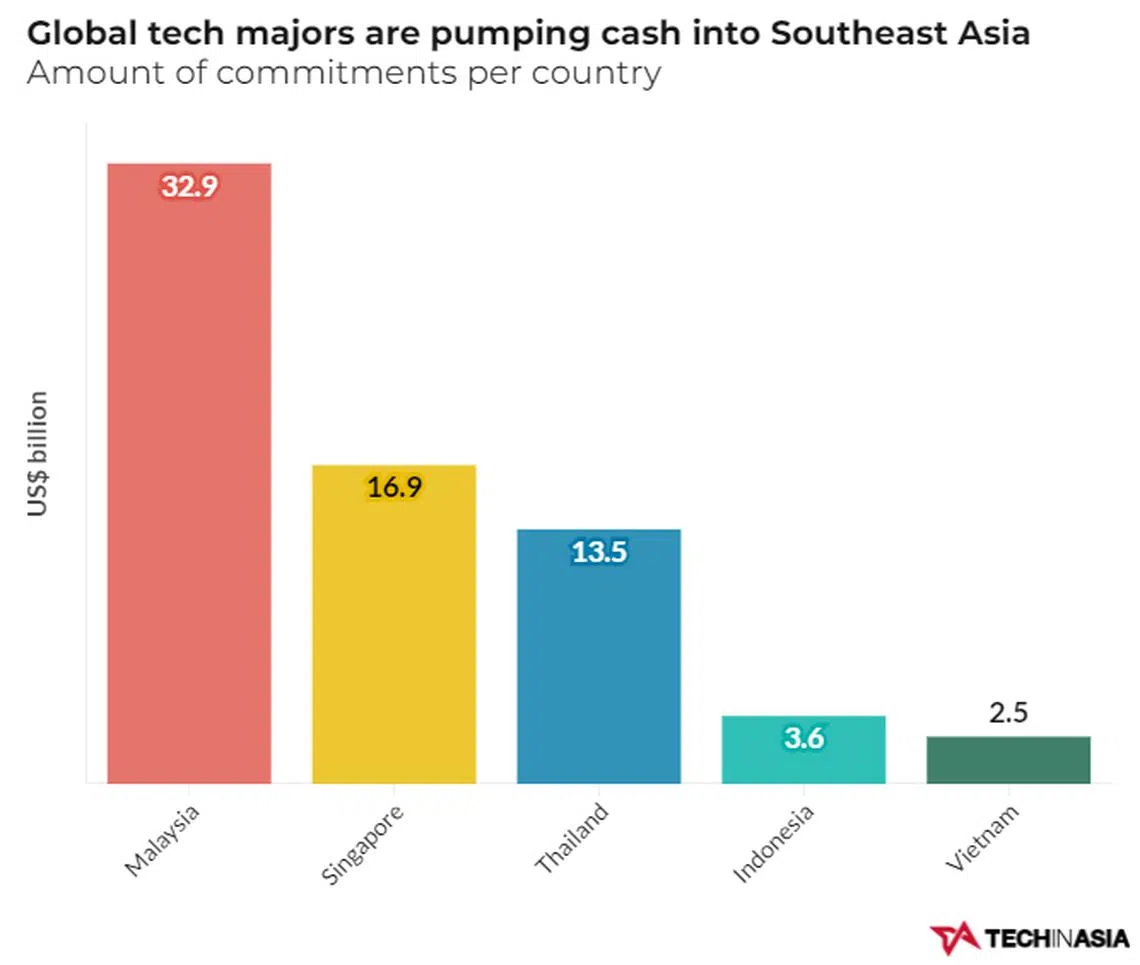
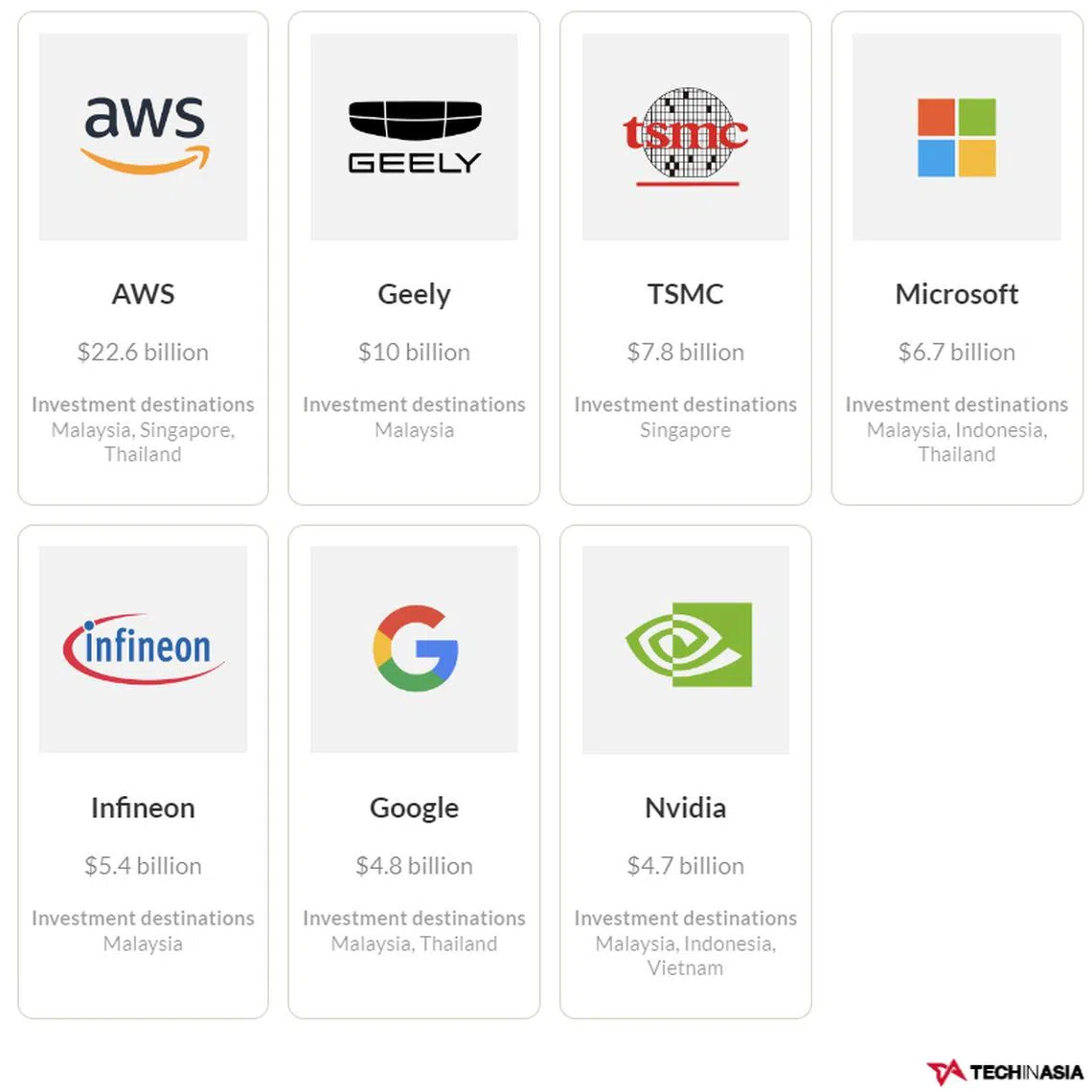
Malaysia alone has received commitments of at least US$32.9 billion. That includes US$10 billion for an auto-making hub from Chinese EV maker Geely, US$4.3 billion for a joint project between local conglomerate YTL Power and Nvidia for AI development, and US$2 billion from Google for a data centre and the development of a “cloud region”.
Singapore has also received commitments totalling US$16.9 billion, which includes US$7.8 billion for a chip factory from Netherlands-based NXP Semiconductors and Vanguard International Semiconductor Corporation, a subsidiary of Taiwan Semiconductor Manufacturing Company.
By the numbers
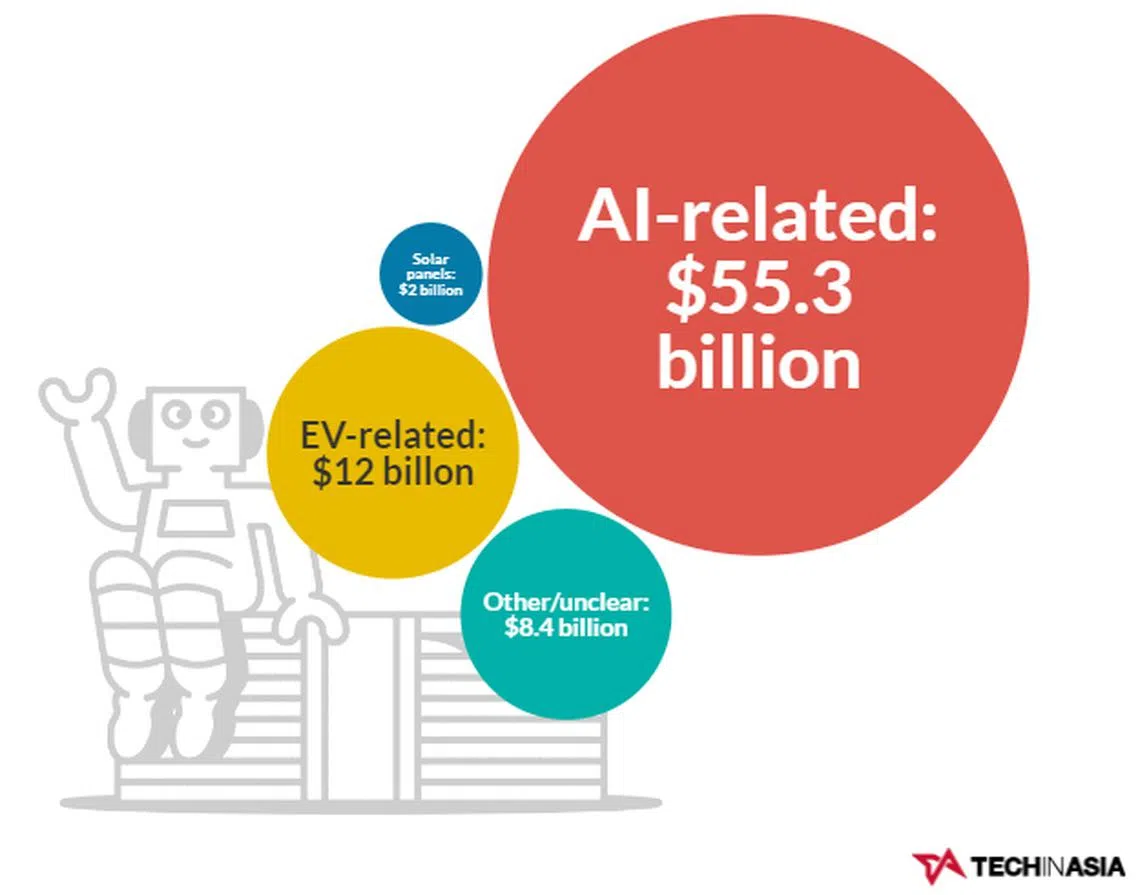
Unsurprisingly, investments related to AI have made up the lion’s share of commitments from global tech majors over the past 18 months. If investments into data centres, cloud tech, and AI chip manufacturing are counted in one bucket, the total amounts to US$55.3 billion.
The region’s AI market size has been tipped to be worth more than US$30 billion by 2030, surging from US$6.7 billion this year. No wonder global players are trying to lay the foundations to grab a slice of that pie.
AI projects have received the lion’s share of investments from big tech
In terms of which companies have made the most commitments, Amazon Web Services has agreed to stump up a hefty US$22.6 billion, including US$6 billion for cloud infrastructure in Malaysia.
Global tech majors have committed big bucks to SEA
All that glitters isn’t gold
It is important to note, however, that these deals are commitments rather than concrete investments. Some were signed as memorandums of understanding, which don’t always translate into deals.
Of course, there are cases of large multinationals following through on their investment plans in the region, such as Meta’s data centre in Singapore. But there are also plenty of examples of announced investments falling through.
For instance, electronics manufacturer Foxconn scrapped plans for a US$1 billion investment in Indonesia in 2015 due to land issues. Just last year, chipmaker Intel reportedly shelved plans to expand in Vietnam amid concerns over excessive bureaucracy and the country’s unstable power supply.
A country’s internal issues aside, sometimes larger macroeconomic forces can put a spanner in the works.
In March of this year, Reuters reported that Chinese EV giant BYD had decided to slow its plans to expand in Vietnam, with the slump in the global EV market seemingly to blame.
Time will tell how many of the promises that big tech made in the last 18 months materialise, and how many aren’t worth the paper they were written on. TECH IN ASIA
TRENDING NOW
OCBC Q3 profit rises 3% to S$2.04 billion, slightly above expectations

Stocks to watch: OCBC, IHH Healthcare, FLCT, SingPost, Koh Brothers Eco Engineering

From legacy to launch: Francis Yeoh and Yeoh Pei Xien on family unity and YTL’s next‑gen ventures

Wealthy Indonesians snap up government bonds as yields near 8%: OCBC

