

Thinking inside the Big Box
A long-term focus has seen Courts grow from a pure furniture store to a regional retailer and electronics vendor, reports KENNETH LIM
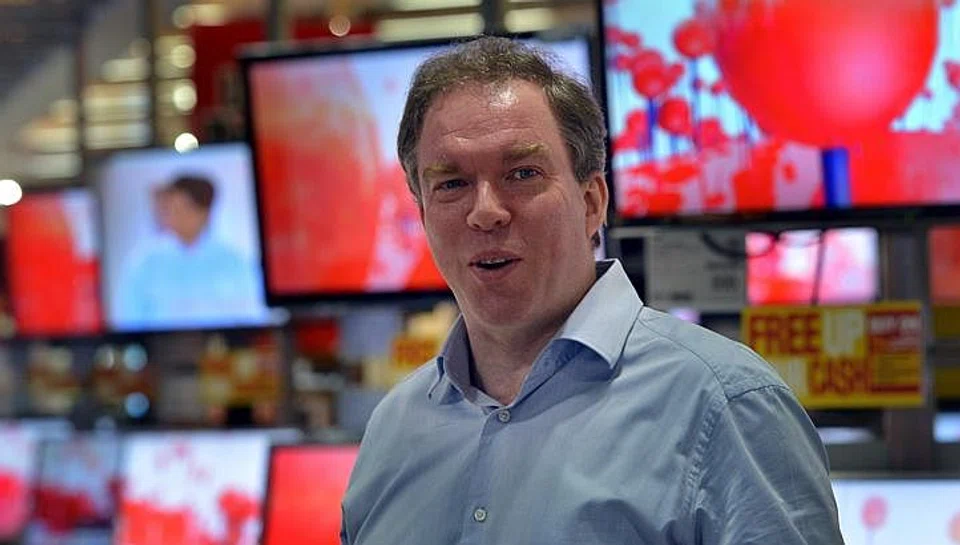
IN the fast moving world of retail, Courts Asia chief executive Terry O'Connor has learnt to keep an even keel through the good times and the bad.
For him, guiding the company through business cycles means never losing sight of the long term, learning to move on from failures and being part of the community. Those are guideposts that have helped Mr O'Connor to grow Courts from a pure furniture store into a regional retailer that is also one of Singapore's largest electronics sellers.
"It's very much about building a solid and sustainable business that unashamedly serves the widest possible audience," Mr O'Connor said.
Courts has not had the best of years. The company's fiscal year-to-date net profit for the nine months ended December 2013 fell 28.8 per cent to $20.5 million, with a dismal second quarter largely to blame. Earnings tumbled 55 per cent to $7.2 million in the July-to-September quarter as Malaysian sales slipped and a shift in business mix towards lower-margin electronics hit the bottom line.
But there were bright spots in those numbers. Despite a weak second quarter, Courts actually grew its profits in the first and third quarters. Revenues have also continued to increase despite volatility on the bottom line, with nine-month sales up 3 per cent at $623.3 million.
The second-quarter numbers "weren't great at all, and we're never happy to have a profit decline", Mr O'Connor said after the second-quarter results. "But having been here for 20 years, you do get good quarters and bad quarters so you learn to be pretty sanguine about it and get on with what needs to be done."
What needs to be done in such challenging times?
Manage risk, for one thing. Mr O'Connor noted that part of the second-quarter decline was self-created, as Courts tightened up its credit policy, raising the barriers for which stores could give customers credit.
"In both Singapore and Malaysia, we've also had some self-inflicted pain which is really taking a prudent view of our consumer finance business, our instalment packages, and making sure that we don't either over-extend our customer or over-extend ourselves," Mr O'Connor said.
That tightening hit business, but from where Mr O'Connor sat, it was an appropriate move that reflected a weakening in the Malaysian market at the time. Delinquency rates of more than 180 days has been kept consistent at about 7.6 per cent in Malaysia, while allowance for impairment loss on trade receivables was lower at 5 per cent of total trade receivables as at December 2013, compared with 5.7 per cent in 2012.
"In Malaysia, the market's distinctly tougher," Mr O'Connor said. "Election sweeteners from the prior year were obviously not in place this year (2013). Fuel subsidies were removed or partially removed. Add to that just generally higher cost of living for our customers."
Mr O'Connor added: "When we front it up to institutional investors around Q2 results, it was really trying to say to them, look, you're not going to be happy with the results, and neither are we, but if you're going to see a profit decline, see a profit decline for the right reasons, in terms of protecting the quality of the book and understand that those customers are still there to be sold to."
Doing the right thing also means staying the course on certain decisions.
One of those is expansion in Malaysia, where Courts has just opened its second megastore in Subang despite concerns about the outlook for retail in the country.
Courts is not scaling back, "but we're not accelerating either", Mr O'Connor said of his Malaysia strategy. "We're just continuing to focus on our plan . . . We're not taking any big risks around the credit space, we're not taking any big punts in terms of unknown quantities or categories, but in terms of opening stores that we feel very strongly about, we'll continue to execute."
The megastore, also known as the "Big Box" in Courts terms, is a key component of Mr O'Connor's plan for Courts.
The first Courts megastore opened in Singapore in 2006, and the company has opened two in Malaysia over the past year. The Sri Damansara store, at 108,000 square feet, is the largest store of its kind in Malaysia.
Importantly, Courts expects to open its first megastore in Bekasi in Indonesia by the end of 2014.
It is Indonesia's still nascent and potentially fast-growing consumer market that has Mr O'Connor most excited about that market.
"Obviously there are concerns about currency, concerns about slightly slower pace of growth; but for most of our categories, that's going to mean they're not going to grow at 20 per cent per year, they're going to grow at 12 per cent," he said.
The megastore will be Courts' second attempt at breaking into the Indonesian market, and Mr O'Connor believed that this time will be different.
Courts' first foray into Indonesia around the turn of the century did not end well, but Mr O'Connor saw it as a lesson to build from.
"The core thing is lower operating costs," Mr O'Connor said. "The big box space gives you opportunity to be more competitive. Placing large stores out in massive conurbations of customers clearly make it easy for people to get to. Having free parking as opposed to expensive internal parking is a huge differentiator. Having a place where the kids can stay and be looked after while people shop in comfort. Clustering with the hypermarkets and food shops is related. I could go on . . . it's certainly, we think, a game changer."
Amid all the operational duties of being a chief executive, Mr O'Connor also makes an effort to be involved with community efforts. In fact, Mr O'Connor is one of the more visible corporate leaders in terms of being directly involved in charity efforts. For example, in November, he hosted an 80s-themed party that raised $290,000 for the Heartware Network and We Care Community Services.
Mr O'Connor said that community service was a family tradition back in the United Kingdom.
"I don't see it as a chore," he said. "I think it's something that our people get excited about getting involved in, and gives them maybe a greater purpose about coming in to work. It helps us make friends in the community . . . it's just part of our DNA. It's part of what we do."
Taking a holistic view of the business is the key to riding out short-term bumps.
"The business is going to keep reinventing itself, and people in the business have got to keep reinventing themselves as well," Mr O'Connor said.
TRENDING NOW

Simba admits to unauthorised spectrum use; director Richard Tan to resign

‘If there’s a price to be paid, so be it’: George Yeo says Singapore must safeguard its reputation

Beyond the greenback, Vietnam’s big borrowers turn to Asian-currency bonds

Could the proposed COE changes mean higher premiums for all car buyers?

