‘Three months to decide, three years to list’: Singapore noodlemaker Leong Guan eyes growth after IPO
The company is aiming for new acquisitions and export markets among its post-listing goals

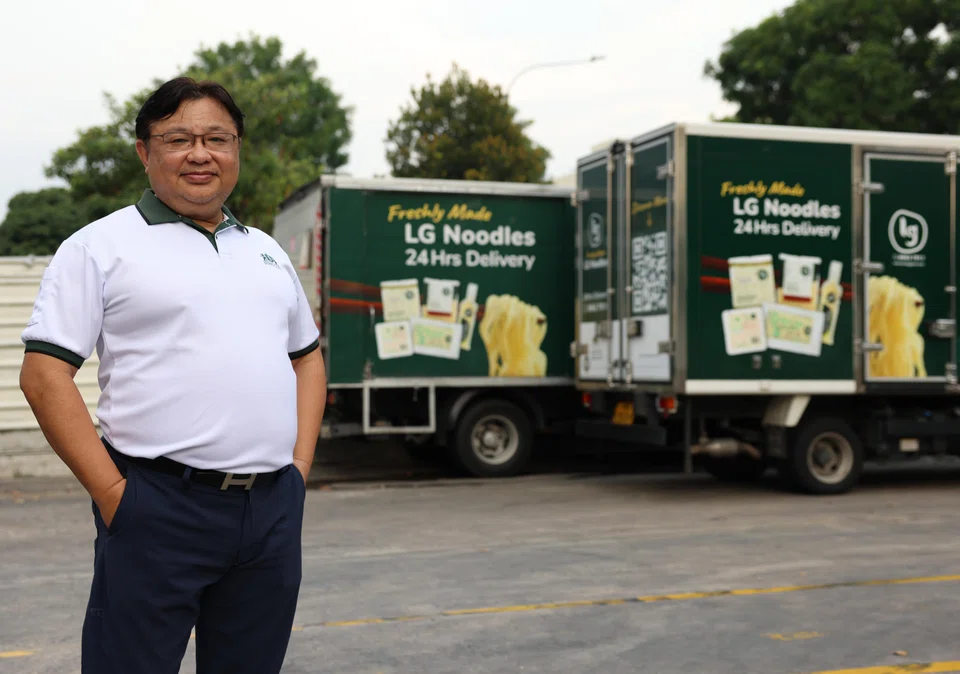
[SINGAPORE] When Lim Tze Chiang first considered the possibility of taking Leong Guan public in 2022, he had not fully imagined the long road that lay ahead for the local noodlemaker before its initial public offering.
“The decision to list took about three months,” said Lim. “But the listing process itself took roughly three years.”
With more than two decades since its founding and incomplete historical records, finding the relevant documentation proved challenging for the company.
The company had been told by a consultant to expect a nine month-long preparation process, but information had to be collected about more than two thousand customers and numerous procedures previously left undocumented.
“We just bit our teeth and went on,” he said.
Three years later, Lim, chairman and executive director of Leong Guan, told The Business Times that the company’s listing in December 2025 had been well worth the trouble.
More than a fundraising exercise, Leong Guan sees its IPO as a springboard for acquisitions, export growth and greater industry influence within Singapore’s food manufacturing sector.
The listing also came amid improving sentiment towards Singapore equities following the launch of the Monetary Authority of Singapore’s Equity Market Development Programme earlier that year.
The company was among the final IPOs on the Singapore Exchange (SGX) in 2025, raising about S$4.75 million in a fully subscribed placement on the SGX Catalist board.
It currently has a market capitalisation of about S$21.8 million. In its first financial results since the listing, Leong Guan reported a net profit of S$497,800 for FY2025 in February – down 71 per cent from the previous year on higher strategic investments and listing-related expenses. Meanwhile, the company’s revenue increased 6.6 per cent to reach S$40 million for the year.
Building blocks
Producing food products from fresh yellow noodles to wanton skins and tofu products, Leong Guan has spent the last two decades supplying Singapore’s supermarkets and hawker stalls with food products. Lim estimates that about one in five noodle stalls in Singapore cook their dishes using Leong Guan’s ingredients.
“In terms of volume and customer base, I don’t think anyone can rival us locally,” he said. The company regularly serves about 2,000 customers, manufacturing about 30 tonnes of fresh noodle products and six tonnes of soy bean-based beancurd products per day – which Lim believes accounts for up to 280,000 meals every day.
But this market share has taken time to build, Lim told BT. Leong Guan got its start in 2003 trading and distributing food items exclusively, then turning manufacturer in 2006 with a noodle production business.
Several years on, the company added beancurd items – such as tau kwa, egg tofu and silken tofu – into its product range, through the acquisition of a beancurd producer in 2012.
The company expects its local production capabilities to increase even further following its listing, Lim said. Funds raised during the company’s listing would be split between new acquisitions, expansion of facilities including machinery, product development and export-related expenses, noted Lim.
Acquiring legacy businesses in the industry is becoming a key part of the company’s strategy, Lim told BT, noting that they are presently in talks with a number of potential targets following a recent 2021 acquisition of a fellow noodlemaker, Five Food Path.
“We are looking for businesses that can create synergies with us, particularly within the food and beverage sector,” said Lim. “Ideally, they would be in similar product categories like noodles.”
“By consolidating operations through acquisitions, we can optimise our manufacturing capacity,” he noted.
Rising costs
The recent Middle East crisis forced food production costs to surge just three months following their admission to the public market.
As one of the leading industry players, Leong Guan had the market share – and the newfound stature of a listed firm – to protect the industry’s livelihood through introducing a fuel surcharge.
As crude oil prices skyrocketed, so did costs for production and transportation, Lim revealed.
“Our boiler and our fleet of vehicles use roughly 80,000 litres of oil a month,” he said.
Furthermore, raw materials such as flour have raised prices, while standing contracts with clients could require renegotiations as cost pressures spike across the F&B industry.
“It’s costing the company upwards of six figures a month and eating into our profits,” Lim lamented.
After speaking with several industry counterparts and the Singapore Noodle Manufacturers Association, Lim recognised that the thin margins within the staple food business had little room to bear the costs of higher production costs.
“We felt we should do something and lead rather than just waiting,” said Lim. The company decided to implement a fuel surcharge to its products to partially subsidise the increased cost of manufacturing its food items, allowing smaller manufacturers to follow suit.
“There are many things we have to do differently following our listing, because of strict regulatory guidelines,” he acknowledged. “But at the same time, we’re given the opportunity to lead in our industry.”
“When I meet other businesspeople, what I say carries more weight – people listen more and believe more. That credibility that comes with being listed is important,” he added.
Moving overseas
With Leong Guan having a bigger voice in the local industry, it has also helped the company in its international ambitions.
It has been attending international trade shows for several years now with the hope of finding new customers to expand its export market overseas. These events include Thaifex Anuga Asia in Thailand and Gulfood in Dubai.
Currently, Leong Guan’s export market accounts for about 5 per cent of revenue. It exports a majority of its products to Asia, but also has a presence in Australia, Europe and North American markets.
The noodlemaker reached its first export market in Australia in 2018, before expanding into Asia, Europe and North American markets.
“Wherever there are Asians, there are noodles to sell,” said Lim. That is, apart from Asia itself, he admitted.
Within the region, competition from local food producers has proven challenging, with noodles common as a staple within regional diets.
Conversely, Leong Guan’s products have received surprising attention from distributors in places like the Middle East and Europe.
Still, expanding across geographical boundaries comes with shifting tastes and challenged assumptions, as products the company expected to sell in different regions turned out contrary to expectations.
“For example, we came to realise that our popular yellow noodles are no longer the most in demand from foreigners, because they are not used to the strong alkaline taste,” explained Lim. Instead, it has been other products like their kway teow rice noodles that have received surprising attention.
“Now, we go out with an open mind – whatever products we have, we bring along,” he said.
In recent years, its product range has expanded considerably from its humble beginnings as a food distributor. Now, the noodlemaker offers items ranging from wholegrain noodles and ready-to-eat meals to Seoul-imported kimchi.
But the chairman of the newly listed firm makes it clear that its leaders are not stopping here. In the long term, he sees Leong Guan as one of a handful of companies that can make the transition from SGX’s Catalist to the bourse’s mainboard.
“This listing is not an exit for the founders,” he said. “It’s the beginning of a new chapter for the company, and we have to grow the topline so that everybody knows we are a growth company.”