

Tiger Brokers Singapore bucks price-cutting trend among digital brokerages
It charges higher fees than some competitors, but still managed to add new accounts for the seventh straight quarter, hitting a new peak

[SINGAPORE] In the cutthroat world of digital brokerages, firms often compete on the basis of price, with some even offering zero commission rates.
But Tiger Brokers Singapore has bucked the trend by maintaining price discipline, charging commission fees of US$0.99 an order or US$0.005 a share, while its competitors are often charging less or even zero.
Nasdaq-listed UP Fintech, Tiger’s parent company, saw its strong performance continue despite implementing higher fees, based on its financial numbers for the third-quarter ended Sep 30.
The company’s earnings nearly tripled from the year-ago period, reaching US$57 million. The number of funded accounts globally grew 18.5 per cent, to reach 1.22 million.
Tiger’s stellar global results were mirrored by its performance in Singapore.
The number of accounts opened in the republic grew for the seventh consecutive quarter, while trading orders rose 54 per cent to a new peak, Tiger said.
Average net inflow for newly funded customers in Singapore reached US$62,000, approximately twice the global average of US$32,000.
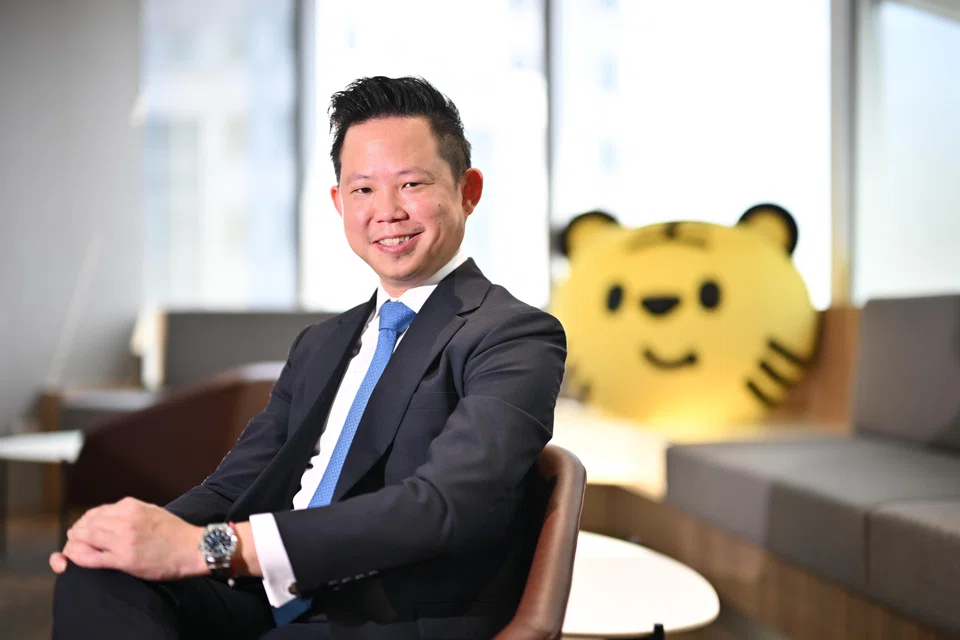
Ian Leong, chief executive of Tiger Brokers Singapore, is a firm believer in sustainable growth and argues that results can be achieved without drastic price competition.
“Assuming, in a hypothetical environment, every (brokerage) goes to zero commissions. What’s next?” questioned Leong in an exclusive interview with The Business Times.
To differentiate itself from the competition, the answer, he argued, is service.
Leong is no stranger to Singapore’s financial services industry.
He entered it in 2010 as an equity dealer in Phillip Securities, where he eventually climbed the rungs to become head of dealing.
He later moved to Lim & Tan Securities, where he was head of client services and trading representatives, before joining Tiger as the head of business development for a year and a half. Between 2021 and 2023, he was CEO of uSmart, another online brokerage.
In 2023, he rejoined Tiger as its Singapore CEO.
When he took on this role, he knew there would be challenges.
In particular, there were four areas that needed improvement: platform, product, processes and people.
“Getting the basics right is essential to success because houses built on shifting sands will not last,” he said.
But before Tiger could develop the best platform, products and processes, it first had to have the “best talent and people”, Leong said.
This is why when planning an increase in headcount, he focused on the frontline team, those in business development and marketing roles. This meant getting a better reach to retail investors.
Under his leadership, Tiger more than doubled its headcount from 46 in 2023 to 110 in 2025.
But Leong does not see talent as a “zero-sum game” in the industry. Instead, he believes in “growing the pie”.
Competing over a fixed base of talents is not beneficial to the investment industry as a whole, he said. It is why Tiger launched its own remisier training programme, Tiger Leap, in February this year.
Partnering the Monetary Authority of Singapore and International Banking Federation, Tiger curated a six-month training curriculum for fresh grads and early-career switchers.
Remisiers are licensed trading representatives that can advise clients and also buy and sell stocks on behalf of their clients. There are around 2,000 remisiers and dealers in Singapore.
Market observers noted that the new programme was one way of rejuvenating the remisier community, now largely dominated by the middle-aged.
To improve the vibrancy of the investment scene, Leong seeks to hire from backgrounds other than finance to join the programme.
Tiger’s first cohort had about 25 new hires from diverse backgrounds such as Stem (science, technology, engineering and mathematics), finance and the humanities.
Narrowing the gap with traditional incumbents
Tiger’s headcount growth reflects a wider trend of an increasing proportion of Singapore investors switching to digital, or “challenger”, brokerages which include the likes of Moomoo and Webull.
As many as 40 per cent of online investors now use such brokerages to invest, based on research firm Investment Trend’s 2025 Singapore Online Investing Report released in November.
Although still lower than the 45 per cent of investors still with established domestic brokers, such as DBS Vickers and UOB Kay Hian, the report stated that the newer entrants have been gaining ground.
“This growth is structurally driven by improved accessibility, with small-ticket investing and commission-free trading opening the market to both new and returning investors,” Investment Trend noted.
But under Leong, Tiger Brokers is not resting on its laurels. In fact, it aims to continue expanding, by using artificial intelligence (AI) to enhance its offerings.
The brokerage said its AI solution, TigerAI, is the “industry’s first AI-powered research assistant”. The tool provides single-stock insight and trading summaries for timely decision making.
The third quarter had other good news. TigerAI’s user base increased nearly 400 per cent from the year-ago period, with total conversations rising 900 per cent.
Leong noted that AI is also being deployed to support back-end functions, such as withdrawal requests and currency conversions.
This enables remisiers to spend less time working on administrative tasks and more on building relationships with their customers.
“We use AI when it comes to our normal day-to-day (workflow) to complement the staff, not to replace them,” he said.
Revitalisation of SGX a boon for Tiger
Apart from AI, Tiger has also benefited from the recent revitalisation of the Singapore Exchange (SGX).
Leong said that around one in three of active local investors on the platform invest in SGX-listed stocks.
For the third quarter of 2025, the brokerage reported that within Singapore, trading of Singapore stocks rose 74 per cent, compared with the year-ago period.
Local blue-chip stocks also had renewed activity that contributed to the increased trading of SGX-listed stocks. In particular, trading volumes of the three local banking stocks – DBS, OCBC and UOB – rose 86 per cent year on year.
The rise in trading value of local stocks reflects the vibrancy brought about by SGX’s revitalisation efforts and improving market depth, Leong said.
It also indicates investors’ “growing appetite” for stability and dividend resilience amid a more uncertain global backdrop, he added.
Tiger intends to double down on its approach to improve on its services, such as continuing to expand its AI offerings, as well as developing the next generation of remisiers.
Leong said Tiger’s future plan boils down to this: “How do we make the local investment scene more vibrant?”
TRENDING NOW

ComfortDelGro appoints two new independent directors

Once staunchly pro-China, Malaysian Chinese businesses are now distancing themselves from Beijing

NoonTalk needs continued financial support from CEO Dasmond Koh, auditors warn

DP Architects sets the benchmark for sustainability disclosure and design

