Timing it just right
Wee Tiong director Tan Wee Beng explains how a pinch of luck, a bit of daring, and a lot of hard work have helped to transform the firm's business.

Mindy Tan
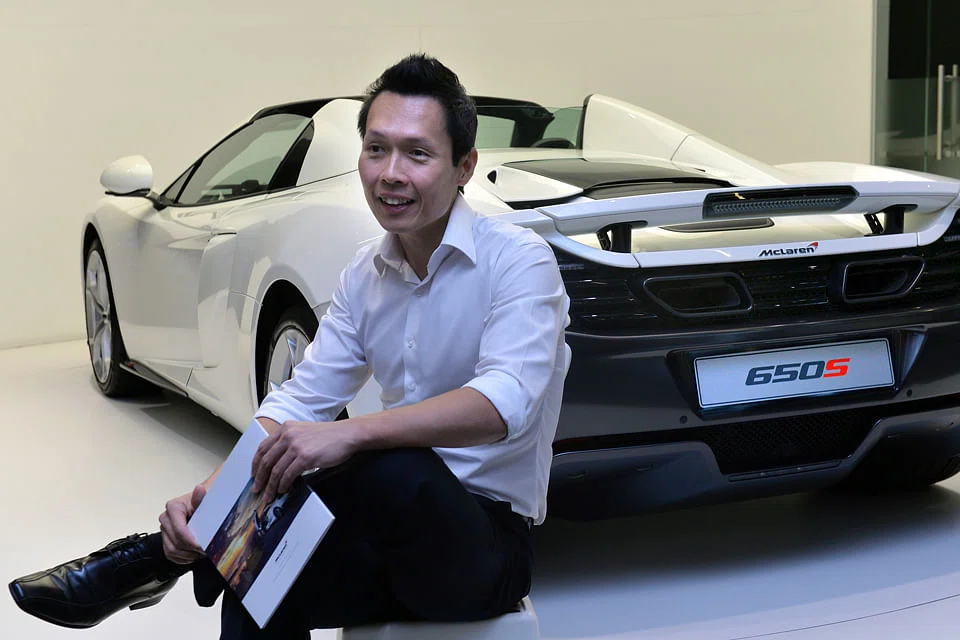
WEE Tiong's director Tan Wee Beng is, to borrow the words of Winston Churchill, a riddle wrapped in a mystery inside an enigma.
The man who loves fast cars - he is eagerly anticipating the arrival of his McLaren 650S - is quick to say that he does not speed on the highways. He is a trader who deals with millions, and yet is a careful investor. He is also the man who walked out of school with an engineering degree, went into the family business which was then a local rice and sugar importer and wholesaler, and turned it into one of the leading physical commodities trading companies in the region.
"I was very lucky to be in the right place at the right time," said Mr Tan. "I joined in 2002, and that's when the market started to shift from normal trading - when there wasn't much interest in commodities trading - to the boom which really started in 2004, 2005 ... I think luck is very important."
A pinch of luck, a bit of daring, and a lot of hard work are the factors that have arguably transformed the business, which at this year's Enterprise 50 Awards, netted its tenth consecutive E50 award. This is the first time a company has been awarded the 10 Year Award in the history of the E50 Awards.
PROFITABLE MANTRA
The turning point for Wee Tiong was the day it realised that being the middle man is a difficult position to maintain, especially when there is no value-added service. It thus went on to form a team of traders to conduct research into worldwide supply and demand. Armed with the latest financial instruments and trading platforms, the trading team was able to provide advice as well as timely information on global demand and supply to clients.
Notably, speculative futures positions take up less than 5 per cent of Wee Tiong's total "paper" futures. "(After all these years), I've learnt not to play so big. If you want, you can, but play within your means. At least, when the market is against you, you have enough to pay," explained Mr Tan. "Of course, I don't engage in those very risky ... Okay, we do," he admitted, with a laugh. "But only once in awhile," he was quick to qualify. "When the market is handing the money to you not on a silver platter but a gold platter, of course we do. But," he stressed, "(we only take deals that are) within our comfort zone."
It is a mantra that has proven profitable for the company. Wee Tiong's yearly turnover for the past 10 years has averaged from S$150 million to S$300 million. In 2012, it achieved US$334 million in sales turnover, with a profit of around US$9 million.
EXPANSION NOT ALWAYS THE KEY
The other key lesson he has gleaned in the past 10 years, is that expansion is not always the key to success, said Mr Tan. "It's not just about expanding and getting more business. I think sometimes, when the market is not good, you really have to learn to hold your horses and just wait for the right opportunity."
Wee Tiong has been looking to open a sugar refinery in Indonesia for a while now. The project is finally expected to be ready in 2015. "We had our own plans (too), but it's lucky it didn't go through because prices came crashing down," noted Mr Tan.
Trade houses were aggressively purchasing assets to move upstream (through the purchase of millers, for example) or downstream (through the purchase of refineries) between 2007 and last year. Some of them bought producing factories, mostly in Brazil, India, or Thailand, or through collaboration in Indonesia and the Philippines to build refineries, as sugar prices hit record highs. Sugar prices have since fallen amid oversupply, however.
"If let's say we had the licence from January, you cannot say I anticipate prices will drop to US$400 in the month of November. That would be pure speculation. And the loss is huge! We're not talking about 10 tonnes, it's about 2,000 to 3,000 tonnes. There's a lot of money at stake. And the worst part is, the rupiah has come down against the US dollar. So you buy in USD, and you store in rupiah ... I wasn't very active in expansion (previously), which is a good thing. Sometimes, expansion isn't always good. I escaped this whole bloodbath."
With the facilities due to open in 2015, Mr Tan was optimistic that things will pick up. "It's a very good time to enter right now. The best time. We had a lot of problems in the beginning, like getting the land and getting the licences from the government. Now is a good time to push because those who have suffered will be getting out of the market. And price-wise, where the rupiah is right now, it is the best time to go in.
"Our cash contribution might not be as significant but our role is crucial to the cooperation as we understand the mechanics of physical commodities trading, especially the financial instruments like hedging, options. In this way, we control the portion in procuring the raw sugar which will generate healthy sales turnover for us. The goal in the long run is to solidify our position to compete with the trading houses and expand our reach to other countries," he added.
Looking ahead, an initial public offering is not something Wee Tiong is looking at in the near future since "right now, I don't really need the cash", said Mr Tan.
"The first refinery, we are really embarking on it right now, and probably can commission it by next year. In a couple of years, if we can get the second one, then maybe I will think about it. But right now, we are really very comfortable," he concluded.
TRENDING NOW
He built the Vingroup empire. Now South-east Asia’s richest man is handing some key roles to his sons
Chagee, Mixue and Luckin won the market. Sustaining their edge is the harder part
From Haidilao to Oriental Kopi: How some of Asia’s favourite F&B players are faring in 2026
CPIB hauls Multi-Chem CEO, COO in for questioning; stock hits ‘circuit breaker’