

Top Glove says it's 'near' to best practices
It has 'resolved 6 of 11' International Labour Organisation forced labour indicators identified by US agency

Singapore
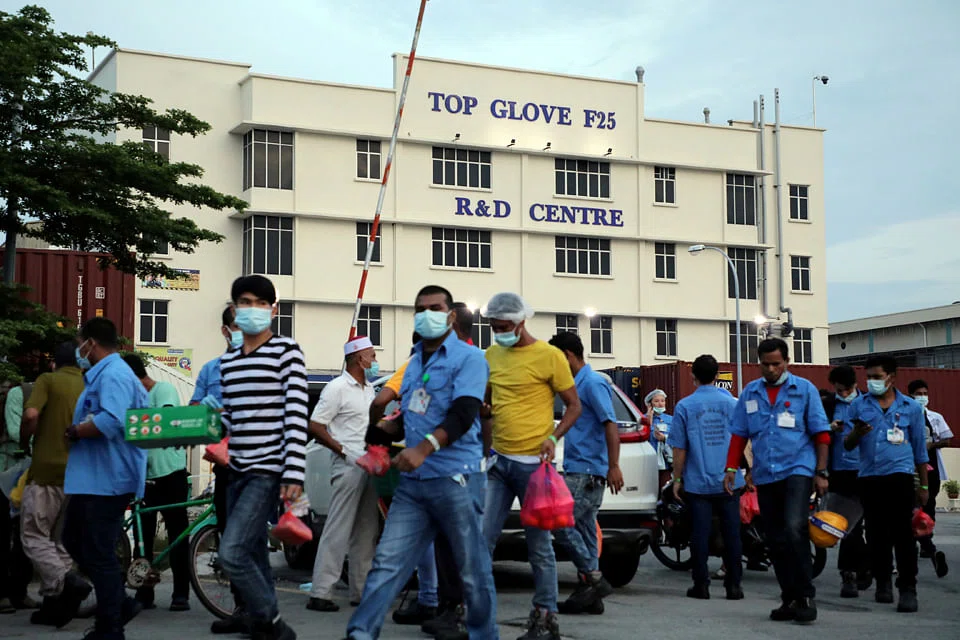
AFTER a spate of labour issues including poor accommodation and forced labour led to a ban on its gloves in the United States, Top Glove said it is now "coming near the best practices in the industry" after significant improvements.
In a briefing on Thursday to provide updates on the glove market, ongoing improvements to its workers' accommodation and engagement with the US Customs and Border Protection (CBP), the glove manufacturer's top management said the company has made "significant improvements" since August 2020 on the 11 forced labour indicators from the International Labour Organisation (ILO) that were identified by the CBP.
Six of the 11 indicators were fully resolved as at March this year, while the remaining five indicators are works in progress. These five indicators are: the retention of identity documents, deception, debt bondage, physical and sexual violence, and intimidation.
"As an industry leader, we are mindful that we are also in the spotlight and held to the highest standards. We know more is expected of us," said Top Glove's managing director Lee Kim Meow.
Mr Lee reiterated that no new issues had been raised with regard to the CBP's latest findings on March 29, but some "rectification and verification works" are still required on the earlier forced labour findings.
He added that Top Glove now has a "high-level leadership team" that tracks the progress of resolving the remaining issues regularly, and is working expeditiously towards lifting the Withhold Release Order (WRO) that CBP issued against the company in July 2020.
The company is currently at the second stage of the four-step WRO modification or revocation process, and is continuing to engage the CBP and make improvements to its processes, said executive chairman Lim Wee Chai.
The CBP will next determine if the indicators have been successfully remediated, and then either modify or revoke the WRO.
Top Glove has to move fast to get the ban lifted. The company is currently unable to ascertain the exact financial or operational impact of the ban, but a "certain percentage" of production at its Malaysian factories has already been affected. Top Glove's factories in Vietnam and China can, however, still ship gloves to the US.
Dr Lim added that the average selling price (ASP) of gloves has been "coming down" as Top Glove's customers are now rebalancing their glove inventory portfolios in tandem with an increase in glove supply. Demand, however, is still strong as the world continues to battle the Covid-19 pandemic.
Separately, independent migrant worker rights activist Andy Hall called on the CBP to justify its approach to Top Glove. Other glove makers in Malaysia also have "appalling conditions" in place but have not been victims of such bans.
Mr Hall had spoken in the same briefing held by Top Glove, and is collaborating with the company on a voluntary basis to help it improve its processes.
Such conditions, he said, include employees having to work seven days a week or not having been allowed out of their compounds for more than a year. Another issues is illegal subcontracting methods used by companies.
"If the findings stay on Top Glove, then WROs should be imposed on other glove companies and other companies in Malaysia," said Mr Hall.
"We've seen so many improvements in Top Glove over the past weeks and months, that it's not viable to just focus on Top Glove. We need to move on to other companies where there are so many illegalities that are continuing."
Top Glove shares, which are dual-listed in Singapore and Malaysia, ended Thursday's trading session markedly higher. The Malaysia-listed counter added 10 per cent or RM0.49 to close at RM5.40, while the Singapore-listed counter rose 10.8 per cent or S$0.17 to end the day at S$1.75.
TRENDING NOW

Knight Frank’s Tan Tee Khoon leaves firm, Nicholas Keong takes over auction business

Keppel Energy, Sembcorp Utilities and Tuas Power to supply biomethane in pilot project

GovTech retrenches another 38 staff in second round of layoffs
Take-up of new private homes dives 45% in Q3 as prices accelerate with 1.4% rise

