Top Glove shares tank in Singapore, Malaysia amid RM130.6m Q3 loss

Uma Devi
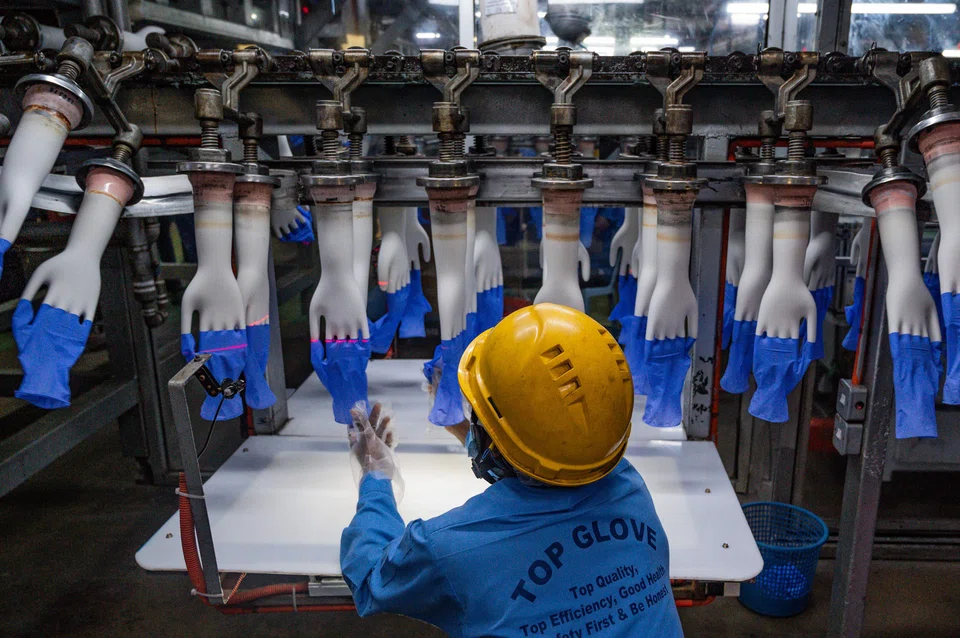
GLOVE manufacturer Top Glove Corporation on Friday (Jun 16) posted a net loss of RM130.6 million (S$37.8 million) for the third fiscal quarter ended May 31, a turnaround from its earnings of RM15.3 million in the corresponding year-ago period.
The latest quarterly loss took the company’s net loss for the nine-month period ended May 31 to RM463.5 million. In the corresponding period ended May 31, 2022, it had booked a net profit of RM288.6 million.
Shares of Top Glove, which are listed in Singapore and Malaysia, took a hit on Friday after the financial results announcement. In Singapore, the counter slipped 9.5 per cent or S$0.03 to close at S$0.285. In Malaysia, the stock lost 10.6 per cent or RM0.115 to finish the trading day at RM0.975.
During a call on Friday to discuss the company’s latest financial results, Top Glove’s managing director Lim Cheong Guan said the company is likely to post a loss for Q4.
He said the company will adopt a “step by step” process in terms of returning to profitability. It will focus on turning positive for its earnings before interest, taxes, depreciation and amortisation (Ebitda) figures, with an emphasis on cash flows.
Top Glove will also look to offset any increases in expenses with an improvement in profitability in the coming quarters, he said.
Based on the company’s cash balance and its cash burn rate, Lim said Top Glove will be able to pull through “more than one year” of losses.
Revenue for the third quarter fell 64.4 per cent year on year to RM530.6 million.
No dividend was proposed by Top Glove’s board of directors for the quarter under review.
On a quarter-on-quarter basis, the company’s loss after tax narrowed to RM120 million in Q3 FY2023, from RM155 million in Q2 FY2023. This came on the back of a 6 per cent increase in the average selling price (ASPs) of gloves.
Top Glove also attributed the quarter-on-quarter reduction to post-tax loss to its “quality and cost-optimisation initiatives to streamline operations”. It added that these measures include the decommissioning of obsolete production lines and temporary stoppage of production at 17 of its 49 factories, in light of softer global demand for gloves.
The decommissioning of production lines eased the group’s production capacity by five billion gloves, bringing its total production capacity to 95 billion gloves. The group also implemented a manpower-restructuring exercise.
Lim said Top Glove has streamlined its workforce from a peak of 23,000 to 24,000 workers to about 12,000 workers currently.
He added that the company will study the market and industry, and decide if it should further consolidate its production.
Raw material prices for the third quarter rose from the preceding quarter. Average natural latex concentrate prices were up 2 per cent to RM4.78 per kilogram; the average nitrile latex price rose by 7 per cent to US$0.92 per kilogram. Natural gas prices, on the other hand, fell 14 per cent.
Top Glove said it is mindful that being the first to increase glove prices will have an impact on its sales volume.
“However, as glove manufacturers are unable to fully absorb rising costs indefinitely, this is a necessary step for the long-term sustainability of the glove industry,” it said.
The company has also put in place a “six-point comeback strategy” to chart its path to recovery. The six pillars of the company’s turnaround plan are boosting sales volume; enhancing quality; consolidating facilities; enhancing people productivity; strengthening cashflow position; and optimising its supply chain.
Top Glove said the business environment is expected to remain challenging and competitive throughout the second half of this year. However, it said it is optimistic on its long-term prospects as gloves continue to be an essential single-use item in the healthcare and food industries.
Lim noted that while there has been an oversupply of gloves and customer stockpiling over the past two years, glove consumption itself has not decreased.
“As customers’ and manufacturers’ glove inventories are close to depletion, replenishment activity is expected to commence in the second half of the 2023 calendar year, spurring an uptick in glove demand,” he said.
Competitor companies – which are other glovemakers in China, Thailand and Malaysia – have been competing for market share.
Top Glove’s executive chairman Lim Wee Chai said the company has a market share of 20 per cent to 25 per cent in natural rubber gloves. The price gap between players in the three countries has also narrowed, he said, as glovemakers in China have raised their prices.