Top Glove’s Q4 loss widens to RM463.1 million due to impairment


Megan Cheah &
Michelle Zhu
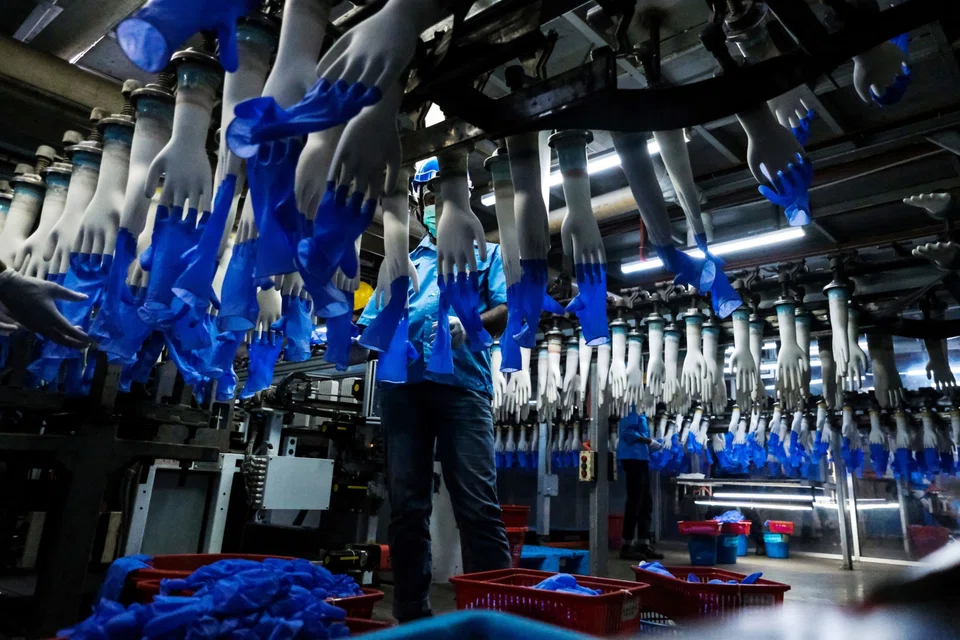
TOP Glove posted a net loss of RM463.1 million (S$134.2 million) for the fourth quarter ended Aug 31, widening from its RM63 million net loss the previous year.
The glove manufacturer was hit by lower revenue and a RM388.5 million impairment over the quarter.
This translated to a loss per share of 5.78 sen, compared with the previous year’s loss of 0.79 sen per share.
The impairment, which had no impact on the group’s cash flow, comprised a goodwill impairment of RM138 million as well as an impairment and write-off of property, plant and equipment amounting to RM251 million.
It resulted from an operational rationalisation exercise and a review of the group’s income-generating assets to strengthen its cost competitiveness, said Top Glove on Friday (Oct 6).
Revenue for the fourth quarter was 52 per cent lower year on year at RM476 million, from RM990 million in Q4 FY2022.
In an earnings call, executive chairman Lim Wee Chai said the group should return to profitability in the next six to 12 months, once the utilisation of the company’s capacity increases to about 50 per cent.
Top Glove has a manufacturing capacity of 95 billion pieces per annum with 788 production lines, but only 30 per cent is currently in use.
“Even now, at about 30 per cent (utilisation), we are already Ebitda positive,” Lim noted.
The company is positive on demand for gloves, as it believes the inventory build-up from the pandemic is very close to bottoming out, following lower glove demand over the past two years.
“We are already seeing an uptick in sales volume month to month, which indicates our customers’ glove inventory is close to being depleted. As the oversupply situation also continues to ease, we look forward to seeing global glove demand resuming its projected 8 per cent to 10 per cent growth per annum eventually, and better times ahead,” said managing director Lim Cheong Guan.
Despite this, sales volume eased 9.5 per cent in Q4 FY2023 compared to Q3, which Lim Wee Chai attributed to the group reducing production so as to not compete with Chinese manufacturers’ low prices.
“We are not willing to sell below variable costs… We concentrated on improving our costs (instead),” said the executive chairman, noting that the group has streamlined various production facilities and temporarily ceased operations in some factories.
Reducing current capacity is a temporary sacrifice for the future, he believes, cautioning against flooding the market with an oversupply of gloves.
Besides, once demand picks up, Top Glove can start up its decommissioned factories again.
But the gap between the prices of gloves made in Malaysia and those from other countries has narrowed. This means that customers are less likely to take the “calculated risk to compromise on quality”, said Lim Wee Chai.
With the price of raw materials such as nitrile and latex likely to rise, the overall prices of gloves will be pushed up as well, he added.
On a quarter-on-quarter basis, the group’s loss after tax widened to RM454 million from Q3’s RM120 million. Notwithstanding the impairment, the Q4 loss after tax would have been RM65 million.
Lim Cheong Guan noted that as conditions are likely to improve, requiring additional impairments is unlikely.
The latest quarter’s results brought Top Glove’s net loss for FY2023 to RM926.6 million, a reversal from its net profit of RM225.6 million in FY2022.
Revenue for the full year declined 59 per cent to RM2.3 billion from RM5.6 billion the previous year. FY2023 loss per share was 11.57 sen; in FY2022, the company reported earnings per share of 2.82 sen.
Top Glove is listed in Singapore and Malaysia. After its results release, the counter in Singapore fell 2.2 per cent or S$0.005 to S$0.22. In Malaysia, its shares declined 3.8 per cent or RM0.03 to end at RM0.755.