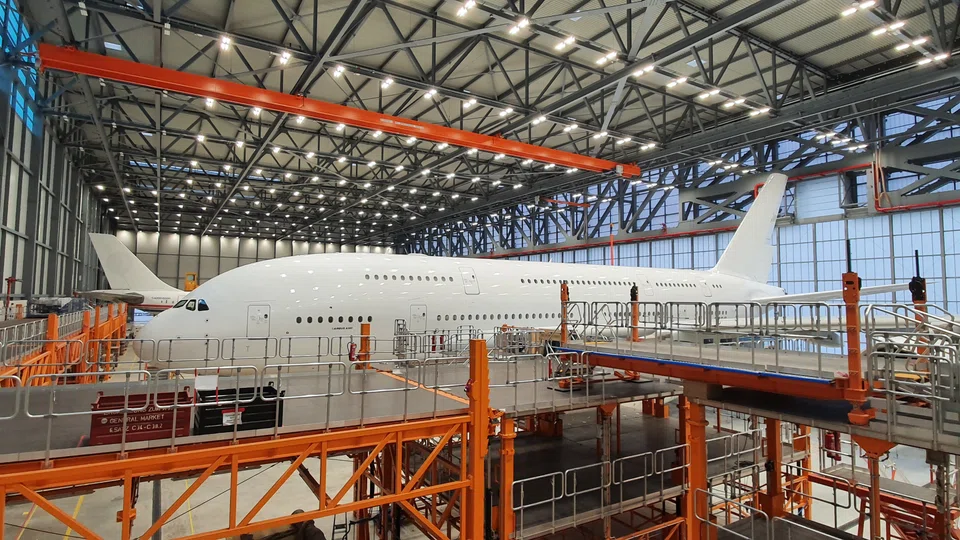
Airbus A380 finds favour with airlines amid planemakers’ delivery delays
Previously deemed surplus to needs, these super jumbos are now prized for their bigger capacity in slot-constrained airports, say consultants

CARRIERS, which had consigned their Airbus A380 jets to storage during the pandemic or even for scrapping, are re-deploying the super jumbo plane now, as a stop-gap measure against a shortage of planes amid delivery delays by planemakers.
Such a move has not only given the large aircraft a new lease of life; maintenance, repair and overhaul players are also seeing a business opportunity.
Mabel Kwan, managing director at Alton Aviation Consultancy, citing statistics from the Centre for Aviation (Capa), noted that there were 171 A380s in service, accounting for 83 per cent of the global fleet of the aircraft as at end-September.
This is higher than the 78 per cent or 164 of these aircraft in service as at end-December 2023.
Qantas Airways recently announced that two of its A380s, having undergone maintenance and cabin modifications, will fly the Sydney-Dallas route amid plans by the Australian flag carrier to raise its capacity to the US by 13 per cent.
Qantas joins its counterparts, including Etihad, which have re-deployed the super jumbo aircraft amid a delay in plane deliveries by Boeing and Airbus.
The A380 has been a favourite with the flying public, who make it their preferred aircraft if given an option.
Singapore Airlines, the first airline to fly this plane, transformed an idle A380 plane into a pop-up restaurant during the pandemic. There were no shortage of takers – even with a S$642 price tag on the meal.
During the pandemic, many airlines mothballed most of their fleets, including their A380s; some operators retired the aircraft, as they found it tough to fill the seats when demand for air travel had almost evaporated, and they were burning through cash.
The super jumbo plane was meant to revolutionise commercial aviation, but with its inefficient design and low demand during the pandemic, Airbus stopped its production at the end of 2021.
But Cirium Ascend’s global head of consultancy Rob Morris told The Business Times that now, 10 of the original 14 airlines with A380 have returned the aircraft to service.
However, some airlines will not do so, he noted: “In the cases of Air France, China Southern (Airlines), Malaysia Airlines and Thai Airways, the shape of their international passenger network has changed, such that there is no longer demand for such a large aircraft.”
Shukor Yusof, an analyst at Endau Analytics, said the A380 is a temporary measure as there is a worsening shortage of aircraft coming into the market, exacerbated by strikes at Boeing.
A fortnight ago, Boeing said that its new 777X wide-body aircraft would enter service only in 2026, amid labour strikes that have stretched into weeks. This would mean a delay of more than five years from the original timeframe, forcing customers around the world to reconsider their fleet plans.
Boeing’s delay will hurt Asian and Middle-eastern airlines’ capacity plans more than others, Bloomberg reported, given that they account for the bulk of the order book and earliest delivery slots.
These regions’ carriers hold 87 per cent of the passenger orders, with Cathay Pacific, Singapore Airlines , Air India, All Nippon Airways and Emirates among the marquee customers.
Airbus, meanwhile, is targeting 770 deliveries for this year after having reduced its goal from 800 jets in July, citing shortages of engines and other parts as the aerospace industry’s supply chain struggles to recover from the pandemic.
The figure suggests that the planemaker would have to deliver 273 aircraft in the fourth quarter to meet its target – which appears to be a stretch.
Kwan of Alton said: “In the current environment, where aircraft supply is tight and planes are delayed, increasing use of A380 deployment is a means to alleviate the situation. A380s are particularly useful in increasing the capacity in slot-constrained airports, given their seating capacity.”
An A380 offers as many as around 850 seats, but most airlines do not max out this limit.
Only a handful of airports worldwide can accommodate this jet because of its size, Yusof of Endau said. Those that can are major hubs, such as Dubai, Singapore, and London.
Kwan added: “It is thus envisaged that the re-commissioned A380s will continue to ply these trunk routes.”
Not all carriers have the luxury of having A380s at their disposal as the aircraft is a niche product, Yusof said.
Carriers that do not own the aircraft type would have to be able to pay a monthly lease of over US$1.2 million. The carriers that can afford it are mainly the larger legacy carriers, he noted, when asked whether airlines would rush to get their hands on the jumbo plane given their immediate availability and capacity.
It is a challenge to make the A380 viable when jet fuel prices are high, Yusof added. “There aren’t many airlines with existing A380s which make money operating it to begin with… Nice plane, but very poor economics.”
However, for the majority, the double-deck aircraft will be significantly depreciated; the relatively lower cost of ownership can offset the higher variable operating costs (fuel price and maintenance), to the extent that the aircraft can remain economical within the overall airline route network, Morris said.
But what is jet makers’ loss adds up to a “win” for providers of maintenance, repair and overhaul services.
Elbe Flugzeugwerke (EFW) announced that it is re-entering the market for the A380 as a growing demand for maintenance services is expected. The joint venture of Singapore Technologies Engineering and Airbus will carry out an upcoming A380 airframe heavy maintenance service for the first used A380 of a new customer, Global Airlines.
EFW said it has received orders from other customers and will expand its A380 maintenance activities from 2025.
TRENDING NOW
Genting Singapore trails MBS, but helps anchor Malaysian parent group’s finances
He built the Vingroup empire. Now South-east Asia’s richest man is handing some key roles to his sons
CDL to invest S$5 billion, target S$6 billion divestments under refreshed strategy
Stocks to watch: CDL, Centurion, Oiltek, Geo Energy Resources