

Airbus enters last month of the year facing a cosmic distraction
The company has long grappled with parts shortages, from engines to kitchen units to toilets, that have held back output
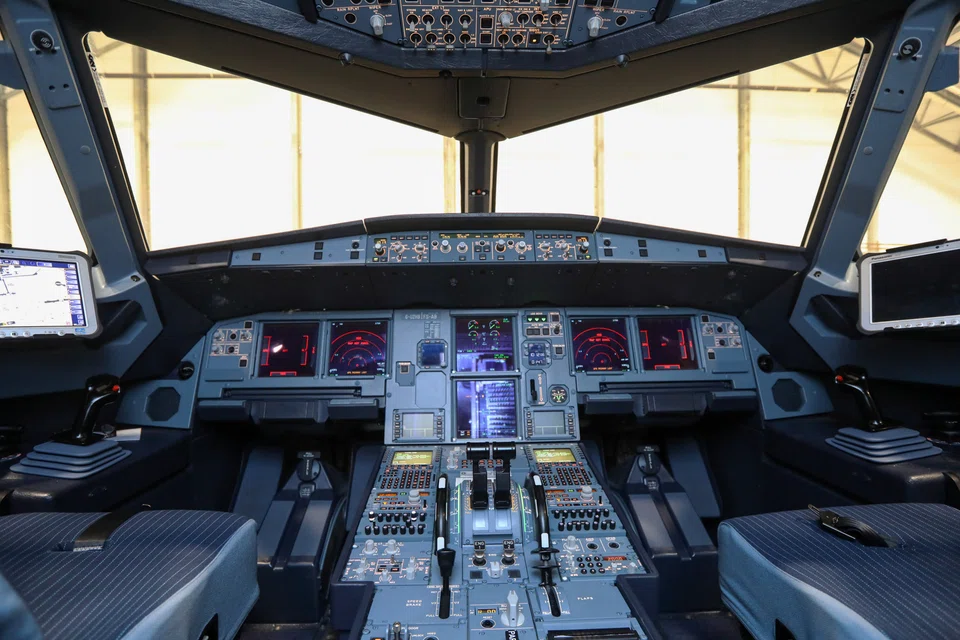
[BERLIN] As Airbus enters the last month of the year, trying to meet an ambitious aircraft delivery target, the European planemaker finds itself confronted with a fresh challenge that’s come out of the blue.
The company surprised airlines and travellers alike late Friday (Nov 28) with a call for “precautionary fleet action” on its A320 aircraft, the most widely flown commercial airliner in history. An Airbus software update left flight controls vulnerable to cosmic radiation, requiring an urgent code fix, four weeks after an in-flight mishap first brought the issue to light.
The statement set off a frantic rush among carriers operating the A320 to address the flaw, with more than 6,000 jets requiring the fix before their next regular flight. And the timing was hardly ideal: US travellers, in particular, were in the middle of their mass Thanksgiving migration, with authorities expecting record activity.
From New Zealand to India to Latin America, operators of the popular A320 family raced to eradicate the bug or face the risk grounding of an aircraft that carries millions of travellers on any given day.
The episode highlights how central the A320 has become to fleets in every corner of the world and how an opaque celestial occurrence can throw the finely tuned system into disarray. Left unanswered is exactly how solar radiation could fry sophisticated onboard systems, and Airbus made only a vague reference to a “recent event” that exposed the problem in the first place.
On Oct 30, a little-reported incident involving a JetBlue Airways airliner set off alarm bells among Airbus technicians that ultimately culminated in a so-called emergency airworthiness directive by regulators. The A320 was flying from Cancun to Newark, New Jersey, when it suffered a computer glitch, resulting in a sudden, unexpected downward pitch without pilot input.
Nobody was seriously injured, and the jet diverted to Tampa, Florida. But a later investigation revealed that one of the plane’s elevator aileron computers, known as Elac 2, had malfunctioned. While the autopilot remained engaged throughout the flight, the result was “a brief and limited loss of altitude”, the European Union Aviation Safety Agency said of the JetBlue incident.
“It’s very curious that they identified a specific failure scenario for which the fix was a software rollback,” Peter Lemme, an aircraft electronics expert and consultant, said. “That would suggest that they released a software version that didn’t have the appropriate safeguards and redundancies for solar radiation events.”
For Airbus, the JetBlue revelation meant “working around the clock to support our operators” and minimise the fallout, according to a memo by chief executive officer Guillaume Faury. And the episode adds to the company’s already long list of challenges.

By Sunday, most carriers managed to implement the software revision. The rapid response helped minimise disruptions, though some airlines said that they had to cancel flights during the updates.
Airbus already has to absorb engine issues on its newer A320neo jets, powered by RTX’s Pratt & Whitney, that forced hundreds of jets to be taken out of service temporarily for maintenance.
Airbus has another four weeks to scrape through to its target of 820 aircraft deliveries for the year, a feat that looks just about achievable if everything falls into place perfectly. The company has long grappled with parts shortages, from engines to kitchen units to toilets, that have held back output.
By the middle of this year, the company was still far from that goal, though Airbus always remained optimistic it would pick up the pace considerably in the last few months.
In that race to the finish line, the solar-radiation incident risks becoming an unwelcome distraction. While Airbus has not said how many teams are working on the fix, as many as 1,000 older aircraft will require an actual hardware upgrade to address the software flaw. That could potentially absorb resources the company would need to build new aircraft.
In the technical prose of the regulator, if the Elac system was not replaced or modified with a serviceable system, a worst-case outcome could be “an uncommanded elevator movement that may result in exceeding the aircraft’s structural capability”.
Aircraft fly where the atmosphere is thinner, exposing them to more particles from space, primarily from the sun, that can interfere with their electronics.
Occasionally, these particles can pass through an onboard microchip, potentially creating a glitch known as a single-event upset, which in turn can make an electronic system behave in unexpected ways, said Mathew Owens, professor of space physics at the University of Reading in the UK.
Aircraft have redundancies built in as safety backups, including the software. But what exactly caused the malfunction will be hard to pinpoint, said Riccardo Bevilacqua, a Stockholm-based nuclear physicist and radiation safety expert.
“The fact is, it doesn’t leave any trace,” Bevilacqua said. “It flips a zero to one or one to a zero, and it’s impossible to detect.”
Modern aircraft are a complex interplay between traditional hardware, such as the aluminium fuselage and advanced technology, such as the computer power that helps command the aircraft. The A320 spearheaded many innovations when it was introduced in the late 1980s.
The A320 uses so-called fly-by-wire systems, which rely on electronic inputs rather than hydraulic mechanisms. The Elac system, which stands for Elevator Aileron Computer, helps manage critical flight parameters such as stabiliser trim and ensures the aircraft remains within its prescribed flight envelope by preventing excessive or accidental inputs.
Arch-rival Boeing learnt the hard way a few years ago just how catastrophic malfunctioning software can be. Two 737 Max aircraft, the Airbus A320’s competing model, crashed in rapid succession in late 2018 and early 2019.
A stabilising system known as MCAS was later found to have delivered the wrong inputs during flight, confusing the pilots and ultimately leading to disasters that killed everyone on board the two jets. BLOOMBERG
Decoding Asia newsletter: your guide to navigating Asia in a new global order. Sign up here to get Decoding Asia newsletter. Delivered to your inbox. Free.
Share with us your feedback on BT's products and services
TRENDING NOW

Once staunchly pro-China, Malaysian Chinese businesses are now distancing themselves from Beijing
‘How many will survive?’: Bubble fears arise as China’s humanoid robotics face reality check

Philippine power giant First Gen rebuffs foreign offers, plans up to US$2.6 billion in expansion
Indonesia imposes US$116 million in fines over manipulation of Sinar Mas, Prajogo-linked stocks

