

Alstom lays down tracks for diversity and railway business
Ling Fang is first woman and Asian to be regional head of Paris-based company

Lee U-Wen
Singapore
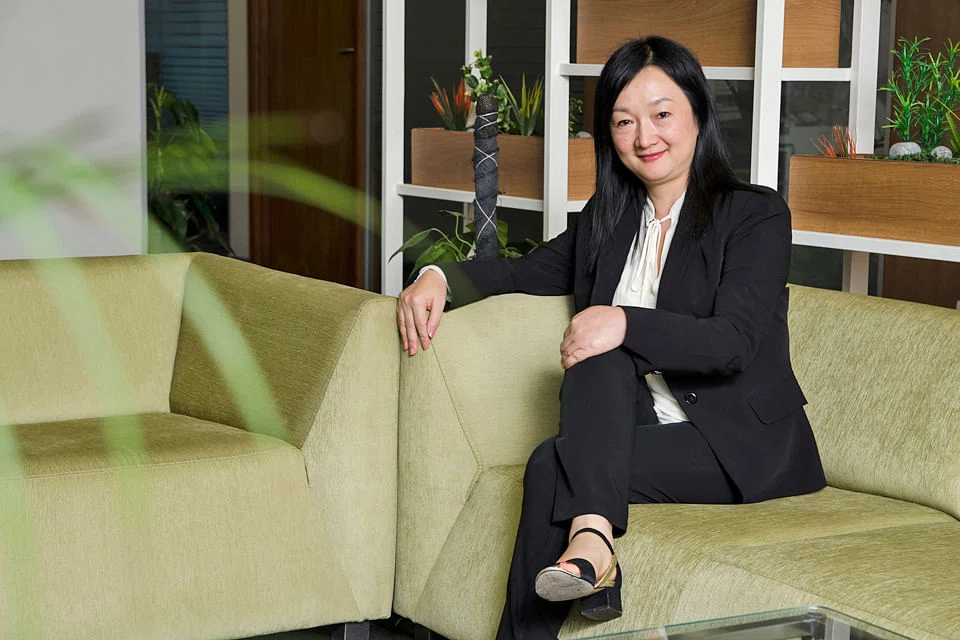
WHEN Ling Fang was promoted to her current role at French multinational Alstom in July this year, she smashed two glass ceilings in one fell swoop.
As senior vice-president of the Asia-Pacific region, she is both the first Asian and first woman to head one of the Paris-based company's regional offices around the world.
The China-born French citizen, who worked her way up the ranks at the railway manufacturer since joining in 1995, is currently the only female on Alstom's 18-member management team.
She also has a seat on the executive committee and reports directly to chairman and chief executive officer Henri Poupart-Lafarge.
"I feel very honoured and proud. But at the same time, I think (my appointment) demonstrates that the company is for internal mobility and promotion, rather than external recruitment," she tells The Business Times in an interview at her office at Mapletree Business City.
Women now make up about one in five of those who hold managerial and professional positions at Alstom, and the company has a target to raise that figure to 25 per cent by 2020.
Six of the 13 directors on Alstom's board are female. Even after Alstom's planned merger with German industrial group Siemens goes ahead as expected in the first half of 2019, half of the new combined board will comprise women.
"I would say, in Alstom, it's reasonable to expect a woman to be able to balance being a mother, a wife, have a family life, all while having a high-responsibility job," said Ms Fang.
She first joined the Alstom Group 23 years ago as an auditor, and has gone on to hold several leadership positions, most recently as managing director for China and East Asia.
Now that she's in charge of the group's operations in the entire Asia-Pacific region with full P&L (profit and loss) responsibility, she oversees 12 markets including Singapore, India, China, Australia, Taiwan and South Korea.
A lot of her time is spent on India, a market that she describes as very important because it is now Alstom's global base for manufacturing and engineering.
Of the 5,200 people on Alstom's payroll in the Asia-Pacific region, some 3,800 of them work in India. There are three manufacturing factories, as well as an engineering centre, in different cities in India.
While most major companies opt for China as their manufacturing base, Ms Fang said Alstom has invested heavily in India - the world's sixth-largest economy, ahead of France - for a number of reasons.
"The populations in the cities in India are growing, and the government wants to solve congestion and pollution issues in an efficient and environmentally-friendly manner. Rail transportation is a very good solution for that."
In September 2018, Australia's Sydney Metro took delivery of the first made-in-India Alstom trains. Some Indian cities such as Chennai, Lucknow and Kochi have already taken delivery of Alstom's India-made trains.
"Every year, we see more metro lines being built in India, not just in the big cities but the emerging cities as well. India is one of the most dynamic markets in the world," said Ms Fang.
In Singapore, Alstom has been active here for the last two decades. The company's first two major projects were for the North-East Line (NEL) and Circle Line on the MRT network. It is currently working on the upcoming Thomson-East Coast Line.
Earlier this year, Alstom won a S$250 million contract from the Land Transport Authority to supply 17 new driverless trains to increase capacity on both the NEL and Circle Line.
These trains will be manufactured and assembled at Alstom's factory in Barcelona, and will be progressively shipped to Singapore from 2020.
"Singapore is a very competitive market. There are usually about six to seven companies - from Asia and around the world - bidding each time the government puts out a tender. Singapore has a strong reputation for having one of the best public transport systems," said Ms Fang.
She also weighed in on the recent agreement by Singapore and Malaysia to postpone work on their high-speed rail (HSR) project until May 2020.
The 350km express service - which would slash land travel time between the two cities to 90 minutes - now has a new commencement date of Jan 1, 2031, four years later than the original start date of Dec 31, 2026.
Before the postponement was announced on Sept 5, Alstom had already put together a dedicated team to work on the HSR tender, Ms Fang said, and they also participated in discussions and consultations.
"Of course, we respect the decision of the two governments. But Alstom still believes that this HSR project is important for the region, and it is an important project for the economic and social development of Singapore and Malaysia."
Alstom ordinary shares have been listed on the Paris Stock Exchange since 1998. In May this year, the company said its revenue for its 2017/18 financial year rose 9 per cent from the previous year to 7.95 billion euros (S$12.7 billion).
Adjusted earnings before interest and tax (Ebit) was up 22 per cent to 514 million euros. The company expects to see sales of about 8 billion euros for next year, and an Ebit margin of up to 7 per cent.
TRENDING NOW
‘We don’t want to stay as we are’: CEO Patrick Ng builds a more resilient Huationg
URA to review guidelines on floor space to give developers more design flexibility: Chee Hong Tat

He built the Vingroup empire. Now South-east Asia’s richest man is handing some key roles to his sons
32 companies, 6 individuals bag accolades at Singapore Corporate Awards 2026

