Baltimore bridge collapse: Compensation may run into billions, say industry watchers

Tay Peck Gek
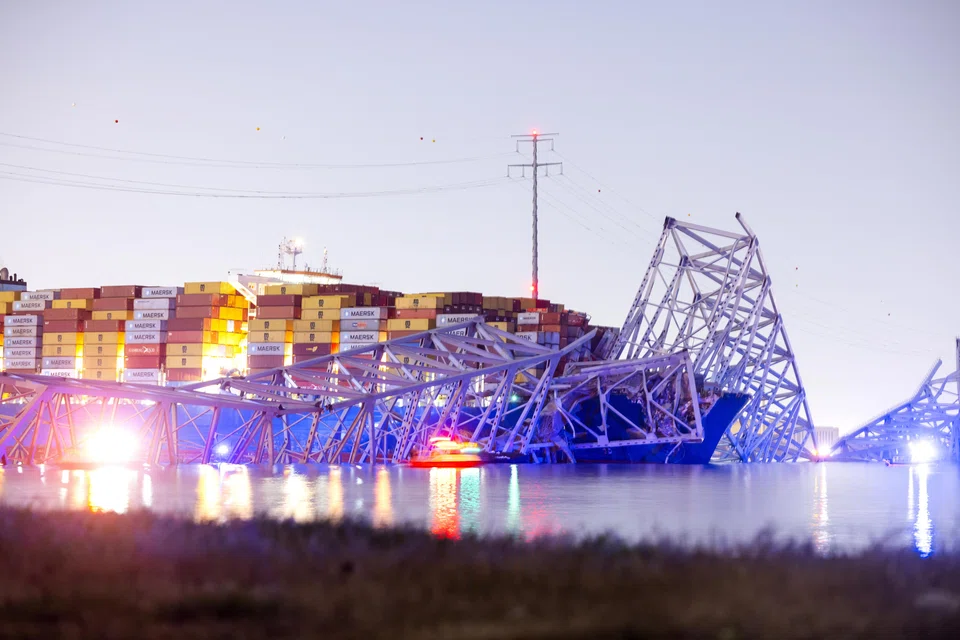
THE collapse of a major bridge in the United States city of Baltimore on Tuesday (Mar 26) that left six workers presumed dead could involve “sizeable” compensation, given the extent of the damage to the infrastructure, its surrounding area and any loss of life, experts have said.
While it may still be too early to provide an estimate, Allianz Commercial’s global head of marine risk consulting Rahul Khanna told The Business Times that the compensation for the significant losses could be sizeable.
He added that this was because it happened in the US, where liability costs are among the highest in the world, and property values and costs of repairing the damage are typically higher. Insurers may also have to make good on other potential losses – from blocked port access and cargo loss to any environmental implications, on top of the loss of lives.
He was responding to BT’s queries on potential damages arising from the Singapore-flagged container ship Dali’s collision into Francis Scott Key Bridge in Baltimore, which caused the bridge to collapse.
Initial reports suggest that the incident is likely to be covered under protection and indemnity (P&I) insurance, which provides third-party liability coverage for vessels, including damage to fixed or floating objects.
Matilde Jakobsen, senior director of analytics at the insurance-focused, credit-rating agency AM Best, said the total cost of the bridge collapse and associated claims will not be clear for some time, but it is likely to run into billions of dollars.
“The insurance issues due to the collapse of the bridge will take a long time to unravel, and may involve several lines such as property, cargo, liability, trade credit and contingent business interruption.
“The claim will likely involve several insurers, reinsurers, subrogation and legal issues, and will serve to add to the increasing challenges in reinsurance availability,” said Dr Jakobsen.
Allianz Commercial described the Baltimore bridge collision as a “rare” one in shipping incidents, citing statistics that showed the most common incidents involved colliding with other types of port infrastructure, such as harbour walls, piers, quays and locks.
There were nearly 2,000 reported incidents of vessels colliding with port infrastructure between 2013 and 2022, going by data from Allianz Commercial Safety and Shipping Review. These figures pertain to shipping collision and contact incidents involving vessels of over 100 gross tonnage and reported incidents.
Collisions with port infrastructure accounted for about 7 per cent of the more than 27,000 shipping incidents recorded over the nine-year period, making them the fourth most common cause of incidents.
Of the nearly 2,000 such incidents, 203 involved container ships such as the Dali. Common causes of hitting port infrastructure included human error and machinery, equipment or engine failure, steering failure and generator blackout. Machinery damage or failure (10,753), collision involving vessels (3,098) and groundings (2,936) were the top three causes of incidents over this period.
Total destruction of vessels due to collision incidents with other vessels and contact with port infrastructure was “rare”.
Over the past decade and across all vessel types, there were 30 cases of total destruction of vessels from collision incidents with other vessels, and four from contact incidents with port infrastructure. Collectively, these accounted for 4 per cent of the 807 vessels reported lost between 2013 and 2022.
Bloomberg reported that Dali’s owner, Singapore-based Grace Ocean, could face a string of lawsuits from multiple directions, including from the owner of the bridge and the families of the six workers who were presumed dead.
However, according to the report, legal experts said that there is a path to reduce liability under an obscure 19th-century law once invoked by the owner of the Titanic to limit its payout for the 1912 sinking.
This law was passed initially to prevent shipping giants from suffering steep and insurmountable losses from disasters at sea.
About 90 per cent of the world’s ocean-bound cargo is insured by an arm of the International Group of P&I Clubs, which oversees the 12 major mutual insurance associations for ship owners, Bloomberg reported.
Key to determining any insurance claims will be proving whether the accident was caused by negligence, and if so by whom, or mechanical failure, Bloomberg said. It said the ship is insured by the Britannia P&I Club, which is a mutual insurance association that is owned by shipping companies. It is one of the dozen clubs that make up the International Group of P&I Clubs.
As for the ship itself, the Bloomberg report quoted Lawrence Brennan, an adjunct professor of law at Fordham University School of Law in New York specialising in admiralty and maritime law, as saying: “The ship’s owner may want to get it out of the US, but the Maryland Transportation Authority will likely seek to keep it under ‘arrest’ while it pursues claims – and possibly until damages are resolved.”
Dali is managed for Grace Ocean by Singapore-based Synergy Marine Group.
The incident primarily affects auto markets because of Baltimore’s role as a key import hub for vehicles; it particular affects the Asia-Pacific’s largest car exporters such as China and Japan, said Moody’s Analytics. While the full impact of the disaster has yet to play out, ramifications in the Asia-Pacific region should be minimal, it added.