Bangkok's expanding mass transit yields mixed economic benefits
Bangkok
THAILAND'S Covid-impacted economy contracted at least 6.5 per cent last year and is heading for only modest growth of 4 per cent in 2021, yet the government has continued to spend billions of dollars annually on expanding Bangkok's mass transit system.
Some economists have started to question whether the hefty expenditure is worth it.
According to the government's latest masterplan for Bangkok, there will be 560 km of electric train track in the capital and surrounding provinces by 2029, surpassing even London's Tube (420 km).
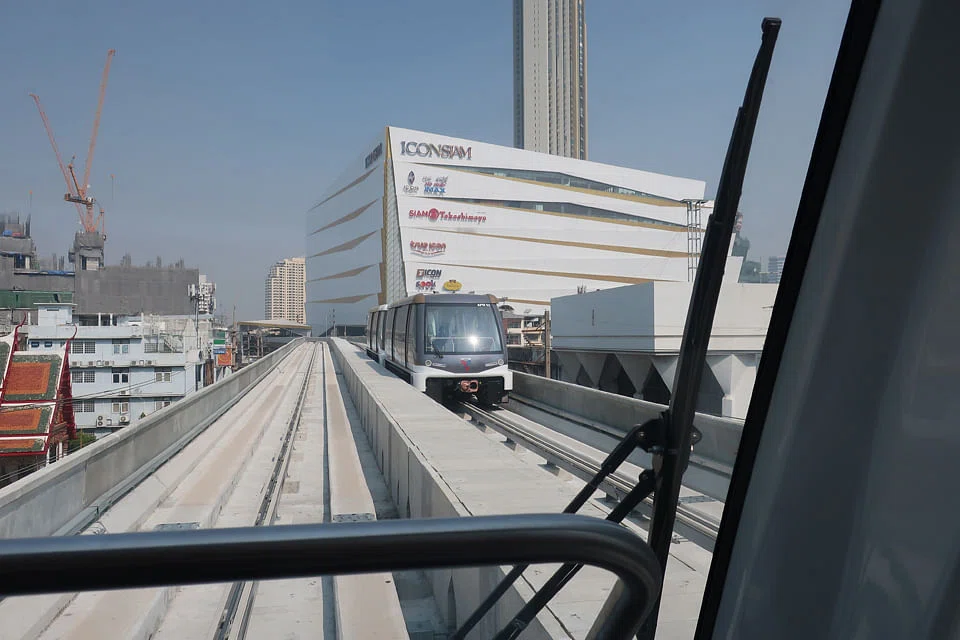
As of the end of 2020, an estimated 180 km of mass rail transit lines were operational in the Thai capital, with the December launches of the BTS Skytrain's new Gold Line (a 1.7 km spur to service the Iconsiam mall) and a 9.8 km northern extension of the Green Line. There are currently five new overhead routes under construction in Bangkok and its suburbs which should add another 125 km of new electric rail tracks by 2024.
The BTS Skytrain, Bangkok's first mass transit rail project, was launched to much fanfare back in 1999. With 23.5 km of tracks, it was erected above the main thoroughfares to service the most populous, busiest neighbourhoods in the capital.
After a slow start, the Skytrain has become the most popular route, topping 800,000 passengers daily in 2019 before Covid-19 slowed ridership by about half to around 400,000.
Land prices along the Skytrain route soared by 1,000 per cent between 1998 to 2017, according to property agency CBRE Thailand, caused by a boom in construction along the rail route and others.
The number of condominiums in Bangkok has jumped from just 2,600 units in 1998 to more than 730,000 units now, with at least 108,000 units completed between 2019 and 2020.
Most new condominiums are located within 800 metres of a mass transit line. Land prices tend to rise 10 per cent a year along new mass transit routes, industry sources said.
"Condominiums use little land, so you can build a 25-storey condominium on two rai (32,000 sq ft) of land, and that means that developers can pay a very high price for the land," said Barny Swainson, senior director of Colliers International in Thailand.
Or that is what happened in the past. With many new mass transit lines being built, some of them reaching out far into the less populated suburbs of Bangkok, not all lines are considered equal any more.
Perceptions started to change with the Purple Line, a 23 km mass transit route opened in 2016 that serves Bangkok's northwestern suburbs out to Nonthaburi province.
"When the Purple Line came in, there had not been a new transit line for a while, so people were excited because everyone saw what had happened with the BTS and I think developers got ahead of themselves," Mr Swainson said. "They followed each other out there, assuming that there would be this huge demand for condominiums, and the result was an oversupply along the line."
Part of the problem with the Purple Line was that when it was opened there was still 1 km of a missing link hooking up with the Blue Line subway.
When the link was finally completed in 2017, the interchange station was poorly designed so commuters need to wait in long queues during rush hours.
Another problem is that the population along the Purple Line is not dense.
"Having a metro is good in areas where we have dense populations," said Sumet Ongkittikul, research director for transport & logistics at the Thailand Development and Research Institute (TDRI), a private think tank.
"For example, the BTS serves dense populations and benefits all, but the pricing is an issue," he said.
The BTS is threatening to raise its maximum fare next month to 104 baht (S$4.60), which has become a political issue this month.
"For Bangkok, I would say 50 to 60 per cent of the system is good, but some lines have been built in very low-density areas, like the Purple Line," said Mr Sumet.
In principle, the mass transit system will also reduce air pollution in Bangkok, but this will only happen if the government enforces restrictions on cars on the roads, forcing commuters to take the trains instead, he added.
Another question for the mass transit network is whether the whole concept of serving commuter traffic in Bangkok is changing, in light of Thailand's altering demographic.
"We have a rapidly ageing population," said Supavud Saicheua, head of research at Phatra Securities.
Thailand currently has 12 million people who are 60 years old and above, with this number expected to reach 20 million by 2040.
"What that means is you have a shrinking workforce, and all those lines are commuter lines, but no one is going to be commuting because of the ageing population," said Mr Supavud.