Berthing delays in Singapore as liner congestion in South-east Asia ports hits historic high
The Port of Singapore received 140 container vessels between May 20 and 23, S&P Global data shows

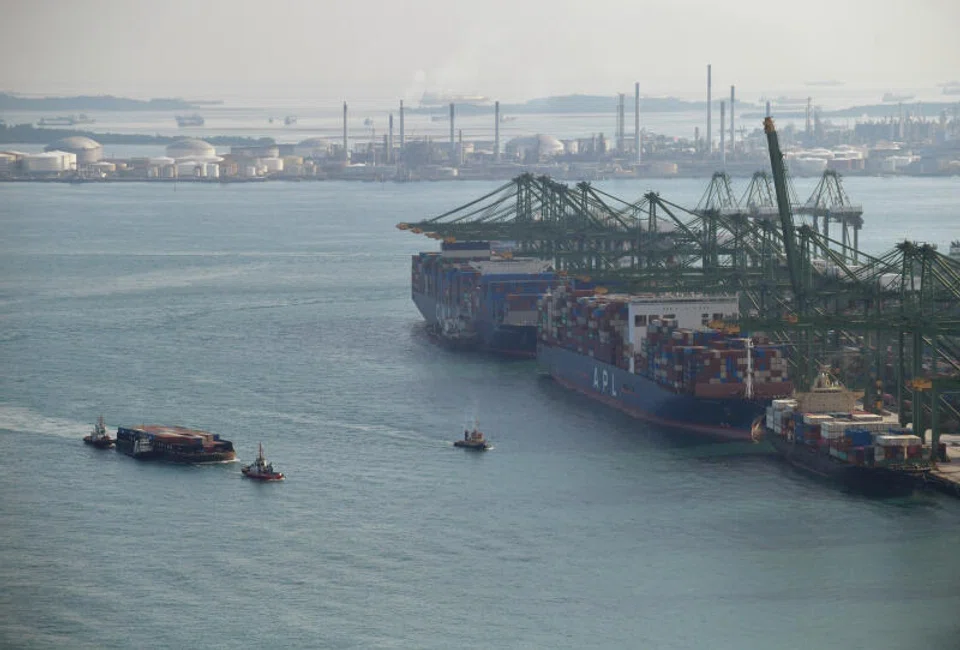
PORT congestion level in South-east Asia is now at a historic high, with Singapore being among the ports hardest hit.
Ships calling at the Republic’s port will have to brace themselves for berthing delays triggered by the diversions caused by unrest in the Red Sea, and carriers skipping Malaysia’s Port Klang. The hold-up in the Republic’s port is said to be around four to five days; under normal circumstances, ships are berthed upon arrival, or at most, within half a day.
Data from S&P Global Commodity Insights showed that the Port of Singapore received 140 container vessels in the span of just four days – between May 20 and 23 – or a total of 999 for the month to Thursday (May 23). In contrast, there were 639 boxships that called at Singapore in April.
A senior pricing analyst for Asia container markets with S&P Global, Tanya Kalra, told The Business Times: “Since the Labour Day holidays in early May, major ports in South-east Asia and China, such as Singapore, Port Klang, Shanghai and Ningbo, have experienced severe congestion.
“The increase in transit times caused by the Red Sea crisis and Panama restrictions has resulted in vessels accumulating in Singapore and Port Klang. To catch up with schedules, carriers have been forced to unload containers in Singapore.”
The congestion in Port Klang has reportedly eased, but carriers have already made Singapore their port of call instead, she added.
Since mid-November – when Yemen’s Houthi rebels began attacking merchant vessels near the Red Sea, major carriers plying between Asia and Europe have been taking an extended route around the Cape of Good Hope off South Africa instead of the shorter one through the Red Sea.
In the trans-Pacific (Asia-to-America) trade route in May, shipping lines made multiple “blank sailings” – the skipping of ports or axing of entire voyages of a scheduled sailing route – even amid an increased movement of white goods, solar equipment, electric vehicles and EV-linked components, noted Kalra of S&P Global Commodity Insights.
A blog post dated May 21 on container-ship industry intelligence website Linerlytica said that congestion in key South-east Asia and Middle East Gulf hub ports hit new highs in May, surpassing the records set in 2021 to 2022 during the pandemic.
The post named the Singapore and Jebel Ali (Dubai) ports as being the most badly hit, with berthing delays of up to six days, resulting in disruptions to vessel schedules.
Linerlytica reported that, as at May 21, there were 50 ships in Singapore’s port, and 23 at anchorage; Shanghai/Ningbo were hosting 116 ships in their ports and 39 at anchorage, and Jebel Ali had 35 ships in port and 36 at anchorage.
The congestion level in South-east Asia is at a historic high at 1.1 million 20-foot equivalent-unit (TEU) containers, Citi analysts wrote in their weekly freight-tracker report published on Thursday (May 23).
In contrast, global congestion was lower; the seven-day moving average stood at 8.9 million, compared to 8.6 million TEUs last week, their report said.
Operator PSA Singapore said the country’s port has been handling strong demand for berths in recent months, but did not say when this congestion was first observed.
A PSA spokesperson said: “The diversion of vessels to alternative routes such as the Cape of Good Hope has increasingly disrupted global trade patterns and vessel schedules. This has resulted in ports facing severe vessel bunching which, in turn, has aggravated berth waiting time.”
To cope with the surge, and in recognition that the volatility is likely to stay, PSA Singapore is looking to add a couple more berths by year’s end to the eight already operational in its Tuas Port in the west of the city-state.
The spokesperson added that PSA Singapore has been working with shipping lines to optimise the delivery of service to its customers in response to the ongoing disruptions.
“This also includes closer communication for the early exchange of vessel arrival and volume information, and the advance planning of berth line-ups,” she added.
S&P Global’s Kalra noted that carriers have raised their rates: Spot rates went from US$4,000 per 40-foot-equivalent unit (FEU) to US$6,200 on May 22 for shipments from South-east Asia to the east coast of North America. Further rate increases are expected.
A group of Asian feeder operators had in April begun to impose an emergency cost recovery surcharge, which ranges from US$40 to US$100 per direction for each loaded 20-foot-equivalent unit (TEU) container. They said this was to mitigate the “significant increase” in operational costs arising from the “heavy congestion” at major transhipment ports in South-east Asia.
Samudera Shipping, a member of the group, did not respond to a query from The Business Times on whether the surcharge applies till further notice.