

Boeing showcases eco-friendly tech as industry faces pressure
 Add BT as a preferred source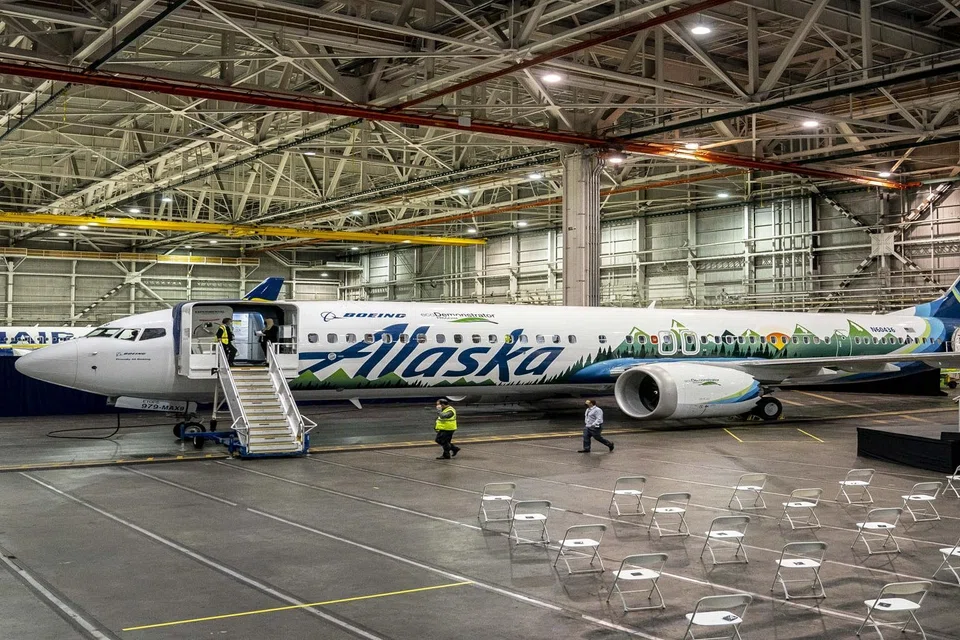
DeeperDive is a beta AI feature. Refer to full articles for the facts.
[SEATTLE] Boeing Co showcased efforts to boost efficiency in its aircraft on Monday, a week after rival Airbus staged a similar conference, as global aviation faces growing political pressure to cut emissions and demands by environmental groups for curbs to air travel.
The US planemaker is just one of many companies in the industry playing up its efforts to make its products more environmentally friendly, though there is debate over the speed at which new technology will be adopted.
Boeing's event at its flight test hangar in Seattle was anchored by an Alaska Airlines 737 MAX 9 flying demonstrator equipped with potential upgrades like a drag-reducing warning light and cabin sidewalls made from recycled carbon fibre.
"Many of our improvements come with a lot of small things at once," Boeing vice president of product development Mike Sinnett told Boeing employees, industry and government officials and media gathered inside the building.
Aviation produces up to 3 per cent of man-made CO2 emissions and 12 per cent of CO2 from transport, the industry says. It has pledged to reduce net carbon emissions to 50 per cent of 2005 levels by 2050.
Europe's Airbus last year announced plans to develop a hydrogen-powered airplane from 2035.
Navigate Asia in
a new global order
Get the insights delivered to your inbox.
Boeing conversely has emphasised the expanded use of sustainable aviation fuels (SAF), which are made from feedstocks such as used cooking oil and animal fat, though it does not rule out generational technology leaps.
"Focusing on SAF is really important because there are thousands of airplanes already flying. The airplanes that will go into service for the next ten years have already been designed and those engines have been certified," Mr Sinnett told reporters later.
"To have any meaningful impact we are going to have to ...expand the use of sustainable fuels," he said, calling hydrogen and other technologies "a longer-term play." Boeing has promised that its fleet would fly on 100per cent sustainable aviation fuels by 2030.
SAF at present accounts for only a miniscule amount of overall jet fuel use and jet engines are currently certified to run on up to 50 per cent of the fuel.
Illustrating the scale of the challenge facing the industry, the world's two largest planemakers in 2020 delivered jets estimated to be responsible for total emissions equivalent to 600 million tonnes of CO2 over their lifetimes, a figure dampened by lower deliveries during the coronavirus pandemic.
Boeing's 737 MAX 9 ecoDemonstrator, the latest configuration in a decade-old test program, is set to fly to Glasgow ahead of a United Nations Climate Change Conference in November, a person familiar with the plan said.
REUTERS
Decoding Asia newsletter: your guide to navigating Asia in a new global order. Sign up here to get Decoding Asia newsletter. Delivered to your inbox. Free.
Share with us your feedback on BT's products and services
TRENDING NOW
Air India asks Tata, Singapore Airlines for funds after US$2.4 billion loss

Beijing’s calculated silence on the Iran war

China pips the US if Asean is forced to choose, but analysts warn against reading it like a sports result

Richard Eu on how core values, customers keep Singapore’s TCM chain Eu Yan Sang relevant

