

Toyota makes its marque with the Supra
Toyota's revived cult-favourite, the Supra sports coupe, represents an exciting return by being a superb modern driver's car
 Add BT as a preferred source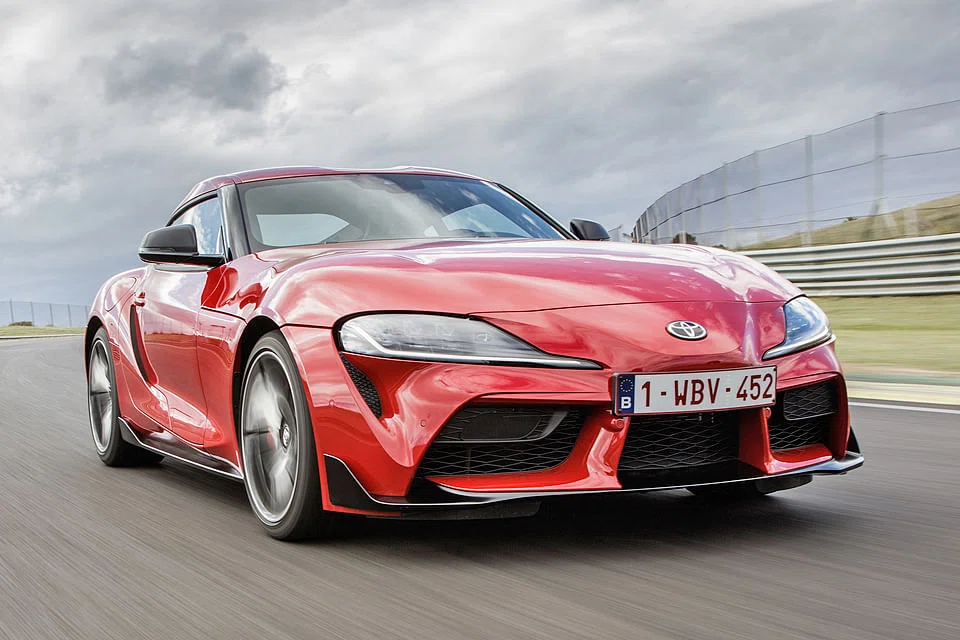
DeeperDive is a beta AI feature. Refer to full articles for the facts.
Sportsland Sugo, Sendai, Japan
ONE of Toyota's most beloved and well-known nameplates is the Supra. After a 17-year hiatus, it's finally returned in the form of this car here, the new fifth-generation model.
The big thing one has to grapple with is that the new Supra shares its platform and engine with the BMW Z4 convertible. Thanks to the astronomical costs of carmaking, courtesy of stringent environmental and safety regulations, Toyota paired with BMW to share development costs and effort. But does that mean the legendary Supra is merely a re-skinned BMW now?
Far from it. Toyota and BMW's engineers merely agreed on the fundamental components and then proceeded to develop their cars independently, says the Supra's chief engineer, Tetsuya Tada.
Mr Tada also said that his team tuned the car's various components, including the engine, rear differential, gearbox and more, quite differently from its BMW counterpart.
To use a metaphor, it's like giving Gordon Ramsay and Jamie Oliver the same ingredients but asking them to make their own dish in separate kitchens.
Navigate Asia in
a new global order
Get the insights delivered to your inbox.
In any case, there's very little chance you would confuse the two cars in person. The Supra's chief designer, Nobuo Nakamura, ensured that the Supra has plenty of Toyota design DNA in it.
It takes obvious reference from the previous, fourth-gen Supra. Most of us would know it (sadly) as the orange car driven by Paul Walker in The Fast And The Furious, and despite the latter being a heavily modified vehicle, one can still clearly see the lineage in the shape and position of the headlights. But to remind us that Toyota has a long history in sports cars, the Supra also has cues from Toyota's classic 1960s icon, the 2000 GT, seen in the dual "bubble" roof and long, graceful bonnet.
Under that bonnet is a choice of two engines, both of which will be offered in Singapore: a 2.0-litre four-cylinder turbo engine with 255hp, and a 3.0-litre straight-six engine with 335hp, which is the car we tested in intense track laps around the Sportsland Sugo circuit.
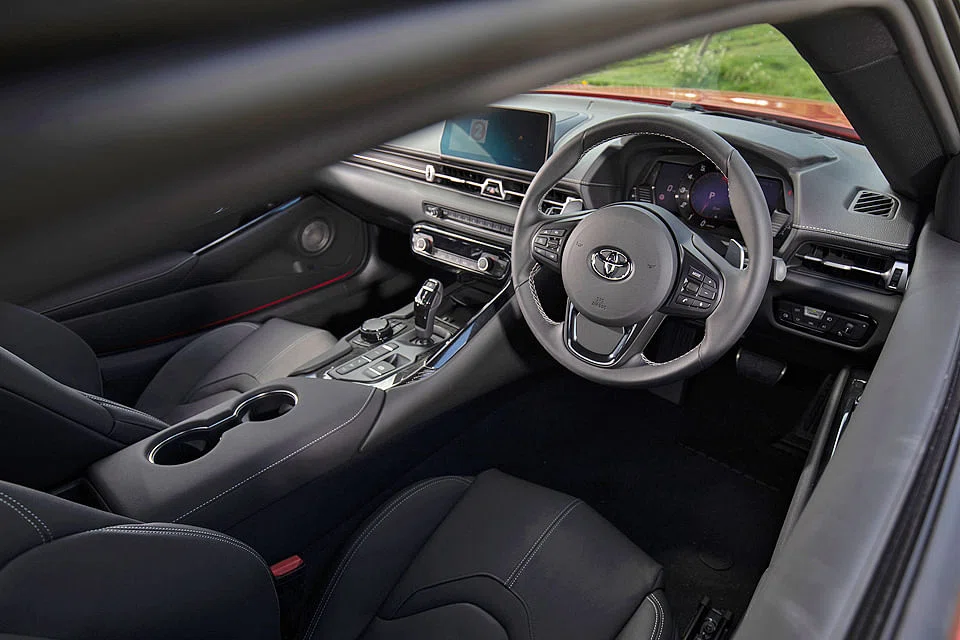
The interior feels spot-on for an engaging sports car: The seating position is low-slung and closer to the ground, while the sport seats hug your body closely, and a large tachometer dominates the virtual instrument panel.
The Supra has evolved into a pure two-seater - unlike the 2+2 layout of the previous machine - and Mr Tada says there is good reason for that.
His engineering target was to make an involving machine first and foremost, in his words, a "supreme fun-to-drive car", and the math dictated losing the two rear seats.
That calculation included both mass and geometry. Firstly, his team worked on lowering the Supra's centre of gravity and overall weight, losing the plus-two helps it tip the scales at a relatively svelte 1.5-tonnes.
Second, the "golden ratio" between its 2460mm wheelbase and track width (the frontal distance between the tyres), also meant there was no space for the seats.
It all sounds a bit like soulless classroom arithmetic on paper, but we can't argue with the results.
In real life, the Supra is an agile, sweetly balanced handler that will nimbly skirt the edges of the traction circle. Like all the best driver's cars, you feel a direct connection to the machine that's very confidence inspiring, so much so that you can tip the car a little over the limit for extra, wriggly fun when you wish.
We like how alert the Supra is as it reacts with sniffer dog alacrity to quick direction changes. The lines of communication between tyres to steering and seat-of-pants are always open as you adjust its angle of attack with the throttle.
Over the badly patched portions of the winding road circuit, there's a civility to the Supra's wonderfully resolved damping, which ensures sublime body control under all circumstances, even on 19-inch wheels.
The snappy automatic shifts are tuned to be lightning-quick and there's a satisfying forward thrust with every upshift thanks to the turbocharged inline-six's monumental 500Nm.
Like the other automotive icons such as the Porsche 911 and Nissan GT-R, the Supra needed to find its way into the future by welcoming newcomers into the Supra fold, yet not exclude long-time purists.
As an engaging, desirable driver's car that successfully channels the spirit of its predecessors, the new Supra is exactly that.
Toyota GR Supra 3.0
Engine 2,998cc, inline 6, turbocharged Power 340hp at 5,500-6,500rpm Torque 500Nm at 1,600-4,500rpm Gearbox 8-speed automatic 0-100km/h 4.3 seconds Top Speed 250km/h Fuel Efficiency 8.2L/100km Agent Borneo Motors Price S$200,000-S$250,000 without COE (estimate) Available Q4 2019
Copyright SPH Media. All rights reserved.
TRENDING NOW

‘Boring’ is the new black: The stars are aligning for a Singapore stock market revival
Near sell-out launches in March boost developer sales to 1,300 units after four slow months

China pips the US if Asean is forced to choose, but analysts warn against reading it like a sports result

Genting Singapore’s Lim Kok Thay receives S$7.5 million pay package for FY2025

