

BYD first China marque to break into Singapore’s top 10; Toyota, Mercedes, BMW still the top three

Derryn Wong
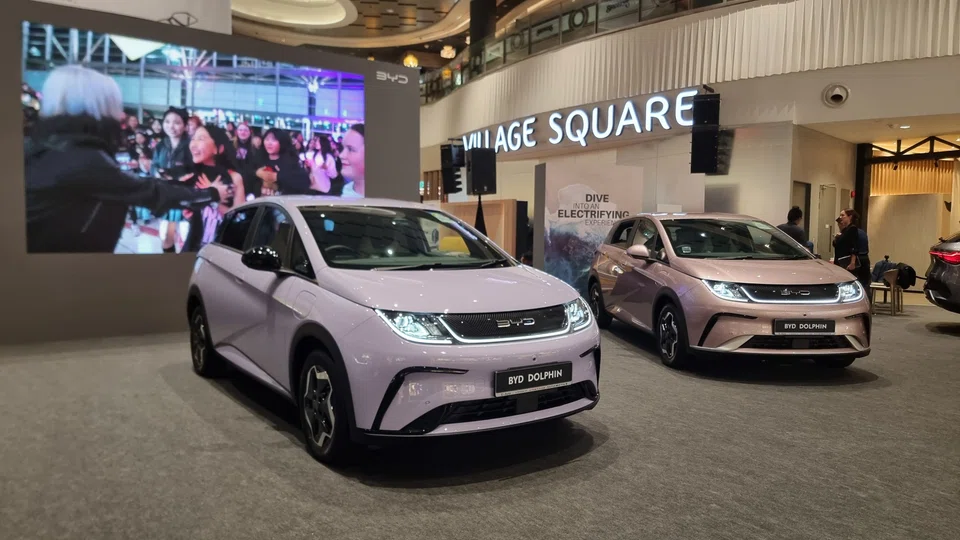
BYD has become the first car brand from China to rank among Singapore’s top 10 bestsellers, jumping to fifth place and becoming the top electric vehicle (EV) brand in 2023. Toyota, Mercedes-Benz and BMW stood their ground as the three best-selling car brands here.
According to Land Transport Authority (LTA) figures released on Monday (Jan 29), BYD registered 1,416 cars in 2023, almost double its 786 registrations in 2022. The next-highest China brand was Great Wall at 54 registrations.
EV-only BYD accounted for 4.7 per cent of the 30,225 new cars registered in 2023, making it the fifth best-selling brand here. Rival Tesla was at 10th position with 941 registrations.
BYD likely has the highest registration figure for a Chinese brand to date. Aside from BYD’s 2022 performance, the next highest figure belongs to Chery with 637 registrations in 2007.
Counting authorised dealer registrations alone, BYD ranked fourth since it had no parallel imports, displacing Honda which had 682 authorised dealer registrations.
In 2023, BYD ramped up its car retail operations here, signing two new dealers – EightX and Motorway – and adding two new models to its line-up.
James Ng, managing director for BYD Singapore and Philippines, said that customers were won over by the improved design, high level of technology and good quality-to-price ratio of its latest models.
Industry observers said that BYD has managed to overcome the negative perception of Chinese car brands, but it remains to be seen if it can sustain its sales momentum, and that challengers would not be far behind.
Say Kwee Neng, a consultant and ex-managing director of a multi-brand car dealership, said: “Being a top 10 brand in Singapore means your brand has arrived and is accepted by an extremely demanding clientele.”
He added that these are still early days for BYD in Singapore, and that the rise would need to be backed by achieving longevity in long-term sales performance as well as customer satisfaction.
Victor Kwan, senior lecturer at the Singapore University of Social Sciences, said that he expects more mainstream Chinese brands to challenge BYD for market share in 2024, but that they would need to match BYD in fleet sales to be competitive in registrations.
Mainstream Chinese brands that established a presence in Singapore in 2023 include Great Wall, Seres and Omoda.
Business as usual
The top three brands, however, remained the same. Toyota accounted for 7,248 or 24 per cent of the 30,225 total new passenger cars registered in 2023.
Mercedes-Benz cars made up 4,317, or 14.3 per cent of the total, while BMW registrations accounted for 3,436 or 11.4 per cent.
Toyota increased its registrations by 843 or 13.2 per cent, compared to 2022.
Ng Khee Siong, managing director for Toyota distributor Inchcape Singapore, said that mainstream models continued to drive the brand’s sales. Its most popular model was the Sienta, a small, petrol-electric hybrid multi-purpose vehicle, followed by the Corolla Altis sedan.
While maintaining their rankings, both Mercedes-Benz and BMW registered fewer cars in 2023. Mercedes-Benz’s registrations dropped 18 per cent or 945, while BMW’s registrations fell by 7.6 per cent or 284.
That means BMW was able to make up ground against its luxury rival, with Mercedes-Benz’s lead dropping to 881 from 1,542 in 2022.
2023 marks the first full year of sales in which BMW had two authorised dealers here. In late 2022, BMW Asia appointed Eurokars Auto as the second dealer here, alongside existing dealer Performance Motors.
Lars Nielsen, BMW Group Asia managing director, said that the two-dealer approach helped the brand take a more “customer-focused” approach with more retail facilities and more customer engagement activities.
Say said: “I think it’s still too early to judge this strategy. Two dealers in a small market – it can eat up a lot of energy managing internal competition issues, and this will need to be properly managed by BMW Asia to achieve its goal of being the No 1 luxury brand.”
SUSS’ Kwan said that the top three brands were “no surprise”, given that they have historically been the most popular car brands here.
Mainstream East Asian brands made up the majority of the brands in the top 10, with Nissan (1,336), Mazda (1,176), Hyundai (1,143) and Kia (1,074) occupying the sixth to ninth positions.
“I see a good mix of brands which have grown year on year and those who have dropped. Compared to 2021 and 2022 where most brands saw their volume drop, this shows that the market is stabilising after four to five really tough years,” said Kwan.
The size of the new passenger car market remained stable as the LTA imposed its cut-and-fill policy to bring forward guaranteed deregistrations of cars and added them to the quota throughout the year.
While there were only 13,224 passenger cars registered in the first half of 2023, the full-year registration figure of 30,225 was similar to the 2022 total of 30,939.
TRENDING NOW

Analysts cut DBS target price on lower 2027 earnings, but see buying opportunity after share price slide

Waymo founder predicts ‘landslide’ robotaxi adoption in Singapore, driven by high car costs

The limits of China’s trade concessions to Europe

Nvidia CEO Jensen Huang drops from world’s top 10 richest after chips sell-off

