

BYD leads Thai auto show bookings as fuel prices surge
Local market leader Toyota places second while slew of other Chinese electric brands also dominate rankings
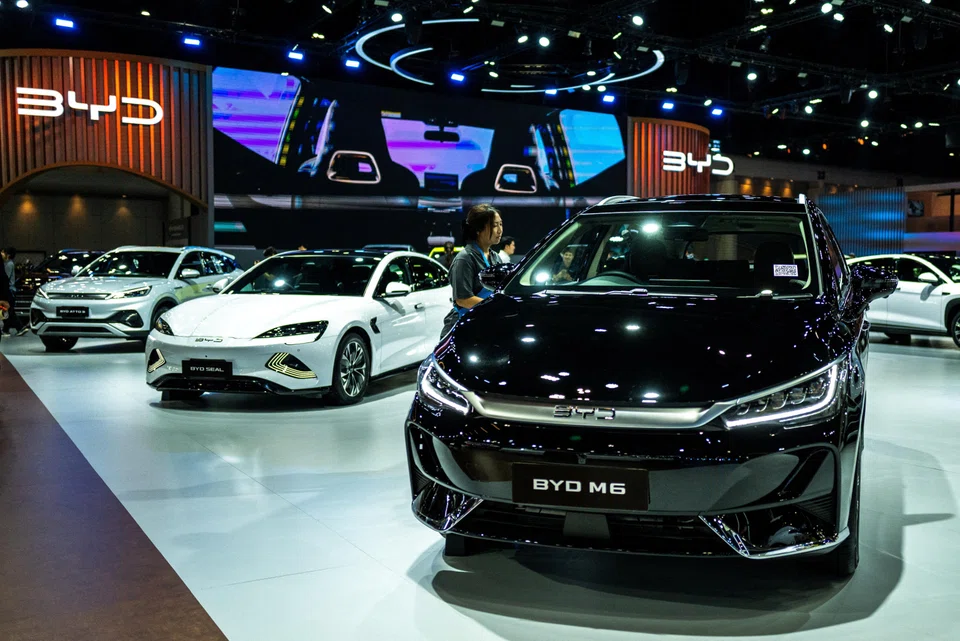
[BANGKOK] Stinging retail fuel prices are pushing more Thais towards electric vehicles (EVs), with models from BYD and other Chinese automakers topping booking charts at Bangkok’s biggest motor show.
Bookings surged 71 per cent from a year earlier to 132,951 at the Bangkok International Motor Show, held from Mar 25 to Apr 5, according to organiser Grand Prix International. Chinese EV makers accounted for more than two-thirds of total sales, relegating Toyota Motor and other Japanese manufacturers to a distant second place, the data showed.
BYD led the tally with 17,354 bookings, while local market leader Toyota placed second with 15,750 units. A slew of other Chinese electric brands, including Chery Automobile’s Omoda and Jaecoo, Saic Motor’s MG, Changan Auto’s Deepal and Nevo, Great Wall Motor and GAC Aion, also dominated the rankings.
Their combined showing outpaced Japanese automakers such as Honda Motor, Mazda Motor, Mitsubishi Motors and Isuzu Motors, which have long dominated Thailand’s auto market but continue to prioritise internal combustion engine (ICE) models.
The surge in EV demand has been driven largely by rising fuel prices, which are prompting consumers to reassess transport costs, said Krisda Utamote, honorary adviser and former president of the Electric Vehicle Association of Thailand.
The Middle East conflict is pushing up oil prices and exposing the vulnerability of fossil fuel-reliant economies such as Thailand, accelerating the shift to EVs. As diesel and petrol prices climb and supply risks intensify, consumers and policymakers are turning to EVs as a more stable alternative, speeding up global adoption beyond climate-driven targets.
“Situations like these act as catalysts, helping people understand and adapt more quickly,” Krisda said. “It’s prompting those who never considered EVs to start thinking about them, and pushing those who were not ready to reconsider as fuel costs rise.”
Krisda expects sales of new battery-powered EVs in Thailand to reach about 160,000 to 180,000 units this year, a gain of at least 30 per cent from 122,128 vehicles in 2025.
Auto exhibitions in Thailand are widely viewed as a real-time gauge of consumer appetite for EVs relative to ICE cars. Booking numbers, foot traffic at EV booths, and the mix of reservations between EVs and ICE models offer an early read on demand trends ahead of official sales or registration data.
SEE ALSO



In recent years, strong EV booking volumes in Thailand, often led by competitively priced Chinese brands, have contrasted with softer interest in traditional fuel-heavy vehicles, signalling a shift in consumer preferences driven by cost concerns, government incentives and increasing model availability.
A longstanding auto manufacturing powerhouse in South-east Asia, Thailand is seeking to boost its post-pandemic recovery and electrify its key auto sector by rolling out competitive tax incentives to entice EV makers to invest in local production.
To support domestic demand and accelerate adoption, recent administrations have also offered subsidies of up to 150,000 baht (S$5,984) per EV for local buyers. BLOOMBERG
Decoding Asia newsletter: your guide to navigating Asia in a new global order. Sign up here to get Decoding Asia newsletter. Delivered to your inbox. Free.
Share with us your feedback on BT's products and services
TRENDING NOW

He built the Vingroup empire. Now South-east Asia’s richest man is handing some key roles to his sons

Grab CEO’s wife Chloe Tong on life with Anthony Tan and finding her purpose

DBS wants to be ‘Asian bank for Asians’ rather than global bank: CEO Tan Su Shan

PropNex plots its next act beyond Singapore residential property

