

Central Park's scenic drives will soon be car-free
 Add BT as a preferred source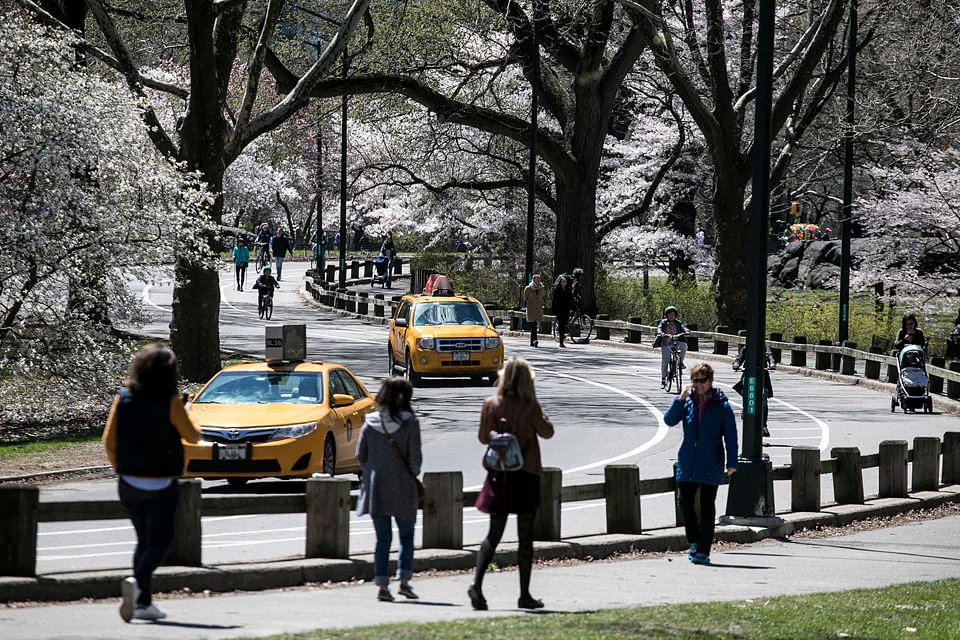
DeeperDive is a beta AI feature. Refer to full articles for the facts.
New York
POWERING through a lunchtime run by himself on Friday, John Hendy was excited by Mayor Bill de Blasio's announcement minutes earlier that cars would be banned from Central Park's scenic drives starting in June.
"You're always looking out. Am I going to get hit?" said Mr Hendy, 57, who works in information technology for a financial services firm on Madison Avenue.
Mr de Blasio said he had parkgoers like Mr Hendy in mind when he made the decision to close the drives below 72nd Street to vehicles beginning on June 27, the day after public schools close. Those drives are currently open to traffic during limited hours.
"This park was not built for automobiles," Mr de Blasio said during the announcement on Friday in Central Park. "It was built for people." The crucial east-west transverses at 65th, 79th, 86th and 97th Streets, which run below the park and keep traffic flowing from one side of Manhattan to the other, will not be affected. Parks Department vehicles and emergency and police vehicles will be allowed access to the park.
Groups such as the Central Park Conservancy and the New York Road Runners celebrated the decision for the benefit it will have for runners and bicyclists in the park as well as for the environment. Last year, 42 million people visited Central Park.
Navigate Asia in
a new global order
Get the insights delivered to your inbox.
"What we are saying is that the street doesn't belong only to drivers, it belongs to all of us," said councilman Ydanis Rodriguez of Manhattan.
The evolution of Central Park's drives has been decades in the making. In 1966, Mayor John Lindsay first announced that Central Park would be closed to cars on Sundays. The next year, Saturdays were added. In 2015, Mr de Blasio banned cars on Central Park drives north of 72nd Street, which had been open during certain hours of the morning and afternoon rush. In January, Mr de Blasio also permanently banned cars from Prospect Park in Brooklyn.
Christopher Nolan, chief operating officer for the Central Park Conservancy, said there has been a steady shift in the notion of the car's role in urban life.
"People have a focus on urban life that's not dependent on the car," Mr Nolan said. "You come to the park to escape the city. By letting the cars in, you perforate the edge of the park and let the city in." As the city has closed more and more of Central Park to cars, drivers have adjusted, said Polly Trottenberg, the city's transportation commissioner.
West Drive, for example, located between 72nd Street and the Seventh Avenue exit and open from 8 am to 10 am on weekdays, is used by 1,050 vehicles per day, according to the Department of Transportation. East Drive, between Sixth Avenue and 72 Street, is open from 7 am to 7 pm on weekdays and is used by 3,400 vehicles per day.
The impact on surrounding streets is expected to be minimal, Ms Trottenberg said. New York Police Department traffic agents will be at intersections to help ease the transition.
"It takes a few weeks, but people find new routes and blend into the grid," Ms Trottenberg said. "Particularly here in Manhattan, there are a lot of different routes people can take." Pedicabs and horse-drawn carriages will also be allowed to continue in the park. Mr de Blasio pledged to ban the horse-drawn carriage industry on the first day of his administration. Three months into his second term, he has been unable to do so.
As city officials, bicyclists and joggers celebrated the news, Mory Kaba, 56, a cabdriver for the last decade, said he wasn't looking forward to the change.
"You run from the traffic by going through the park," Mr Kaba said on Friday while waiting for a fare in front of the Time Warner Center at Columbus Circle. He said he uses the Central Park loop at least three times per day, though he had been expecting the full closure after the drives above 72nd Street were closed in 2015.
"I don't make money sitting in traffic," Mr Kaba said, his cab inching towards the front of the line. "But what can I do?" NYTIMES
Share with us your feedback on BT's products and services
TRENDING NOW
Air India asks Tata, Singapore Airlines for funds after US$2.4 billion loss

Beijing’s calculated silence on the Iran war

China pips the US if Asean is forced to choose, but analysts warn against reading it like a sports result

Richard Eu on how core values, customers keep Singapore’s TCM chain Eu Yan Sang relevant

