China’s car sales extend slide as shift accelerates to overseas markets
For the first seven months of the year as a whole, domestic passenger vehicle sales decline 20.5%
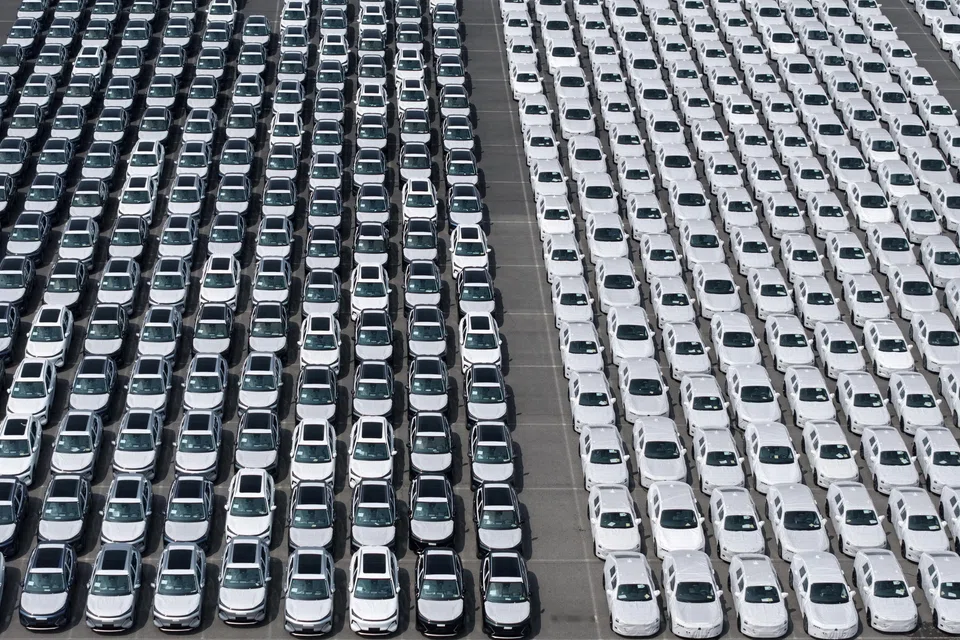
[BEIJING] China’s car sales fell for a 10th straight month in July, though the pace of decline eased, contrasting with strong export growth as automakers step up overseas expansion to offset cut-throat competition in the world’s largest auto market.
The decline underscores broader strains in China’s economy, where sluggish household spending has left exports accounting for a greater share of growth.
Sales at home slid 21.1 per cent last month from a year earlier to 1.47 million vehicles, while exports rose 88.2 per cent to 923,000, data from the China Passenger Car Association (CPCA) showed on Tuesday (Aug 11).
“The downturn has proved more severe than we had expected. We had anticipated a noticeable improvement in July,” said Cui Dongshu, secretary-general of the CPCA, attributing the weakness to elevated fuel prices that have weighed on gasoline-powered vehicle sales and subdued demand for entry-level sedans.
By contrast, electric vehicle and plug-in hybrid exports grew 147.8 per cent year-on-year, versus a 3.9 per cent drop in their domestic sales.
For the first seven months of the year as a whole, domestic passenger vehicle sales declined 20.5 per cent, equivalent to about 2.65 million fewer vehicles than in the same period a year earlier.
Automakers have stepped up efforts to expand abroad, particularly in Europe, South-east Asia, Latin America and the Middle East, creating a pronounced gap between domestic and overseas demand.
In the domestic market, some carmakers are also piling into the premium segment with bigger, feature-packed models, including Xiaomi’s extended-range SkyNomad SUV series.
“Replacement demand has moderated after the subsidy-driven pull-forward, while consumers have become increasingly selective given frequent product launches and a more competitive market,” HSBC analysts said in a note in July.

The pressure is evident among industry leaders. BYD, the world’s largest EV maker, has been grappling with a slowing home market, yet record overseas shipments in July helped lift its global sales for a third consecutive month.
But not everyone is suffering, even in the home market.
Stellantis-backed Leapmotor, one of BYD’s fastest-growing challengers, reported global sales of more than 100,000 vehicles in July, more than double a year earlier.
Analysts say that it is catering better for current consumer demand. “What consumers want are vehicles with strong value for money, not necessarily premium models,” Cui said. “Automakers want to move upmarket, but consumers are looking for affordability.”
As Chinese automakers accelerate their overseas push, one tactic is to tap underutilised factories owned by traditional carmakers to expand production capacity and market access.
Last month, Geely Auto and Ford reached an agreement under which Geely will build electric SUVs at the US company’s plant in Spain.
Yet sector weakness at home may persist in the second half.
“Automakers are expected to face continued margin pressure from increased promotional activities and rising sourcing costs for lithium batteries and semiconductor memory,” said Deutsche Bank analyst Bin Wang. REUTERS
Decoding Asia newsletter: your guide to navigating Asia in a new global order. Sign up here to get Decoding Asia newsletter. Delivered to your inbox. Free.
Share with us your feedback on BT's products and services