China’s domestic car demand stays weak but exports strengthen
In April, sales at home drop 21.6% from the year before to 1.4 million vehicles
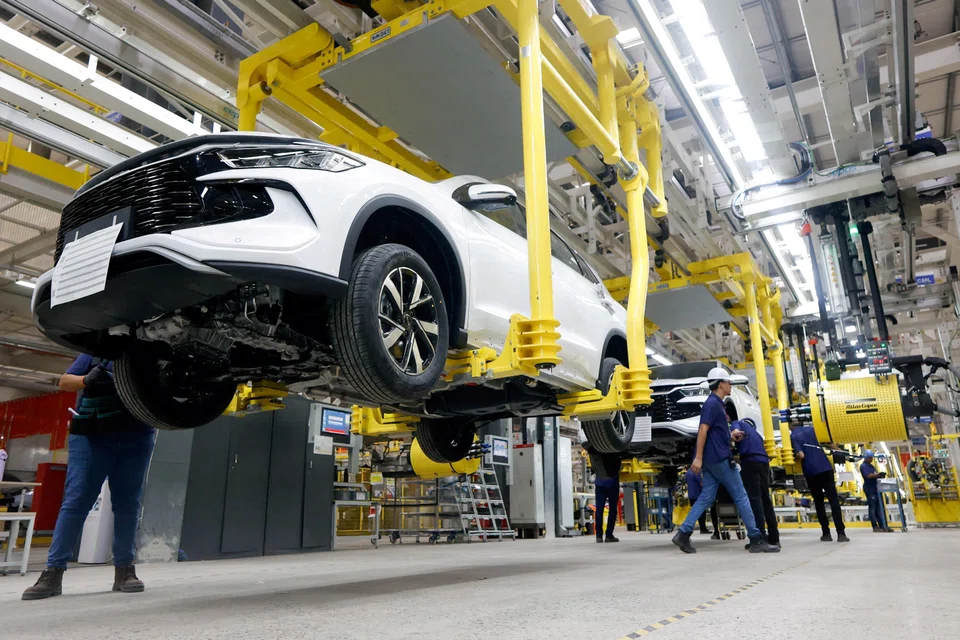
[BEIJING] China’s domestic car sales fell for a seventh straight month in April, amid intense competition in the world’s biggest car market. But exports stayed strong as carmakers increasingly targeted overseas markets.
Sales at home dropped 21.6 per cent from the year before to 1.4 million vehicles in April, based on data from the China Passenger Car Association (CPCA) on Monday (May 11).
Combustion engine car sales missed expectations due to high oil prices and demand for plug-in hybrids was also sluggish, said Cui Dongshu, CPCA’s secretary-general.
Electric vehicle and plug-in hybrid sales, accounting for 60.6 per cent of the total, slid 6.8 per cent, extending the losing streak to four months.
In contrast, EV and plug-in hybrid electric vehicle (PHEV) exports shot up 111.8 per cent from the year before, outpacing an 80.2 per cent increase in overall car exports.
This comes as rising global fuel prices triggered by the US-Israeli war on Iran bolstered EV demand in overseas markets.
The widening gap between domestic weakness and export strength is evident at BYD, the world’s largest EV maker. Its sales downturn globally stretched to an eighth month in April despite persistent strength in overseas shipments.
In April, Morgan Stanley maintained its expectation that China’s domestic and export car sales would fall 2 per cent in 2026, but raised its export growth estimate to 33 per cent from 15 per cent.
It also expects the decline in domestic sales to deepen to 11 per cent from an earlier projection of 6 per cent.

Chinese carmakers are increasingly shifting away from budget vehicles priced under 150,000 yuan (S$28,000) towards larger, feature-rich vehicles.
A wave of premium SUVs unveiled at the Beijing car show in April underscored the move upmarket, a boost for premium brands such as Nio and Geely’s Zeekr.
But robust growth in premium EVs and PHEVs, now dominated by domestic brands, has not been enough to offset the overall downturn. The weak demand for affordable cars, which account for a sizeable share of new car sales, remains a drag on the sector.
Sluggish sales in the entry-level segment became a “key bottleneck” holding back the sector’s recovery, said Cui at CPCA.
He suggested China adopt standards for mini vehicles akin to Japan’s “kei car” category to create a regulated, low-cost segment that catered to elderly and rural consumers, unlocking suppressed demand and boosting entry-level sales. REUTERS
Decoding Asia newsletter: your guide to navigating Asia in a new global order. Sign up here to get Decoding Asia newsletter. Delivered to your inbox. Free.
Share with us your feedback on BT's products and services