China’s Xpeng expects to start delivering ‘flying’ cars in 2027
Like many other Chinese automakers, the EV maker has expanded overseas and currently operates in about 60 countries

[BEIJING] Chinese electric vehicle maker Xpeng expects to start large-scale production of its “flying” cars next year and of its humanoid robots in the fourth quarter of 2026, president Brian Gu said on Thursday (Apr 23).
Gu also said that there is “tremendous potential” to increase cooperation with German automaker Volkswagen, which last month began mass production of its first EV model, developed jointly with Xpeng.
“There are a lot of areas that we can partner and really provide value to each other,” Gu said, adding that Xpeng was also open to partnerships with other automakers.
“We need to be nimble and willing to partner with different players in different regions.”
Xpeng has received more than 7,000 orders for its flying cars, the majority of which are in China, where the company is working on obtaining approval from the country’s aviation authorities.
Speaking to Reuters ahead of the Beijing Auto Show, Gu said that the company would start robotaxi tests in the southern Chinese city of Guangzhou this year and that 2027 will be a “critical year” for “tests around the world with partners”.
He said that the company will likely produce hundreds to thousands of robotaxis over the next 12 to 18 months.
Gu said that its humanoid robots will initially be used as receptionists or in sales to interact with customers. He said that within the next 10 to 20 years, Xpeng’s robot business should be larger than its automotive division as “there will be more use cases for humanoid robots in our lives”.
Like many other Chinese automakers, Xpeng has expanded overseas and currently operates in about 60 countries outside China.


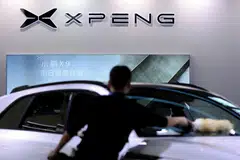
Gu said that last year, Xpeng generated about 10 per cent of its sales volume and around 15 per cent of its revenue from overseas sales.
He added that in the next five to 10 years, “more than 50 per cent of the revenue should come from outside of China”. REUTERS
Decoding Asia newsletter: your guide to navigating Asia in a new global order. Sign up here to get Decoding Asia newsletter. Delivered to your inbox. Free.
Share with us your feedback on BT's products and services