Consumer goods will face ‘largest impact’ from delays, higher costs as vessels avoid Red Sea

Tay Peck Gek
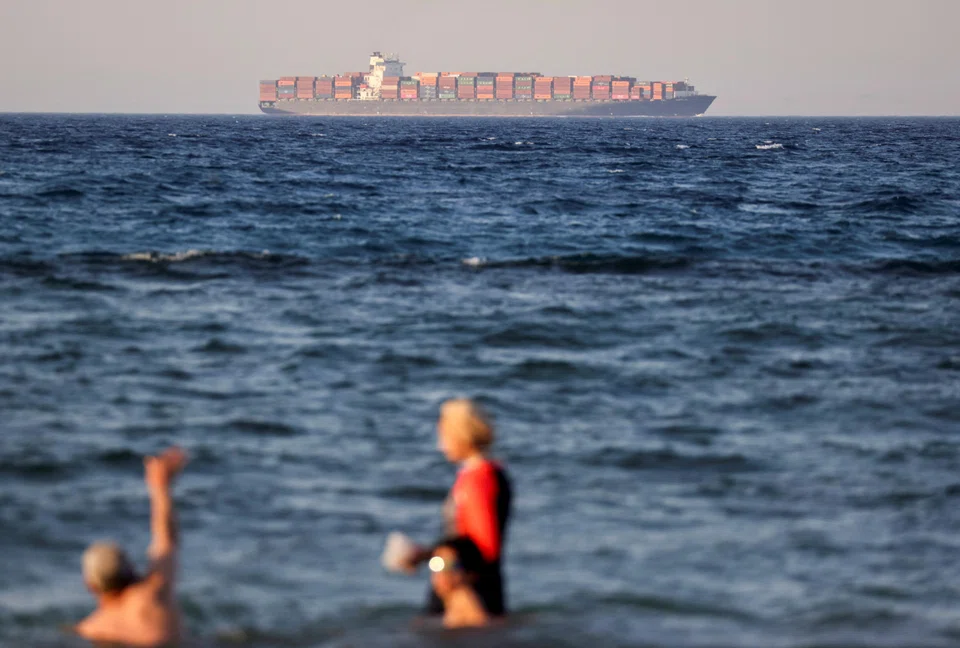
SHIPPING and logistics companies are warning of delays and higher charges for Asia-Europe freight, as major shipping lines reroute from the Suez Canal to avoid Yemeni rebel attacks in the Red Sea.
At least one logistics player has advised its clients in all regions that vessels using South Africa’s Cape of Good Hope as an alternative route will add about 14 days or 30 per cent more time to voyage. It has also advised them to ensure they have enough stocks to tide them over.
C H Robinson said in its advisory to clients: “Be advised this shift could put a strain on capacity globally, and will lead to carriers imposing rate increases and war risk surcharge.”
Shipping costs are likely to rise by at least 15 per cent.
Consumer goods will face the largest impact, though current disruptions are occurring during the off-peak shipping season, noted Chris Rogers, head of supply chain research at S&P Global Market Intelligence.
About 12 per cent of global trade passes through the Suez Canal, representing 30 per cent of all global container traffic and over US$1 trillion worth of goods per year, said Bimco. The international organisation for shipowners, charterers, shipbrokers and agents has urged nation states to counter the attack – by military means if necessary.
Over 300 industrial categories and 6,000 products – amounting to 14.8 per cent of all imports into Europe, the Middle East and North Africa – were shipped from Asia and the Gulf by sea, S&P Global Market Intelligence data showed.
That included 21.5 per cent of refined oil and 13.1 per cent of crude oil. Among industrial materials, 24 per cent of organic chemicals and 22.3 per cent of flat-rolled steel exported to Europe, the Middle East and North Africa were shipped from Asia and the Gulf by sea.
Only 8.6 per cent of total Asia and Gulf imports came from Europe, the Middle East and North Africa by sea. But the automotive industry may be affected as 41.3 per cent of vehicles and 20.8 per cent of parts were shipped on that route, Rogers of S&P Global Market Intelligence, noted.
“Shipments of perishable goods including pork and milk products may not be able to endure the longer routes,” he added.
“We see the Suez Canal disruption, if prolonged, as potential upside risks to container rates likely until Chinese New Year’s seasonal trough sets in,” Citi analyst Kaseedit Choonnawat wrote in a note on Monday (Dec 18). He estimated an effective 6 per cent supply reduction to the container industry if all trades via the Suez Canal are rerouted through the Cape of Good Hope.
Freight forwarder Flexport estimated that as much as 25 per cent of effective capacity could be removed. It said: “Along with the increase in demand from the pre-Chinese New Year peak season, we expect rates to increase significantly, and fast, unless the situation resolves quickly – which seems unlikely.”
When the container ship Ever Given was stuck in the Suez Canal for six days in 2021, rates climbed up to US$20,000 per container relative to the historical average of US$1,500 per container. Rates on the Asia to North Europe trade lane for January 2024 are at more than US$3,000 per container, noted Flexport.
Laurence Biard Tertois, Allianz Commercial Asia’s senior marine hull claims specialist, said the rerouting of shipping traffic has several implications, including higher bunker consumption and possibly longer delays and increased risk of incidents due to the longer journey.
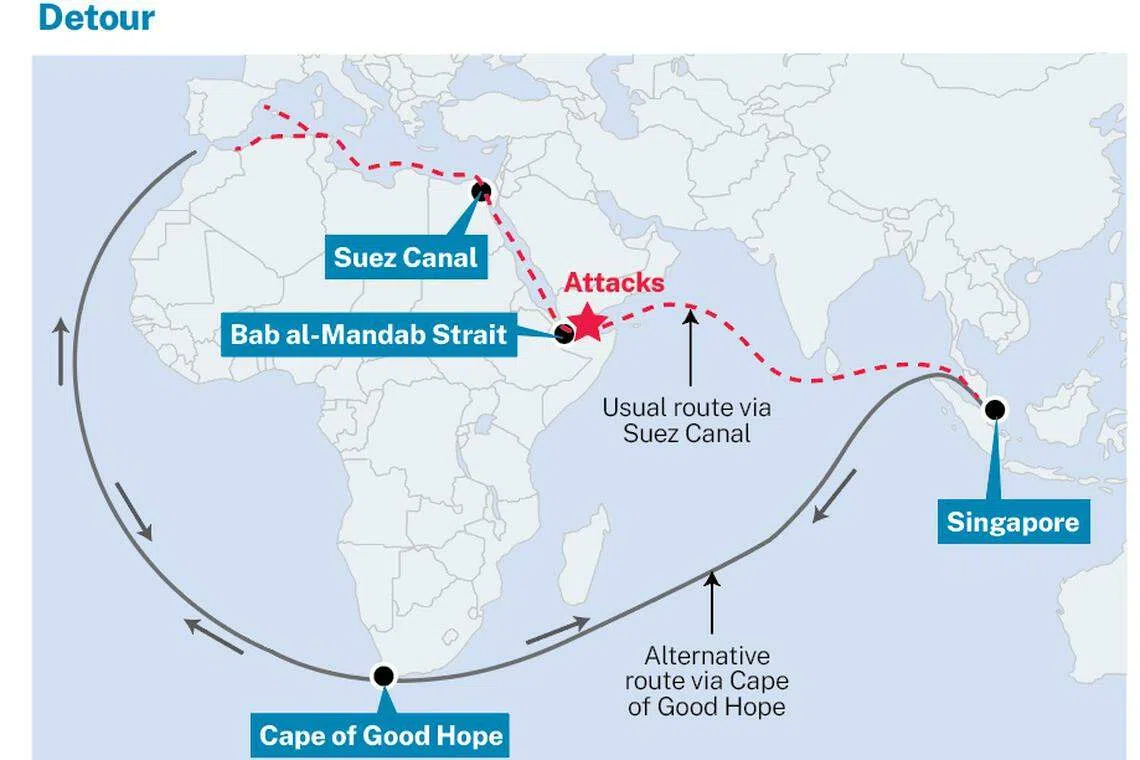
Carrier Hapag-Lloyd told The Business Times (BT) on Tuesday shortly after its crisis committee’s meeting that it will route all vessels around the Cape of Good Hope.
The decision was made after pausing transit through the Red Sea over the weekend. One of its vessels was attacked last Friday, said Nils Haupt, senior director for corporate communications at the world’s fifth-largest container ship company.
CMA CGM, Maersk and MSC have announced suspending their vessels transiting through the Egyptian waterway, after some of their ships were attacked in the Bab el-Mandeb Strait at the southern end of the Red Sea by Yemen’s Houthi rebels in solidarity with the Palestinians amid the Israel-Palestine war.
Maersk had 20 vessels that had paused transit on Monday. Half are waiting east of the Gulf of Aden and the rest waiting south of Suez in the Red Sea or north of Suez in the Mediterranean Sea.
Meanwhile, oil and gas behemoth BP said it will also pause all shipments through the Red Sea.
The escalated threat in the Red Sea, together with the restrictions imposed in the Panama Canal, can potentially have a major impact on world trade for the short to medium term, added Nitin Chopra, a senior marine risk consultant at Allianz Commercial Asia.
The Panama Canal has been restricting shipping traffic as it has been strained by drought, prompting shipping liners to use the Cape of Good Hope.
“It is also important to differentiate a short-term shock from a long-term realignment,” said Rogers of S&P Global Market Intelligence. “In the short term, ports will need to deal with a dearth of imports followed by a surge as the global fleet bunches up as a result of the pauses and onward sailing.”
Hapag-Lloyd, meanwhile, said it will reassess the situation in the Red Sea regularly and reinstate its services through the Suez Canal when the situation in the area is deemed safe and secure, the German shipping liner told customers in a note, which was shared with BT.
A spokesperson from port operator PSA Singapore said port operations have not been impacted thus far, in its response to queries from BT.