

DBS lifts target price of ST Engineering, Sats; cuts SIAEC to ‘hold’
It favours upstream aviation service providers

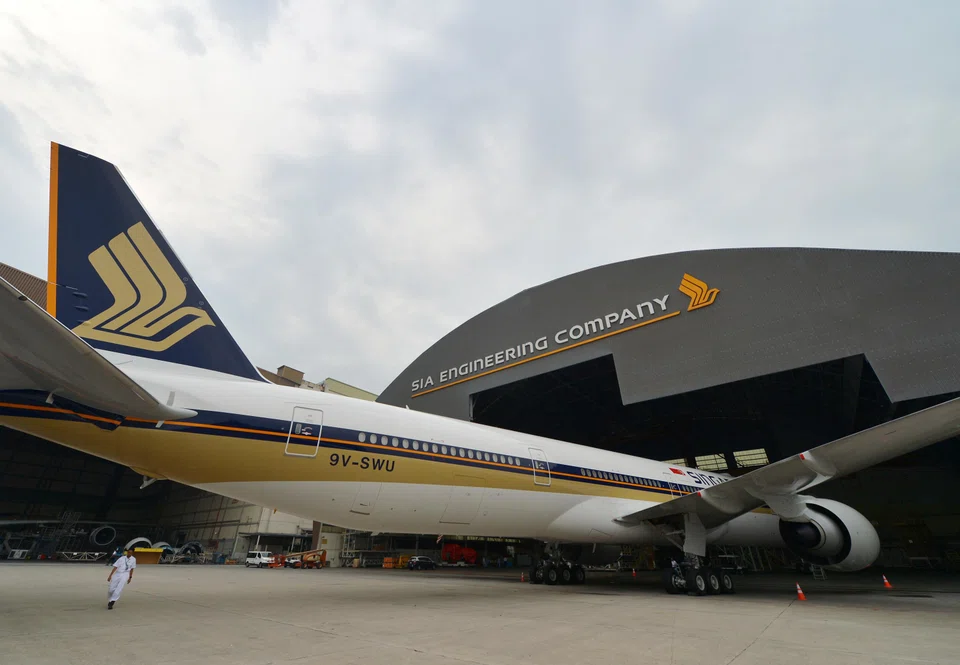
[SINGAPORE] DBS Group Research downgraded SIA Engineering Company (SIAEC) to “hold” and raised its target prices for ST Engineering and Sats , as it advised investors to shift their exposure from Asia-Pacific airlines to upstream aviation service providers.
ST Engineering and Sats offer “superior” earnings visibility compared to airlines such as Singapore Airlines (SIA) which are grappling with persistent yield pressure, said analysts Jason Sum and Tabitha Foo.
The target price for ST Engineering was upgraded to S$10.20, up from S$9.40 previously, while the target price for Sats was lifted to S$4.40, up from S$4 previously. The analysts maintained a “buy” call on both counters in their note on Wednesday (Jan 14).
The analysts attributed the SIAEC downgrade to “limited upside and execution risks” around its profitability recovery. They also stayed “neutral” on SIA given “persistent” competition in Asia-Pacific and drag from Air India. They maintained target prices of SIA and SIA Engineering at S$6.50 and S$4, respectively.
They added that China Aviation Oil offered a “value-unlocking narrative” with stronger capital return potential than airlines in Asia-Pacific. The researchers continue to hold a “buy” call and target price of S$1.75 for the counter.
Upstream defence and maintenance companies were also flagged as “clearer winners” in a maturing post-pandemic cycle, owing to “structurally positive fundamentals” tied to fleet age, utilisation and defence spending over more volatile metrics such as fare pricing, added the analysts.
Industry fundamentals ‘favourable’
Singapore’s aviation industry is expected to have “favourable” fundamentals in 2026, continuing on from a 5.2 per cent and 3.1 per cent year-on-year gain in passenger traffic and cargo volumes, respectively. This expansion was despite “softer consumer sentiment, geopolitical tensions and trade uncertainty”, said the analysts.
Despite that growth, Asia-Pacific airlines including SIA underperformed due to falling average revenue per passenger – or passenger yield – amid “intense” regional competition.
“The outlook for 2026 remains constructive, with passenger traffic expected to continue outpacing gross domestic product growth at 4.9 per cent year on year even as the cycle matures,” said the note, referring to the post-pandemic travel growth cycle.
SEE ALSO




Supply constraints in focus
Supply constraints will be closely watched this year, added the analysts, with aircraft delivery delays keeping older fleets flying for longer with heavier utilisation.
This should support maintenance, repair and operations (MRO) demand, while new-generation engine durability issues and spare-parts shortages further lift maintenance intensities, they added.
Airbus cut its 2025 delivery target to about 790 aircraft from a previous expectation of 820, indicating that industry output will remain insufficient to meet fleet replacement needs. As a result, fleets around the world are now nearly two years older on average than in 2019, versus around one year had expected deliveries materialised, said DBS.
“Looking ahead, even if Airbus and Boeing ramp up deliveries over 2026 to 2027, most new aircraft are likely to be absorbed by overdue fleet replacement,” it said.
Passenger yield pressure in Asia-Pacific is also expected to persist into 2026, though at a more gradual pace than in 2025.
In contrast, air cargo demand is expected to significantly outstrip global trade volumes with 2.6 per cent year-on-year growth in 2026, supported by “adaptive trade flows and robust demand for higher-value shipments” such as artificial intelligence hardware.
Meanwhile, the analysts said that global defence spending has shifted onto a structurally higher trajectory as geopolitical fragmentation and security priorities increasingly dominate fiscal planning, “reinforcing order and revenue visibility” across the industry. This comes amid US intervention in Venezuela, China-Taiwan tensions and continued war in Ukraine.
The analysts noted that defence spending is rising in Singapore, but in a “controlled and deliberate manner” with long-term fiscal discipline.
The 2025 financial year marked a “temporary” increase, with defence expenditure projected to increase 12.4 per cent year on year to about S$23.4 billion, reflecting the “catch-up” of projects deferred by Covid-19 and supply chain disruptions.
From the 2026 financial year onwards, spending growth is expected to taper, with defence outlays targeted to remain broadly within 3 per cent of GDP over the next decade, compared with about 2.8 per cent in 2024.
“This implies low to mid-single-digit growth over the medium term, while preserving flexibility to scale up if the external security environment deteriorates,” said DBS.
Decoding Asia newsletter: your guide to navigating Asia in a new global order. Sign up here to get Decoding Asia newsletter. Delivered to your inbox. Free.
Copyright SPH Media. All rights reserved.
TRENDING NOW

Once staunchly pro-China, Malaysian Chinese businesses are now distancing themselves from Beijing

Looking beyond looming CEO succession, should UOB potentially pursue a transformative merger?

Could stablecoins be the future of money?

Grab CEO’s wife Chloe Tong on life with Anthony Tan and finding her purpose

