

Emirates not interested in Qantas investment
Move doesn't fit with airline's strategy, says CCO
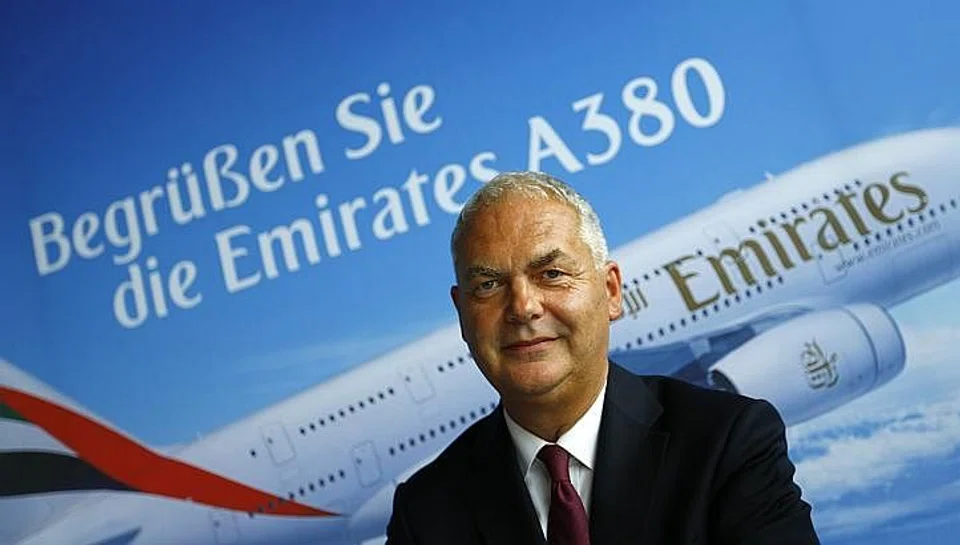
[FRANKFURT] Airline Emirates is not interested in investing in the international operations of Qantas, the Dubai-based carrier's chief commercial officer (CCO) said on Monday.
In the biggest restructuring step since Qantas was privatised two decades ago, the airline is hiving off its international arm from its domestic business.
The move will allow a foreign airline to take as much as a 49 per cent stake - a major change from the previous 35 per cent limit - and analysts had suggested that alliance partner Emirates could be interested.
But Emirates' CCO Thierry Antinori said that doesn't fit with the airline's strategy. "We buy planes and invest in products; we do not buy shares," he told Reuters in an interview during an event in Frankfurt to celebrate the airline putting an A380 jumbo jet on the Dubai-Frankfurt route.
Under its partnership with Qantas, through which the companies share some revenue, Qantas has moved its European operations base from Singapore to Dubai and Emirates is letting Qantas share its new terminal, which was for the exclusive use of its Airbus A380.
Emirates, though, has shied away from traditional airlines alliances One World, Star Alliance and Sky Team, saying it prefers to go it alone.
The rapid expansion of Gulf carriers such as Emirates, Qatar and Etihad has posed a particular problem for European legacy airlines. Lufthansa and Air France are both planning to expand their low-cost units to respond to competition from Gulf airlines and budget rivals.
Mr Antinori, a former Lufthansa manager, said this kind of thinking was the wrong path to take.
"If you, as an airline, and there are unfortunately a lot of examples of this in Europe, begin to calibrate your strategy as 'what can I do against this airline or this airline', you will fail," he said.
Mr Antinori also said that recent suspensions of routes to places such as Arbil, Syria and Tripoli because of fighting in those countries were not good news for Emirates but that the company had been able to redeploy planes on routes such as to Casablanca and Budapest.
Emirates has also suspended flights to Guinea because of the Ebola virus.
"It's not good news, but we are able to redeploy the aircraft and to limit the damage," he said of the suspensions.
In particular, the suspension of flights to Arbil, northern Iraq, is damaging to its cargo operations, Mr Antinori noted.
Load factors are still running above last year's levels, he said, when asked whether the route changes were having an impact on how full its planes were.
He also confirmed that Emirates is still interested in ordering more A380s from Airbus if the planemaker revamps the jumbo jet with new engines, and that the airline is in continuous discussions with Airbus.
Emirates is the world's biggest operator of the A380, with 51 in service and another 89 on order, but Mr Antinori said further orders would have to be for the more fuel-efficient neo version of the aircraft.
Emirates also said it's ready to play the long game in seeking to add routes in Germany, one of the few major travel markets that the world's No 1 airline by international traffic is struggling to penetrate.
Emirates can serve only four German cities under a bilateral air-services accord dating from 1975 that is "maybe a little old", Mr Antinori said on Monday in Frankfurt.
"We will get the traffic rights one day or the other," Mr Antinori added. "It's a question of time. We have to respect the rules. Germany is missing an opportunity, it is a pity."
Emirates's timetable to Europe's biggest economy comprises three daily trips to Frankfurt and two apiece to Munich, Hamburg and Dusseldorf, with none to Berlin, the capital. That compares with its network of six UK airports and five in Australia, a country with just over one-quarter of Germany's population.
Since Emirates began flights to Hamburg in 2006, the carrier has added 59 further destinations spanning major markets such as the US and China, as well Italy and smaller economies including Austria and Switzerland, Mr Antinori said.
"The only country we did not open a new destination in was Germany," he said. "We are not obsessed, we are not angry. We are also very optimistic, because Germany is the most pragmatic country in Europe."
In order to boost capacity on those German routes it can serve, Emirates on Monday converted one daily Frankfurt flight to operation with an Airbus Group NV A380, the world's largest passenger plane. The double-decker features 519 seats, adding 165 a day compared with the Boeing Co 777 used previously.
The switch means that Emirates now serves 30 destinations with the A380, and makes Germany the carrier's most important market for the model after the UK, with Munich's two daily flights already superjumbo-operated.
Emirates will also start serving Dallas with the A380 from October, and San Francisco and Houston starting in December.
Emirates's outstanding fleet requirement is for a plane offering 250 to 350 seats, with the upper end of that range beyond the planned capacity of the revamped jetliner. - Reuters, Bloomberg
TRENDING NOW

Indonesia’s coal tycoon Low Tuck Kwong replaced as Bayan Resources president-director

OCBC names Ang Eng Siong as global corporate banking head in rejig of wholesale banking business

Consider lowering homeownership barriers for some non-resident foreigners

DBS opens flagship investment strategy to retail investors with new fund

