EVs move closer to price parity with normal cars as cheaper models enter Singapore

Derryn Wong
THE entry of smaller, less-expensive electric vehicles (EVs) to Singapore is narrowing the price gap with conventional cars, although industry players say it will be a few more years before true price parity is reached.
While EVs generally remain more expensive than petrol or hybrid passenger cars, new entrants have increased the range of EVs priced below the S$160,000 mark, the current price of a typical mainstream sedan.
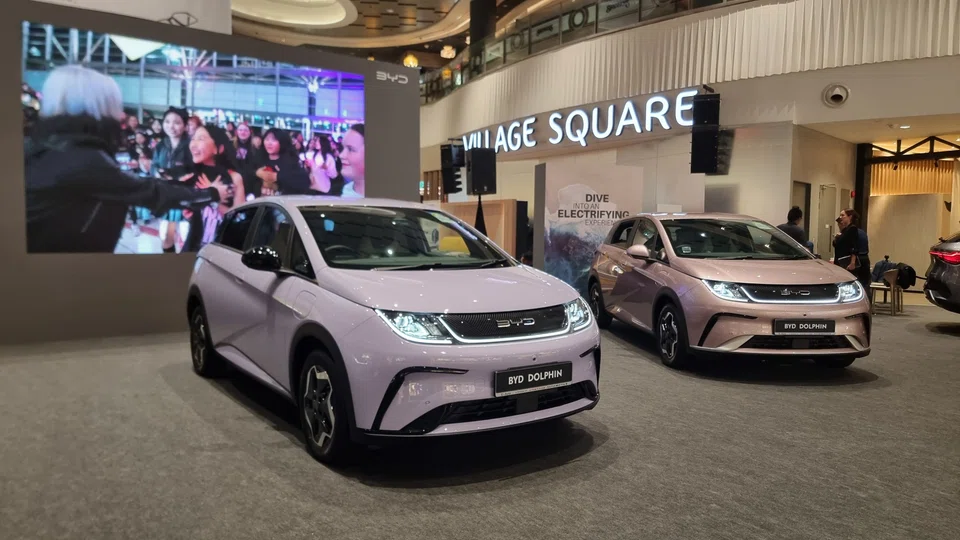
On Monday (Jul 3), Chinese mainstream EV brand BYD launched its Dolphin EV compact hatchback – its smallest, cheapest model to date. Its launch price of S$156,888 with Certificate of Entitlement (COE) also makes it the cheapest EV available in Singapore from an authorised distributor.
Peugeot’s e-2008, launched in August 2022, is the Dolphin’s closest competitor in terms of price and size, although it is classified as a compact sport utility vehicle instead. It retails for S$159,888 with COE.
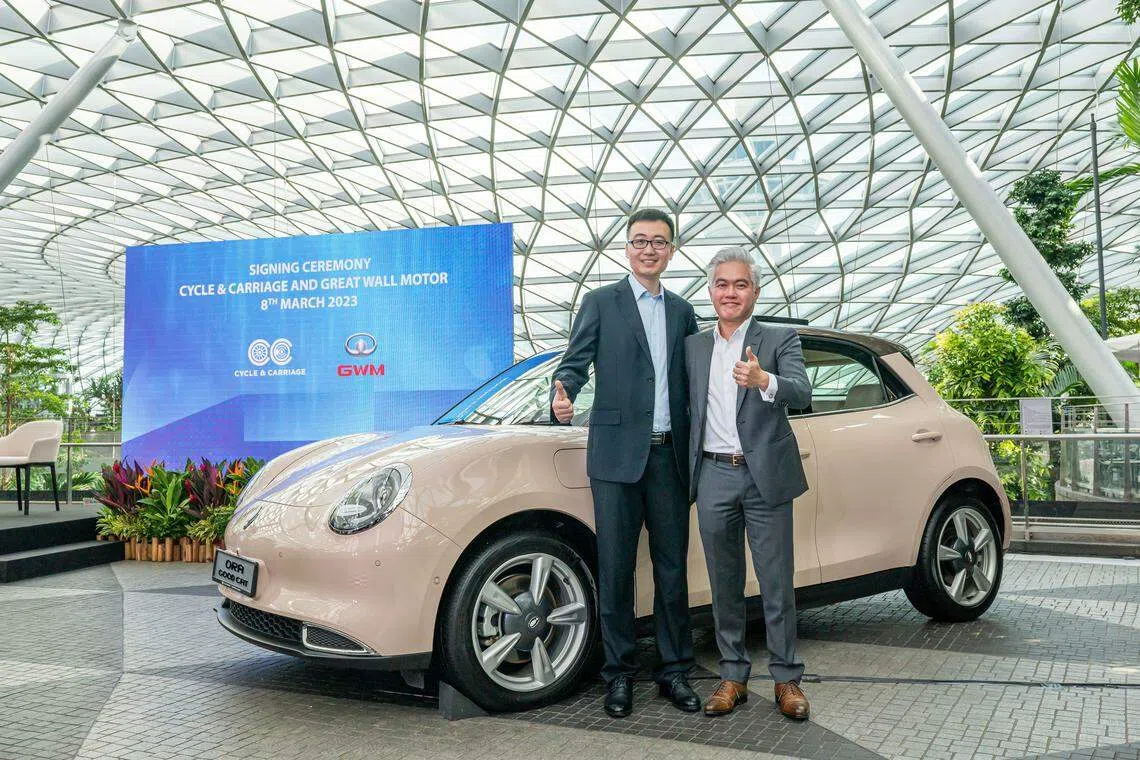
Mainstream Chinese EV brand Ora is expected to launch its own electric compact hatchback, the Good Cat, in Singapore later this year. A direct rival to the Dolphin, it is expected to be priced on similar terms.
Some of these cheaper EVs are priced similarly or even lower than comparable internal-combustion engine models. However, this apparent affordability is enabled by two main incentive schemes which collectively shave up to S$45,000 off EV prices. EVs registered from 2021 till end-2023 are eligible for the EV Early Adoption Incentive (EEAI), which grants 45 per cent off their Additional Registration Fee, up to a maximum of S$20,000.
EVs are also the only passenger vehicle type eligible for the highest rebate of S$25,000 under the Vehicular Emissions Scheme (VES), which assigns rebates or penalties to vehicles depending on how pollutive they are. Without such incentives, the Dolphin would cost S$35,000 more, in excess of S$190,000, said BYD.
“The cost of EVs, without incentives, is still very high, and not sustainable in the long term,” said Nicholas Wong, general manager of official Honda distributor Kah Motor.
Hybrids are not eligible for EEAI, but some can qualify for a lower-tier VES rebate of up to S$15,000, which has so far been enough to keep them price-competitive, said Wong.
As hybrids run on petrol, offer cost savings and are less polluting than regular cars, they remain a better choice than EVs – until the cost of EV production truly does match that of traditional cars, he added.
Industry players are mixed on exactly when manufacturers might achieve such parity. Wong said he expects parity could take three to 10 years, and that it would differ among carmakers.
Jim Farley, chief executive officer of US carmaker Ford, said at an investor conference in early June that price parity may not arrive until after 2030, when production processes for EVs are expected to become much simpler.
The global head of French carmaker Renault said at last year’s Paris Motor Show that he did not expect parity in the near term. This is partly because battery costs have not declined as much as expected, due to fluctuations in material prices.
But Volkswagen Group Singapore’s managing director Kurt Leitner expects that for consumers, the “tipping point” for price parity would be in 2025 or 2026, which is when the group expects to sell as many EVs as it does regular cars.
Buyers who do not need a larger EV may benefit first. In April, the International Energy Agency said that smaller EVs could hit price parity by the mid-2020s, followed by larger EVs in the 2030s.