

FedEx, UPS shares sink on ‘watershed’ Amazon logistics move
The news is a ‘shot across the bow’ to the entire transport market, according to analyst
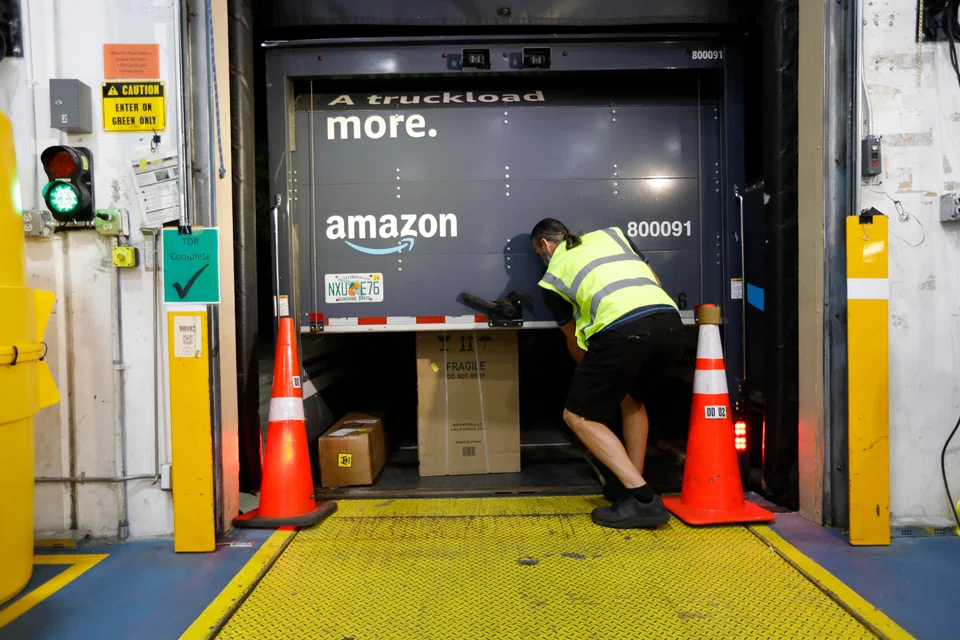
[NEW YORK] US transportation stocks plunged on Monday (May 4) after Amazon.com announced expanded logistics offerings that will turn it into a major competitor for parcel carriers and air freight companies, and also impact truckers and third-party brokers.
FedEx shares fell 9.1 per cent in their worst day in more than a year, while rival United Parcel Service dropped more than 10 per cent. Logistics firms Forward Air and GXO Logistics suffered double-digit declines. Old Dominion Freight Line, among other truckers, slid almost 7 per cent.
The news is “a shot across the bow to the entire transport market”, said Joe Gilbert, portfolio manager at Integrity Asset Management.
The move is a threat not just to other couriers’ grasp on e-commerce, but potentially to more profitable, specialised areas such as healthcare, which UPS and FedEx have made a central part of their strategies, said Alan Amling, a former vice-president for corporate strategy at UPS.
“They’ve retreated into the upper end of the market, where all the margin is,” Amling said of the legacy carriers. “They trapped themselves.”
Amazon has been building out its distribution network for years, primarily focused on boosting fast shipping for sellers on its own marketplace. The retailer is now opening that network to businesses beyond Amazon sellers. It will offer freight, distribution and fulfilment, and parcel shipping to standalone customers, from industrial manufacturer 3M to outdoor retailer Lands’ End, Amazon said in a statement on Monday.
The announcement “could be a watershed moment for North American freight transportation companies,” Morgan Stanley analyst Ravi Shanker wrote in a note to clients on Monday. Air freight companies and parcel carriers are likely to take the hardest hit, while truckers, railroads, ocean shippers and warehouse operators are also at risk, he added.
For years, Amazon depended on existing networks as it grew, eventually becoming UPS’s largest customer. It built out its own delivery network at the same time and now operates an extensive Web of warehouses and delivery stations.
Last year, Amazon delivered more than a quarter of the 23.9 billion parcels shipped in the US, while FedEx and UPS combined moved around a third, according to industry data provider ShipMatrix.


Unified offering
By offering to transport goods as a service even when the transport has nothing to do with Amazon’s core e-commerce business, Amazon can serve an increasing share of the market, threatening to peel even more business away from UPS and FedEx.
“Amazon has been heading in this direction for several years, offering portions of its supply chain capabilities as services to non-Amazon sellers,” said Nate Skiver, founder of LPF Spend Management, a shipping consulting firm. “Bringing its end-to-end capabilities to market in a unified service offering stands to disrupt the US logistics market.”
Third-party logistics firms, including GXO and broker CH Robinson Worldwide, are among the most vulnerable to competition from a player with Amazon’s scale, technology and relationships in e-commerce, according to Truist’s Lucas Servera.
Companies such as Old Dominion, which carry shipments larger than parcels but smaller than full truckloads, are more shielded by comparison, Servera added. Less-than-truckload firms have networks of buildings dedicated to moving and sorting shipments of 1,000 pounds or more, something the analyst doesn’t expect Amazon to develop.
FedEx has its own less-than-truckload business, which it’s spinning off in June as FedEx Freight.
The rout comes just as transportation stocks were shaking off jitters from the war in Iran. The S&P 500 Transportation Index by late last month was trading within a hair’s breadth of all-time highs. FedEx had been the standout performer so far this year, rising 36 per cent through Friday. The stock pared it’s year-to-date gains to roughly 24 per cent Monday.
High valuations made the sector vulnerable to a sell-off, Citi analyst Ariel Rosa said in a note, comparing Monday’s “indiscriminate selling” to fears about artificial intelligence disruption earlier in the year.
“The stock price reactions are expected, though at this point, the direct impact is immeasurable and the reaction is likely exaggerated,” said Mark Hackett, chief strategist at Nationwide. “The sector will likely be in wait-and-see mode for some time, as this is a third leg to the bear stool, after energy prices and supply chain disruptions.” BLOOMBERG
Decoding Asia newsletter: your guide to navigating Asia in a new global order. Sign up here to get Decoding Asia newsletter. Delivered to your inbox. Free.
Share with us your feedback on BT's products and services
TRENDING NOW

Once staunchly pro-China, Malaysian Chinese businesses are now distancing themselves from Beijing

Looking beyond looming CEO succession, should UOB potentially pursue a transformative merger?

Could stablecoins be the future of money?

Grab CEO’s wife Chloe Tong on life with Anthony Tan and finding her purpose

