Fire is still the big enemy at sea
FOR the non-mariner, the sea can seem to be a scary environment, and storms and huge waves come to mind. Of course, the power of the sea must be respected and never underestimated.
However, the one danger that frightens most seafarers more than anything else is not the sea but fire. If a blaze starts on a ship and gets out of control, the risks to the crew, the ship, cargo and the environment can be enormous.
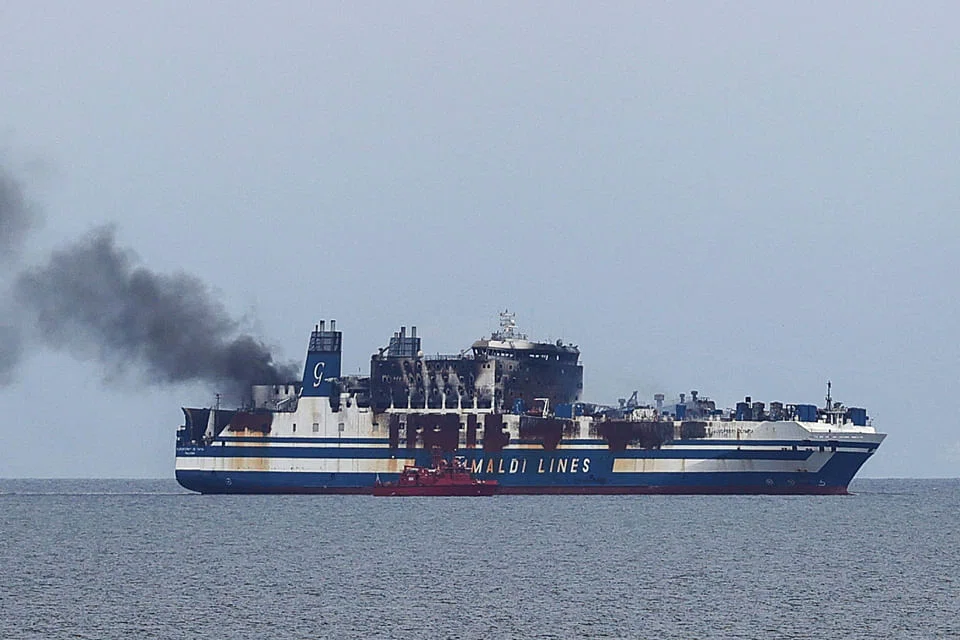
And, tragically, there were two grim reminders of this just last week. Eleven people are feared dead after a fire swept through the roll on-roll off (Ro-Ro) passenger vessel Euroferry Olympia in the Ionian Sea near the Greek island of Corfu.
Operated by Italian company Grimaldi Lines, the ship is one of the largest and most modern in the Mediterranean. Early reports suggest the fire started on her vehicle deck.
It has been reported that the fatalities were among lorry drivers who were in apparently still in their cabs. If so, that would be something requiring close scrutiny.
Given the attention that has been given to Ro-Ro safety over the past several decades, the industry and its regulators will be concerned to discover what happened. The findings of the eventual enquiry into this incident will no doubt be pored over intently.
Meanwhile, the large car carrier Felicity Ace, with a cargo of nearly 4,000 luxury cars on board, caught fire in the Atlantic off the Azores. Fortunately, there was no loss of life and a salvage operation is underway. However, this will turn into a very big insurance loss.
According to online valuation and market intelligence provider VesselsValue, the Japanese-owned, 2005-built car carrier has a current market value of US$31.5 million but its cargo of Porsches, Volkswagens, Bentleys and Lamborghinis are thought to be worth more than US$200 million.
There will also be knock-on costs. Dan Nash, Head of Ro-Ros at VesselsValue said: "There are very few suitable ships available in the market to replace her. (The ship's operator) MOL will have a difficult few days ahead dealing with insurance claims and fleet network changes.
Ironically, last week also saw the publication of the Allianz Global Corporate & Specialty (AGCS) Safety & Shipping Review, which highlighted that the number of fires on board large vessels has increased significantly in recent years. Fire was the third top cause of shipping losses over the past decade.
According to Allianz, there were a record 40 cargo-related fire incidents in 2019 or one every 10 days. Fires resulting in total losses hit a 4-year high of 10 at the end of 2020 - accounting for around 1 in 5 total losses around the world.
"The shipping industry has seen its safety record improve significantly over the past decade with the number of total losses now at record lows," said Captain Rahul Khanna, global head of Marine Risk Consulting at AGCS.
"However, fires on car carriers, Ro-Ros, container ships and other vessels remain among the biggest worries for the sector, as demonstrated by the recent rise in incidents."
He added: "Ro-Ro and car carrier vessels in particular can be more exposed to fire and stability issues than other vessels, and require additional emphasis on risk management. To facilitate carriage of automobiles the internal spaces are not divided into separate sections like other cargo ships.
"The lack of internal bulkheads can have an adverse impact on fire safety and a small fire on one vehicle or battery can grow out of control very quickly. Vehicles are not easily accessible once loading has been completed.
"The large volume of air inside the open cargo decks provides a ready supply of oxygen in case of fire. At AGCS, we look deeply into the risk management of operators and have worked with a number of companies operating Ro-Ro vessels to agree to a robust risk management programme."
Allianz noted that other significant recent incidents include the Ro-Ro cargo ship, the Grande America, which sank after its cargo of vehicles and containers caught fire in March 2019. Also, in June 2020, a blaze on the car carrier Höegh Xiamen lasted for 8 days before it was extinguished, while the Ro-Ro passenger ferry Cruise Bonaria also suffered a fire.
Seafarers are trained to fight fires when they occur, but they are not professional firefighters and they must not be expected to take undue risks.
Once fires take hold in a ship they are very dangerous and extremely difficult to put out.
The focus has to be on preventing fires in the first place with particular emphasis on making sure that hazardous and inflammable cargoes are properly declared and correctly stowed.
Moreover, with passenger Ro-Ro ships, it is essential that strict control is maintained over the vehicle decks while at sea.