First China-made international jet could gain ground in Asia-Pacific on Airbus, Boeing delays: observers

Derryn Wong
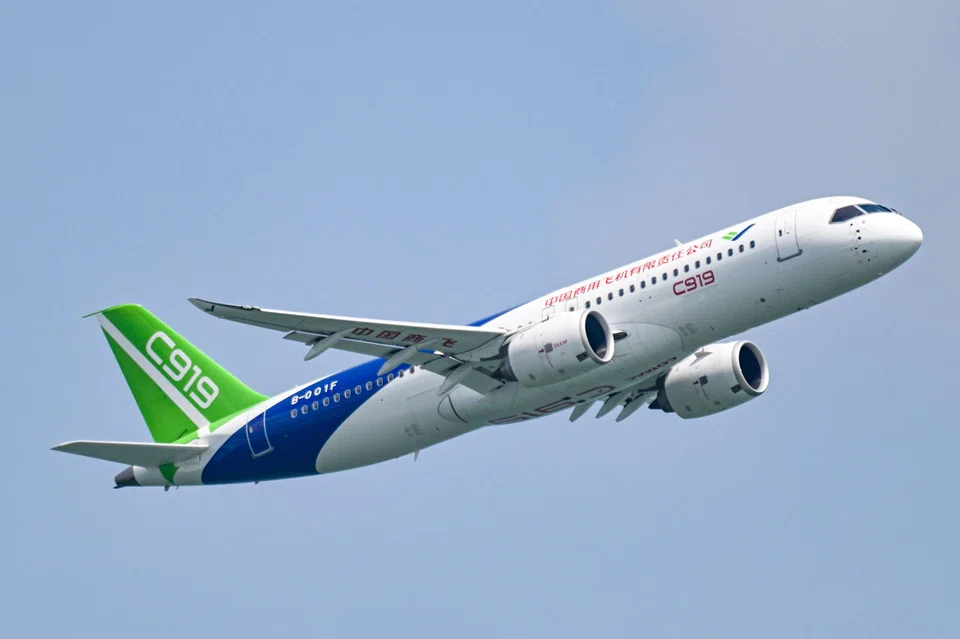
THE first major China-made passenger jet – Commercial Aircraft Corporation of China’s (Comac) C919 airliner – could gain ground in the Asia-Pacific market amid delayed deliveries by major aircraft makers Airbus and Boeing, said industry players.
But they added the aircraft is still years away from being able to compete internationally, as that would require regulatory approvals that could be hindered by political tensions and trade disputes.
The C919 made its international debut at last week’s Singapore Airshow on Feb 18. On Tuesday (Feb 27), Comac announced that it will conduct showcase flights of the aircraft, as well as its smaller ARJ21 regional jet, in Indonesia, Malaysia, Cambodia, Laos and Vietnam, over the next two weeks.
Capable of short and medium-haul flights, the C919 is a “narrow-body” jet, similar to the Airbus A320 and Boeing 737.
The narrow-body airliner market is the biggest in commercial aviation. Boeing, for example, expects narrow-body planes to comprise around 80 per cent of the 42,595 jets it will sell from 2023 to 2042.
Subhas Menon, director-general of the Association of Asia-Pacific Airlines, said the C919 is an “option to consider” for regional airlines which want earlier deliveries, given that an order placed with Airbus and Boeing now would only be delivered in 2030.
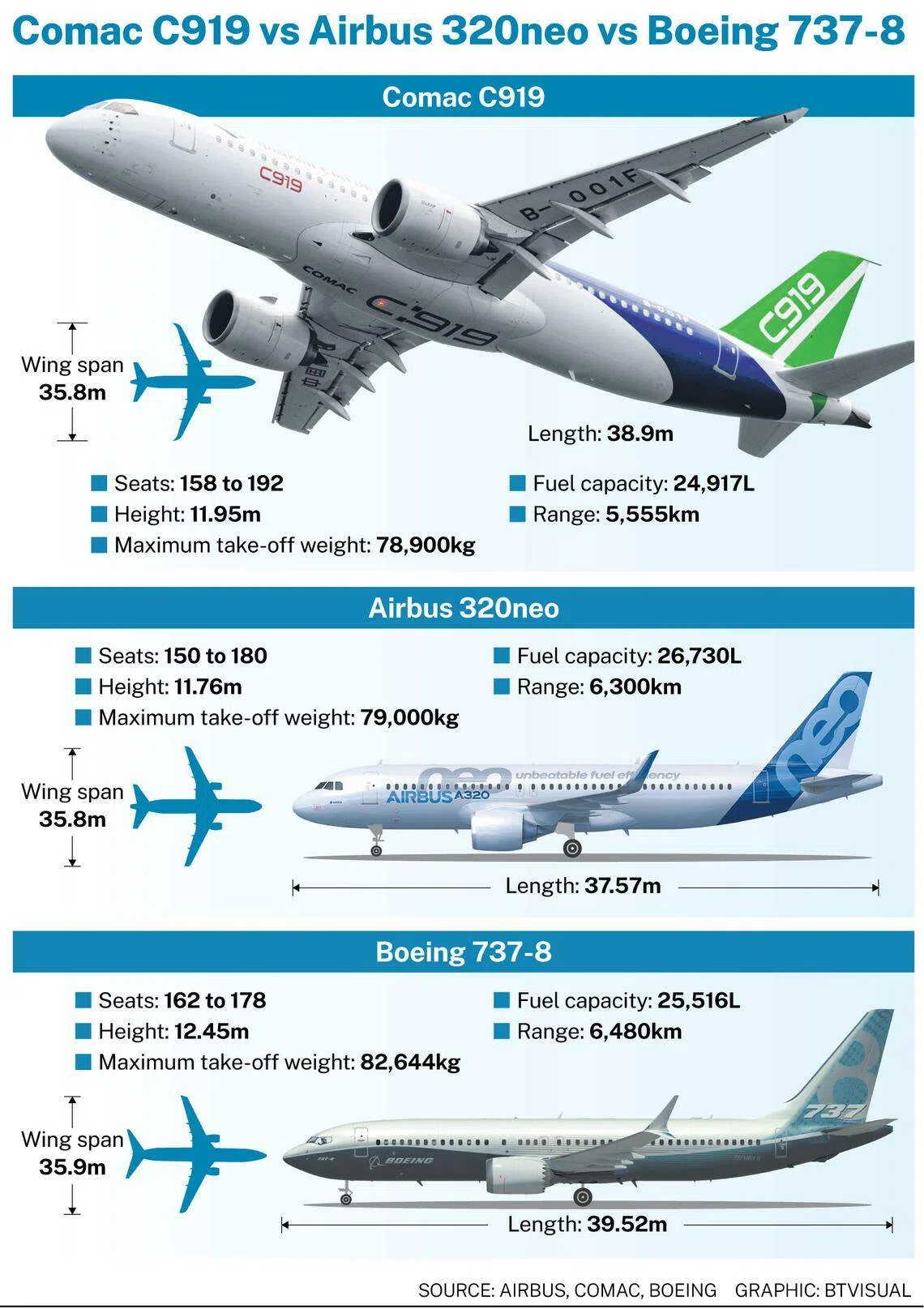
The two giants dominate the market for commercial air transport, but supply-chain disruptions have created a bottleneck. Airbus has 8,598 aircraft in its backlog and Boeing 5,626.
“If these problems carry on for much longer, then regional airlines might consider (the C919),” said Menon.
Volodymyr Bilotkach, an associate professor in aviation management at Purdue University in the US, said that since Comac has already established itself at home, an expansion to the Asia-Pacific region is a logical next step.
Christian Scherer, chief executive officer of the commercial aircraft business of Airbus, said: “The market in China and the regions around it is large enough to cater for (Comac’s) competition, which is a good thing.”
Chinese state media reported that Comac has received more than 1,000 orders for the C919 to date, although there have been no orders from foreign airlines yet.
The company has stated a goal of producing 150 planes a year by 2028.
China Eastern Airlines was the first to operate the C919, with a maiden flight in 2023. It ordered five C919s in 2021 and made a further order for 100 aircraft in 2023, worth US$9.9 billion.
International sales possible, but tricky
Outside the Asia-Pacific region, the C919 could also appeal to Africa, as operators there would be likely interested in aircraft that are cheaper than offerings from Airbus and Boeing, said Purdue’s Bilotkach.
India and Russia are also potential markets, he added, but will require caution.
India’s booming domestic aviation market needs aircraft to support growth, but ongoing tensions with China could be a stumbling block. The Russian market is cut off from Western manufacturers, but China could face retaliation from the US and the European Union if it begins selling planes to Russia, he said.
Geopolitical tensions will also inform the certification process, which aircraft require from a country’s regulators before they can begin operating there.
The time taken for the C919 to be certified by the US Federal Aviation Authority (FAA) and European Union Aviation Safety Agency is “rather uncertain”, said Bilotkach.
Without such certification, at least half of the global airline market, by volume, would be unavailable to Comac, he added.
He said that the FAA could delay signing off on the C919 in retaliation for the Civil Aviation Administration of China’s delays in returning the Boeing 737 MAX to operation in China.
The planes were grounded in China since 2019 after two crashes that killed more than 300 people, and were only allowed to resume flying from January this year.
The US Justice Department has also made allegations of Chinese industrial espionage in the aviation sector, such as the theft of trade secrets from C919’s suppliers, including GE Aviation and Honeywell.
Observers also agreed that the C919’s domestic operation would have to go off smoothly before widespread adoption.
Menon said that with Boeing’s recent safety issues bringing safety back into the spotlight, airlines themselves would need to be “very scrutinous” before adopting the airliner.
Bilotkach expects “a wait-and-see approach to observe how the new aircraft will perform in China”. He added: “I don’t see orders for Comac aircraft from Europe, North America or Japan for at least seven more years.”