Foreign airlines told to cut passengers into Covid-hit Shanghai
 Add BT as a preferred source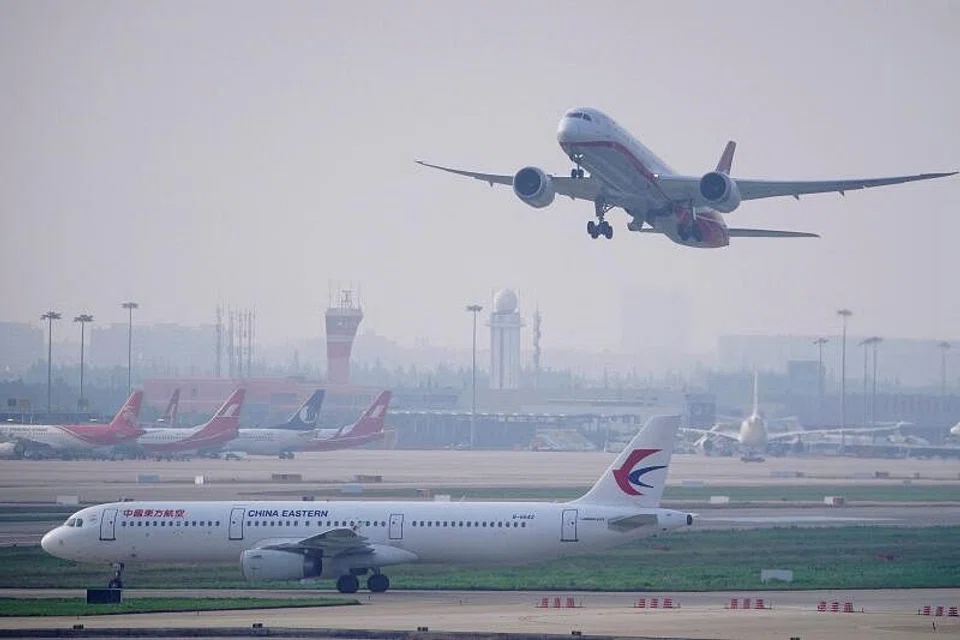
DeeperDive is a beta AI feature. Refer to full articles for the facts.
[SHANGHAI] International airlines have been told to ensure that flights into Shanghai are less than half full as part of the Chinese financial hub's latest attempt to curb the spread of Covid-19, according to people familiar with the matter.
Non-Chinese carriers were instructed by Shanghai's Center for Disease Control and Prevention (CDC) on Thursday (Apr 7) to reduce passenger loads to a maximum of 40 per cent starting Apr 11 until at least the end of the month, the sources said, asking not to be identified because the information is confidential. Capacity on foreign flights already has a ceiling of 75 per cent. The Shanghai CDC did not answer calls seeking comment.
Separately, the 3 airlines currently flying from Hong Kong to Shanghai - Cathay Pacific Airways, Hong Kong Airlines and China Eastern Airlines - have been directed to rotate on the route so that they each only fly into the city once every 3 weeks, a person with knowledge of the situation said. That change starts from Friday and will last for an indefinite period, the person said. A 50 per cent cap on the number of passengers on those planes will remain in place.
Early on in Shanghai's outbreak, China discussed diverting international flights away from Shanghai entirely to ease the pressure on quarantine hotels and isolation facilities. Chinese carriers subsequently diverted many international flights away from the city while most foreign airlines continued operating as normal.
Under its rigid Covid Zero policy, China isolates all positive virus cases in government-run facilities, as a way of halting the infection's spread. Authorities are having to build and convert more facilities as the caseload climbs, with the city's cavernous convention centre being converted into a facility for more than 40,000 beds.
It is a tactic that worked well at the start of the pandemic in Wuhan, but is proving tougher in the face of the more contagious Omicron variant and in a larger and more open metropolis like Shanghai. The city of 25 million people has seen food shortages, protests and people going without non-Covid medical care in the 10 days since a lockdown started in the eastern half of the city and was later expanded to include the more populous western side.
Navigate Asia in
a new global order
Get the insights delivered to your inbox.
The outbreak has virtually paralysed one of China's most populous and recognisable cities, with businesses shuttered and factories of companies like Tesla halting production because of the curbs.
Shanghai reported 19,982 local Covid cases on Wednesday, data released by the municipal government showed. While the tally is low globally, it is a record for China, which effectively eliminated the virus in 2020 and for the first half of 2021, before the Omicron and Delta strains snaked through its defences, which include border curbs, mandatory quarantines and repeated mass testing.
The strategy is leaving China and the territory of Hong Kong increasingly isolated as the rest of the world dismantles border restrictions and opens up. Hong Kong has recently eased some of its inbound travel and quarantine curbs amid pressure from the business community, but it remains shut off to non-residents. BLOOMBERG
Decoding Asia newsletter: your guide to navigating Asia in a new global order. Sign up here to get Decoding Asia newsletter. Delivered to your inbox. Free.
Share with us your feedback on BT's products and services